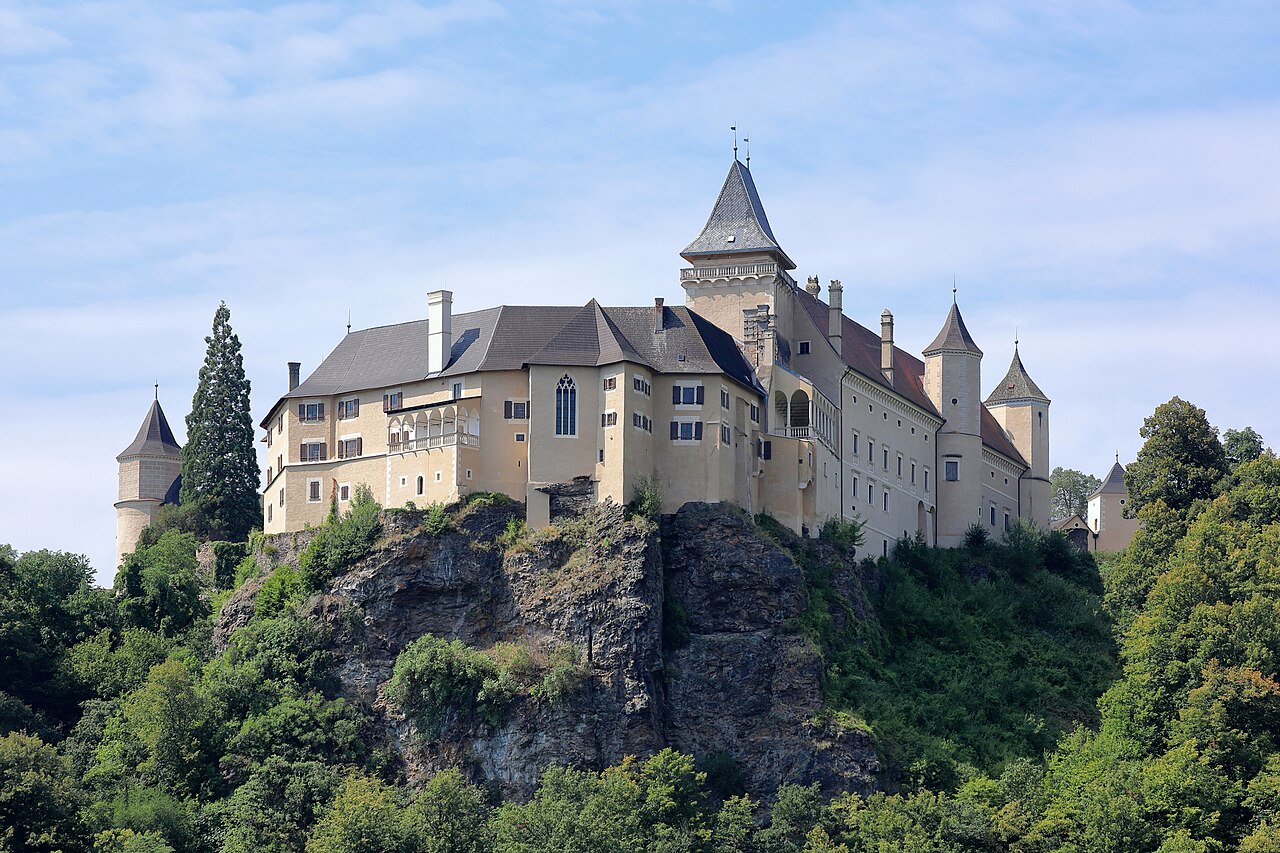
Burgruine Schimmelsprung
Burgruine Schimmelsprung stands as a remarkable example of a medieval hill castle located in the municipality of Gars am Kamp in Austria. Established by the ministerial family von Thunau (also recorded as Thumbenove), the castle first appears in written records dating back to 1196. This fortress played a significant role during the High Medieval period, serving as the administrative seat for the von Thunau family and acting as a strategic stronghold overseeing the fertile lands near the Kamp River.
Historical significance and origins
The castle’s origins are closely tied to the feudal structure of medieval Austria, where noble families like the von Thunau held both administrative and military authority over their territories. Burgruine Schimmelsprung was constructed to assert control over the surrounding region and to protect vital trade routes along the river. The von Thunau family’s influence extended through the castle’s function as a local center of power, justice, and defense.
Throughout the 13th and 14th centuries, the castle maintained its importance, but by the late 14th century, it began to decline. This decline culminated in its abandonment, and the castle was never restored after its destruction, leaving it in a state of ruin that persists today.
Legends and folklore surrounding the castle
Local folklore has deeply shaped the identity of Burgruine Schimmelsprung. The castle’s name, which translates roughly as "Schimmel’s leap," originates from dramatic legends associated with its final days. According to these stories, the lord of the castle—depicted variously as a Templar knight or a robber baron—was notorious for his harsh treatment of peasants and subjects.
During a siege by oppressed locals, the lord is said to have attempted a desperate escape by leaping from the castle’s cliff on horseback. This daring but fatal leap resulted in his death and symbolized the fall of the fortress. These tales have contributed to the castle’s enduring mystique and cultural significance in the region.
Architectural features and defensive design
Strategic location
Burgruine Schimmelsprung is perched on a rocky outcrop approximately 100 meters above the right bank of the Kamp River. Its natural setting is imposing, with steep cliffs on three sides that drop sharply to the river below, providing formidable natural defenses. This elevated position allowed for extensive surveillance and control over the surrounding landscape.
Defensive structures
Access to the castle was carefully controlled from the west, where a series of three successive defensive ditches—similar to moats—protected the approach. These ditches formed a critical part of the castle’s defensive system, designed to slow and deter attackers.
The castle was enclosed by a curtain wall laid out in an approximate square shape, securing the entire site. This wall included numerous arrow slits, narrow vertical openings that allowed defenders to shoot arrows while remaining protected from return fire. The curtain wall’s robust construction and strategic placement highlight the military engineering expertise of the period.
The bergfried and internal structures
At the western corner of the enclosure stood the bergfried, the main defensive tower typical of medieval castles in this region. Primarily used for observation and as a last refuge during attacks, the bergfried’s vaulted basement (a tonnengewölbtes Untergeschoß, or cellar with a barrel vault) still survives today, offering valuable insights into the castle’s original construction techniques and layout.
Along the side facing the Kamp River, a large portion of the curtain wall remains intact. This wall section includes preserved arrow slits and visible outlines of internal passages, giving a clear sense of the castle’s internal organization and defensive capabilities.
Burgruine Schimmelsprung in the present day
Today, Burgruine Schimmelsprung stands as a well-preserved ruin that attracts visitors interested in medieval history, architecture, and folklore. Its dramatic location on a cliff above the Kamp River offers spectacular views and a tangible connection to Austria’s medieval past.
The site provides an educational experience through its visible architectural remains, illustrating the defensive strategies and living conditions of a medieval hill castle. Although the castle was never restored after its abandonment, the existing ruins are stable and accessible, allowing visitors to explore the remains of the curtain wall, bergfried, and defensive ditches.
Burgruine Schimmelsprung remains a significant cultural landmark in the region, embodying both the historical realities of feudal Austria and the enduring power of local legends. It continues to inspire interest in medieval fortifications and the complex history of noble families like the von Thunau.
Architectural and historical context
The castle’s design reflects common features of High Medieval hill castles in Central Europe, combining natural topography with man-made fortifications to create a defensible residence and administrative center. The use of a bergfried, curtain walls with arrow slits, and multiple defensive ditches exemplifies typical military architecture of the period.
Its location near the Kamp River was strategic both for defense and for controlling trade and communication routes. The castle’s decline in the late 14th century corresponds with broader regional shifts in political power and military technology, which rendered many such fortresses obsolete.
Frequently asked questions (FAQ)
- How do I get to Burgruine Schimmelsprung?
- Burgruine Schimmelsprung is located near Gars am Kamp in Lower Austria. Visitors can reach the site by local roads and hiking trails leading to the rocky outcrop above the Kamp River.
- What is the historical significance of Burgruine Schimmelsprung?
- Burgruine Schimmelsprung served as the administrative seat for the von Thunau family during the High Medieval period and played a key role in regional defense and governance.
- Can I explore the ruins of the bergfried and curtain walls?
- Yes, visitors can explore the remains of the bergfried’s vaulted basement and large sections of the curtain walls, including preserved arrow slits and defensive ditches.
- When was the castle abandoned?
- The castle declined and was abandoned by the late 14th century, after which it was not restored and fell into ruin.
- Why is the castle called Schimmelsprung?
- The name Schimmelsprung comes from local legends about the castle lord’s dramatic escape attempt by leaping from the cliff on horseback during a siege, which led to his death and the castle’s downfall.
Information
Website
Visit websiteSources & official resources
Verify the information above using these authoritative references.
Loading map...
Visitor reviews
No reviews yet. Been here? Write the first review and help other travelers!
Write the first reviewVisited this castle? Share your experience
Your review helps other travelers and adds first-hand knowledge to our encyclopedia.