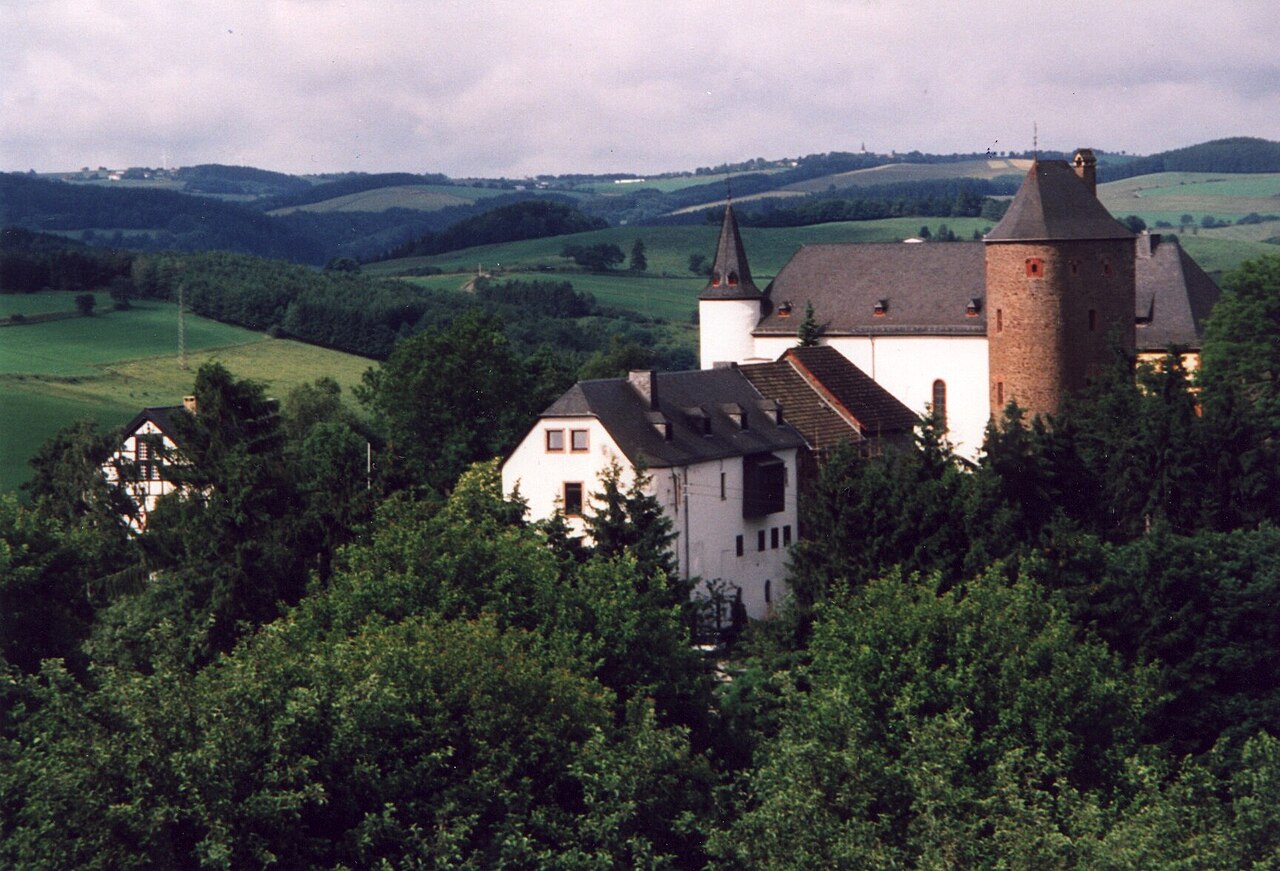
Kronenburg Castle
Kronenburg Castle, located in the village of Kronenburg within the municipality of Dahlem in the North Rhine-Westphalia region of Germany, is a striking example of a late-medieval hill castle whose ruins still dominate the local landscape. Perched on a rocky outcrop at the heart of the village, the castle's remains offer a glimpse into the feudal history and architectural evolution of the Eifel region. Although the castle was first documented in 1277, archaeological and historical evidence suggests that its origins likely date back earlier, possibly to the early 13th century or late 12th century, making it a significant medieval stronghold in the area.
Historical background and ownership
The earliest known lords of the castle, the Lords of Kronenburg, were elevated to nobility around 1300, despite their relatively modest means. This elevation coincided with the castle's strategic importance in the region. By the end of the 14th century, the last knight of Kronenburg, Peter of Kronenburg, became a vassal to the powerful Counts of Luxembourg, marking a shift in the castle's political allegiance and influence. The Counts of Luxembourg maintained control over Kronenburg Castle until 1795, when the region was annexed by the French Republic during the upheavals of the French Revolutionary Wars.
Following the annexation, the castle was confiscated by the French state and subsequently auctioned in 1809 to a former bailiff of the Counts of Manderscheid-Blankenheim. By this time, the castle had already fallen into ruin. Over the 19th century, the structure was extensively quarried by local inhabitants, accelerating its decline. The village and the castle's outer bailey also suffered damage during World War II, further impacting the site's preservation.
Architectural features and layout
The castle originally featured a bergfried (keep) and a fortified bergbering (ring wall) dating from the 13th century, which still leave a visible imprint on the village today. The surviving ruins include two semi-circular towers that formed part of the north gate, as well as the remains of the keep. These elements reflect the castle's defensive purpose and typical late-medieval military architecture.
The dimensions and layout of the original castle grounds can be discerned from the remains of the surrounding curtain wall and a semi-circular bastion. Within the courtyard, there are also remnants of the working quarters situated further down the rocky spur, illustrating the functional aspects of castle life beyond mere defense.
The castle's position on a rocky hilltop classifies it as a hill castle, a common type in the Eifel region where natural rock formations were utilized for fortification advantages. This elevated location provided strategic views over the surrounding landscape and helped control local trade routes.
The village and associated heritage
The village of Kronenburg itself forms an integral part of the castle ensemble. Adjacent to the castle ruins lies the well-preserved half-timbered houses of the village, which have been restored and maintain the historic character of the settlement. This combination of castle ruins and traditional architecture creates a picturesque and culturally rich environment.
One of the most notable landmarks in the village is the late-gothic parish church of St. John, constructed around 1500. This church is incorporated into the castle's defensive wall, exemplifying the integration of religious and military architecture. The church is renowned for its unique single-support vault, characterized by only one central buttress supporting the fine vaulting, a rare architectural feature that has earned it the nickname "single support church." The church's interior and architectural details attract visitors interested in gothic ecclesiastical architecture.
Current condition and visitor experience
Today, the ruins of Kronenburg Castle are freely accessible to the public. While the ruins themselves may not be as grand or intact as some other castles, their setting within the historic village and the surrounding natural landscape offers visitors a compelling experience. The site provides insight into medieval fortification techniques and the historical development of the region.
The castle ruins, combined with the village's preserved medieval structures and the parish church, create an ensemble that is both historically significant and visually appealing. Visitors can explore the remains of the semi-circular towers, the keep ruins, the curtain walls, and the bastion, while also enjoying the charm of the restored half-timbered houses and the gothic church.
Despite the damage sustained over centuries, including quarrying and wartime impacts, Kronenburg Castle remains a testament to the region's medieval heritage and offers valuable educational and cultural opportunities for visitors and scholars alike.
Architectural significance and style
Kronenburg Castle exemplifies late-medieval military architecture typical of the Rhineland and Eifel regions. Its design incorporates defensive features such as semi-circular gate towers, a bergfried, and a bastion, reflecting the evolution of castle fortifications in response to advances in siege warfare during the 13th and 14th centuries.
The castle's integration with the village and the inclusion of the parish church within its walls demonstrate the multifunctional nature of such fortifications, serving as military strongholds, noble residences, and community centers.
Accessibility and visiting information
The ruins are open to visitors year-round without admission fees, making Kronenburg Castle an accessible destination for those interested in medieval history, architecture, and picturesque village settings. The site is suitable for casual exploration, photography, and educational tours. Visitors are encouraged to respect the fragile ruins and the surrounding village environment.
Frequently asked questions (FAQ)
- How do I get to Kronenburg Castle?
- Kronenburg Castle is located in Dahlem, Germany, easily accessible by car or public transport. The nearest train station is about 10 kilometers away, and local buses provide connections to the castle. Parking is available on-site for visitors arriving by car.
- What is the historical significance of Kronenburg Castle?
- Kronenburg Castle dates back to the 12th century and served as a strategic fortress during various conflicts in the region. Its architecture reflects the medieval style and has been well-preserved, showcasing the history of the area. The castle is a testament to the feudal system that once dominated this part of Germany.
- When was Kronenburg Castle built?
- Kronenburg Castle was originally constructed in the early 12th century, with various renovations and expansions taking place over the centuries. Its long history has allowed it to evolve architecturally while retaining its medieval charm. Today, it stands as a significant landmark in Dahlem.
- Can I take a guided tour of Kronenburg Castle?
- Yes, guided tours are available at Kronenburg Castle, providing visitors with in-depth knowledge about its history and architecture. Tours typically last about an hour and are offered in multiple languages. Be sure to check the schedule in advance, as they may vary throughout the year.
- Why is Kronenburg Castle popular among tourists?
- Kronenburg Castle attracts visitors due to its stunning architecture, rich history, and beautiful surrounding landscapes. The castle offers panoramic views of the Eifel region, making it a perfect spot for photography and exploration. Additionally, its proximity to other attractions in Dahlem makes it a convenient stop for tourists.
- Is it possible to host events at Kronenburg Castle?
- Yes, Kronenburg Castle is available for private events, including weddings and corporate functions. The unique setting and historic ambiance provide a memorable backdrop for any occasion. It is advisable to contact the castle management for booking details and availability.
- What are the opening hours of Kronenburg Castle?
- Kronenburg Castle is open to visitors from 10 AM to 6 PM during the tourist season, which typically runs from April to October. In the off-season, opening hours may vary, so it's best to check the official website for the most current information. Guided tours may have specific time slots, so plan accordingly.
- What are the ticket prices for visiting Kronenburg Castle?
- Ticket prices for Kronenburg Castle are generally affordable, with discounts available for students and seniors. Adult tickets usually cost around 8 euros, while children under 12 may enter for free. Group rates are also offered, making it a great destination for school trips and family outings.
- When is the best time to visit Kronenburg Castle?
- The best time to visit Kronenburg Castle is during the spring and early autumn months when the weather is mild, and the surrounding countryside is in full bloom. During these times, you can enjoy outdoor activities and the beautiful scenery. Summer can be busy with tourists, so visiting in the shoulder seasons may offer a more tranquil experience.
- Are there any nearby attractions to explore after visiting Kronenburg Castle?
- Yes, there are several nearby attractions worth exploring, including the picturesque Dahlem village and the scenic hiking trails in the Eifel National Park. Visitors can also enjoy local museums and historic sites that reflect the region's culture and heritage. Plan to spend a full day in the area to make the most of your visit.
Information
Loading map...
Visitor reviews
No reviews yet. Been here? Write the first review and help other travelers!
Write the first reviewVisited this castle? Share your experience
Your review helps other travelers and adds first-hand knowledge to our encyclopedia.