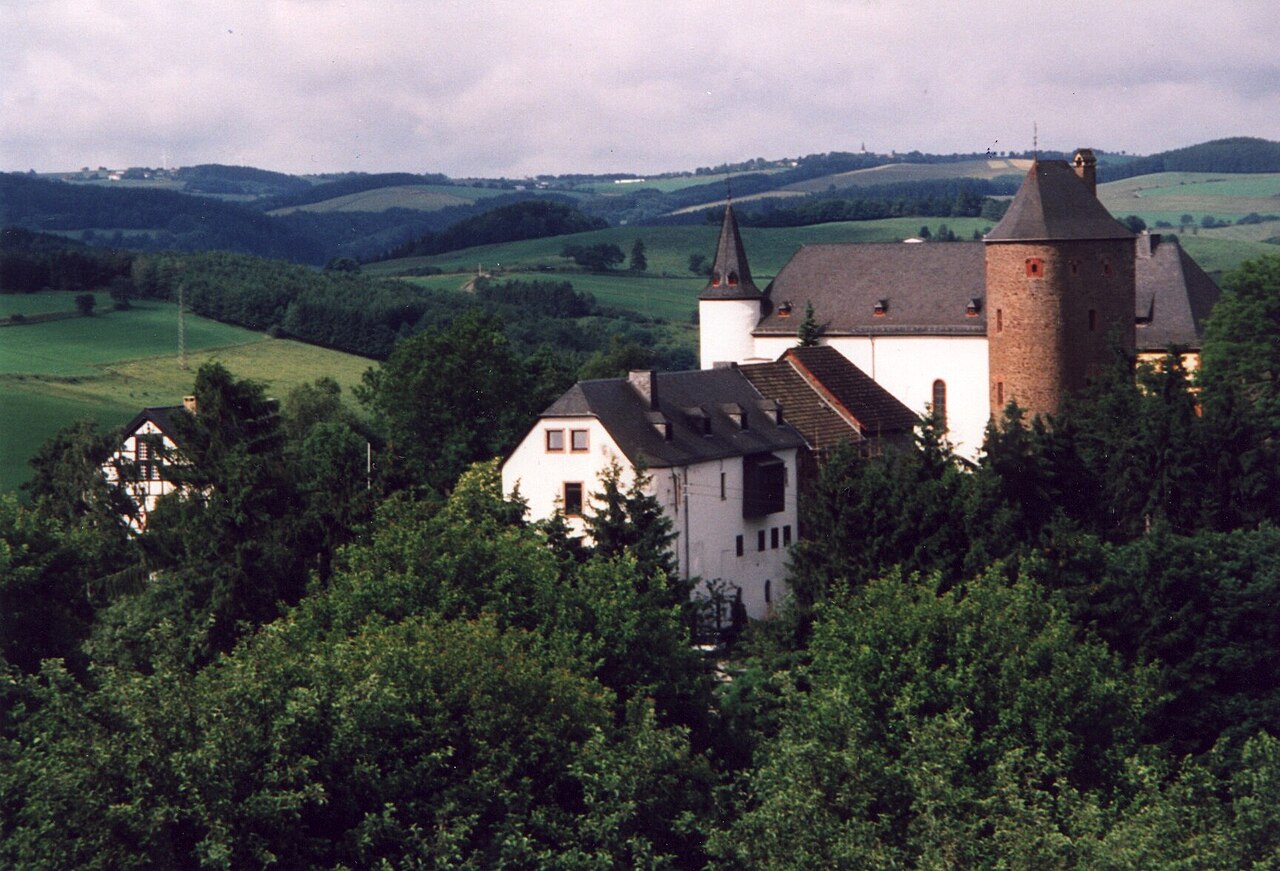
Reifferscheid Castle
Reifferscheid Castle, also known as Burg Reifferscheid, is a historic medieval hill castle located in the village of Reifferscheid, within the municipality of Hellenthal in North Rhine-Westphalia, Germany. Perched at an altitude of approximately 450 meters near the German-Belgian border, the castle stands between the Eifel and Ardennes mountain ranges, offering a strategic vantage point that has shaped its turbulent history and architectural evolution.
The castle's origins trace back to the early 12th century, with its first recorded mention in 1106 under the name "Riferschit" in the Chronica regia coloniensis. At that time, Duke Henry I of Lower Lorraine and Limburg deliberately destroyed the fortress to prevent it from falling into enemy hands during regional conflicts. This early destruction reflects the castle's significance as a military stronghold in the volatile political landscape of medieval Germany.
By 1130, the castle had been rebuilt, and an outer bailey was added, which included a small village and a church. The chapel near the castle was granted parish status by Archbishop Frederick I of Cologne and was overseen by Steinfeld Abbey, emphasizing the castle's role not only as a military fortification but also as a center of local religious and community life.
The lords of Reifferscheid and territorial divisions
The noble family known as the Lords of Reifferscheid first appeared in records in 1195, establishing their feudal presence in the region. In the early 13th century, the lordship was divided between brothers Gerhard and Philipp von Reifferscheid. This division led to the creation of a new family branch, the Lords of Wildenburg, illustrating the common medieval practice of partitioning estates among heirs, which often influenced local power dynamics and castle ownership.
Architectural development and military significance
Over the subsequent centuries, Reifferscheid Castle was fortified and expanded into a formidable fortress. Its defensive features included curtain walls that enclosed the castle grounds, a gatehouse flanked by two round towers, and a gabled entrance that controlled access. The castle's round bergfried, a tall defensive tower constructed of rubble stone and now white-plastered, remains a prominent feature and was typical of German medieval military architecture. This bergfried served as a lookout and last refuge during sieges.
The castle's military resilience was notably demonstrated during the 1385 siege by a coalition known as the Meuse-Rhine Alliance, which included forces from Cologne, Aachen, Liège, Jülich, and Brabant. The siege was a response to raids conducted by John V of Reifferscheid, who had violated regional peace agreements. Despite being besieged for three months, the castle's defenses held, and the attacking forces withdrew without success.
Fires, reconstruction, and architectural transformation
Reifferscheid Castle endured significant damage from fires, notably in 1509 and again in 1669. The 1669 fire was particularly devastating, destroying both the castle and the adjacent village. Following this catastrophe, the castle was rebuilt in the Baroque style, marking a shift from purely military architecture to a more representative residential schloss. This Baroque palace was constructed on the foundations of the medieval castle, and the houses within the former castle precinct, known as the Burgfreiheit, were also rebuilt.
However, this period of renewed grandeur was short-lived. During the War of the Palatine Succession in 1689, troops under King Louis XIV of France deliberately destroyed the castle as part of military campaigns in the region. Despite this, the castle was quickly restored, as evidenced by an ink drawing by Mathieu Throuüet around 1725, which depicts the castle fully rebuilt.
Decline, destruction, and modern preservation
The final blow to Reifferscheid Castle came in 1794 when it was occupied and destroyed by French Revolutionary troops. Following the political upheavals of the time, the castle was confiscated in 1803, and the barony was dissolved. In 1805, the ruins were auctioned off and largely dismantled for building materials, serving as a quarry for local construction projects for several decades.
Ownership returned to the princely Salm-Reifferscheid family in 1889, who had been elevated in status during the 19th century. Since 1965, the castle ruins have been owned and managed by the municipality of Hellenthal. Local residents have actively engaged in preservation efforts, earning recognition and awards for their dedication to maintaining the site as a cultural heritage landmark.
Architectural remains and visitor experience
Today, visitors to Reifferscheid Castle can explore the ruins that reflect its layered history. The surviving curtain walls and the gatehouse with its two distinctive round towers offer insight into the castle's medieval defensive design. The gabled entrance remains a notable architectural feature, while the white-plastered bergfried stands as a symbolic and functional remnant of the castle's military past.
The bergfried has been adapted as an observation tower, known locally as the "Eifel-Blick Bergfried", providing panoramic views over the surrounding landscape at approximately 470 meters above sea level. This vantage point highlights the castle's strategic location and its enduring presence in the region's cultural and historical landscape.
Reifferscheid Castle's ruins, set amidst the scenic backdrop of the Eifel and Ardennes mountains, offer a compelling destination for history enthusiasts and visitors interested in medieval architecture, military history, and cultural heritage preservation. The site is freely accessible, allowing guests to experience firsthand the tangible remains of a fortress that has witnessed centuries of conflict, transformation, and resilience.
Frequently asked questions (FAQ)
- How do I get to Reifferscheid Castle?
- Reifferscheid Castle is located in the village of Reifferscheid within the municipality of Hellenthal in North Rhine-Westphalia, Germany. It is accessible by local roads and is best reached by car or regional public transport followed by a short walk to the site.
- What are the opening hours for visiting Reifferscheid Castle?
- The ruins of Reifferscheid Castle are freely accessible to the public at any time, as there are no formal opening hours or admission fees. Visitors can explore the site throughout the day.
- Is there an admission fee to visit Reifferscheid Castle?
- No, there is no admission fee to visit the ruins of Reifferscheid Castle. The site is open to the public free of charge.
- What historical events is Reifferscheid Castle known for?
- Reifferscheid Castle is known for its resilience during the 1385 siege by the Meuse-Rhine Alliance and its destruction and rebuilding following major fires in 1509 and 1669. It also played a role in regional conflicts during the War of the Palatine Succession and was finally destroyed by French Revolutionary troops in 1794.
- What architectural features remain at Reifferscheid Castle?
- Visitors can see the remains of the curtain walls, a gatehouse with two round towers, a gabled entrance, and the white-plastered round bergfried. These features illustrate the castle's medieval defensive architecture and later Baroque influences.
- Can I climb the bergfried at Reifferscheid Castle?
- Yes, the bergfried, known as the Eifel-Blick Bergfried, is accessible to visitors and offers panoramic views of the surrounding Eifel and Ardennes landscapes from its observation platform.
- When was Reifferscheid Castle built?
- The castle was originally constructed in the early 12th century, with the first documented mention in 1106. Significant construction and fortification occurred during the 13th century.
Information
Current owner
Municipality of Hellenthal
Loading map...
Visitor reviews
No reviews yet. Been here? Write the first review and help other travelers!
Write the first reviewVisited this castle? Share your experience
Your review helps other travelers and adds first-hand knowledge to our encyclopedia.