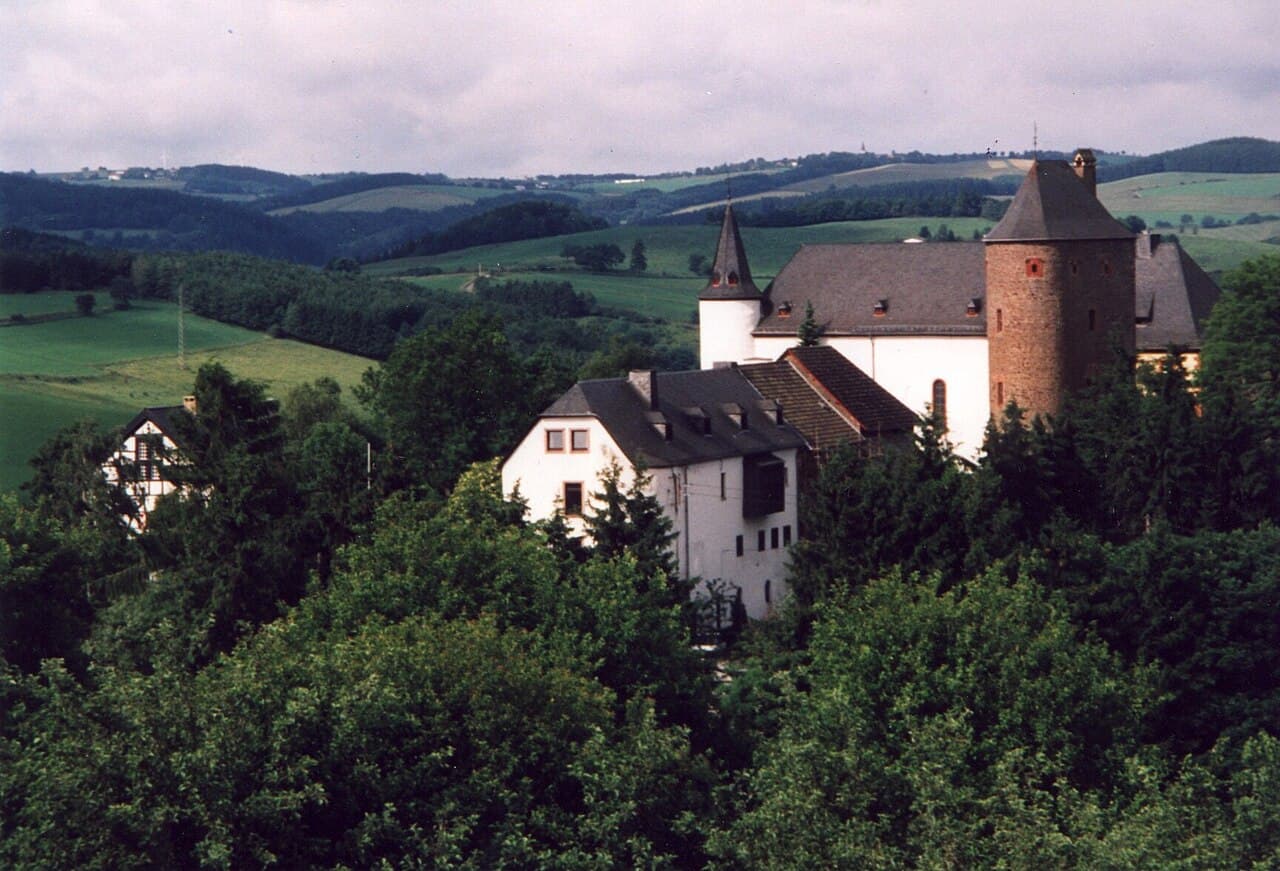
Wildenburg Castle
Wildenburg Castle, locally known as Burg Wildenburg, is a historic hill castle perched near the village of Reifferscheid in the North Rhine-Westphalia region of Germany. With origins dating back to the early 13th century, the castle stands as a testament to the medieval territorial lordships and the architectural evolution of fortifications in the region. Situated strategically atop a mountain spur, the castle overlooks the surrounding landscape, including the Bergische Eisenstraße, a historic trade route.
Early history and origins
The exact date of Wildenburg Castle's initial construction remains uncertain, but it is believed to have been built between 1202 and 1235 by the Lords of Wildenburg, a branch of the Lords of Reifferscheid. This family line emerged following a division of territory between brothers Gerhard and Philipp von Reifferscheid in the early 13th century. The castle served as the ancestral seat for the Lords of Wildenburg, who managed a substantial lordship that stretched westward to the modern Belgian border and eastward near Steinfeld Abbey.
Prior to the medieval castle, the site held significant strategic importance during earlier periods. Archaeological evidence indicates that the location was originally a Celtic refuge fort from the La Tène period (circa 450-50 BCE), featuring double ramparts typical of Celtic fortifications. This ancient fortification was part of a network of Celtic strongholds in the southern Hunsrück region, alongside sites such as Otzenhausen and Alteburg. Around 350 AD, the Romans briefly established a fortification here, reflecting the site's long-standing military significance.
Medieval development and architectural features
By the 14th century, Wildenburg Castle had evolved into a classic medieval fortress. The castle was equipped with a dry moat, drawbridge, towers, and ramparts, designed to withstand sieges and control the surrounding territory. The large bergfried (keep), originally square, was later reinforced and rounded to better resist cannon fire, illustrating adaptations to changing military technology.
The castle's layout included a main castle (Hauptburg) and an outer ward (Vorburg), with defensive walls and gatehouses controlling access. The main residential building, or palas, was flanked by prominent towers, including the Johannisburg (named after Saint John) and a stair tower that was later converted into a bell tower. These towers served both defensive and residential purposes, with the palas housing the lord's hall and chapel.
In 1328, the Lords of Wildenburg died out, and the castle passed to the Counts of Jülich. Under their control, the castle continued to serve as a regional administrative center. However, over time, some defensive features such as the moat were filled in, and the drawbridge and ramparts were removed, reflecting a shift from military to administrative functions.
Baroque transformation and religious use
In 1715, the castle was acquired by the abbots of Steinfeld Abbey. Two years later, in 1717, the former palas was transformed into a church, marking a significant change in the castle's function. The stair tower was adapted to serve as a bell tower, and the residential tower became a sacristy. The church interior features 18th-century altars and pulpit crafted by monks from Steinfeld Abbey, along with notable wooden statues, including a life-size figure of John the Baptist and a valuable 15th-century oak statue of Saint Anne.
The castle's religious role continued into the 19th and 20th centuries, serving as a parish church, parsonage, and school. From 1953 to 2005, it functioned as an educational center under diocesan management and now operates as a community and educational venue managed by a cooperative.
Damage, restoration, and modern use
Wildenburg Castle suffered significant damage during the Thirty Years' War when troops from Lorraine pillaged and largely destroyed it in 1651. Partial reconstruction efforts in 1660 focused mainly on the lower bailey, which served as the administrative center for the Amt of Wildenburg until the county's abolition in 1792.
Following the French Revolutionary Wars, the castle was confiscated in 1794 and became French national property. It was spared from auction in 1803 when it was assigned to the newly established parish. Over the 19th century, parts of the castle were restored and repurposed, including adaptation for use by the Prussian Forestry Commission.
Today, the castle is privately owned but its exterior remains freely accessible to visitors. The site includes a reconstructed section of the ancient Celtic rampart, known as a murus gallicus, demonstrating early fortification techniques. A modern 22-meter-high observation tower built in 1980 offers panoramic views of the surrounding Hunsrück mountains and the Idar Forest.
Architectural highlights and notable structures
- Johannisburg tower: Approximately 18 meters tall with a horseshoe-shaped floor plan and four heated floors. It historically served as a watchtower and now provides visitors with extensive views via an external staircase added in 1905.
- Hexenturm (Witch Tower): A bastion tower with walls up to 4.4 meters thick, used as a prison during witch trials in 1628. It features vaulted prison cells and a baroque belvedere offering views of the former lordship.
- Kellnerei: A baroque manor house built after the demolition of the original bergfried, featuring a symmetrical facade, a broad staircase, and richly decorated interiors including a Renaissance-style sandstone fireplace.
- Outer bailey structures: Including the House at the Gate, Pallandt'sche barn, and House Pallandt, reflecting the castle's evolution from military fortress to administrative and residential use.
Cultural significance and heritage
Wildenburg Castle holds a prominent place in the regional history of the Eifel and Hunsrück areas. It exemplifies the transition from early medieval fortifications to later administrative and religious functions. Its layered history from Celtic refuge fortifications to a medieval lordship seat, followed by baroque ecclesiastical transformations, illustrates the dynamic nature of castle architecture and use over centuries.
The castle's preservation and adaptive reuse today contribute to local cultural identity and tourism, with its accessible ruins, historic buildings, and observation tower attracting visitors interested in medieval history, architecture, and natural landscapes.
Visitor information
The castle's exterior and grounds are open to the public at all times, allowing visitors to explore the historic site and enjoy views from the observation tower. However, the interior of the castle buildings is privately owned and not generally open for public tours. Visitors are encouraged to respect the property and enjoy the surrounding hiking trails and natural scenery of the Hellenthal area.
Frequently asked questions
- When was Wildenburg Castle built? The castle was constructed between 1202 and 1235 by the Lords of Wildenburg, a branch of the Lords of Reifferscheid.
- Can I visit the interior of Wildenburg Castle? The castle is privately owned, and its interior is not generally open to the public, but the exterior and grounds are freely accessible.
- What architectural styles are represented at Wildenburg Castle? The castle features primarily medieval architecture with later baroque modifications, particularly in the church conversion of the palas.
- What is the significance of the Hexenturm? The Hexenturm, or Witch Tower, served as a prison during witch trials in the 17th century and is notable for its thick walls and vaulted cells.
- Is there an observation tower at Wildenburg? Yes, a 22-meter-high observation tower was built in 1980, offering panoramic views of the Hunsrück mountains and surrounding areas.
- How can I reach Wildenburg Castle? The castle is located near the village of Reifferscheid in Hellenthal, accessible by local roads and hiking trails in the North Rhine-Westphalia region.
- Are there any nearby attractions? Visitors can explore the Hunsrück-Hochwald National Park nearby, including a wildcat conservation center and extensive hiking opportunities.
Frequently asked questions (FAQ)
- How do I get to Wildenburg Castle?
- Wildenburg Castle is located in Hellenthal, Germany, and can be accessed by car or public transport. If you are driving, follow the signs to Hellenthal, and there is parking available near the castle. For public transport, check local bus schedules for routes that stop in Hellenthal.
- What is the historical significance of Wildenburg Castle?
- Wildenburg Castle dates back to the 13th century and played a crucial role in the medieval defense system of the region. It has witnessed numerous historical events and changes in ownership, contributing to the rich history of the area. Today, it stands as a symbol of the region's heritage and attracts many history enthusiasts.
- When was Wildenburg Castle built?
- Wildenburg Castle was constructed in the early 13th century, with its origins dating to around 1250. It was built as a fortification and residence for local nobility, reflecting the architectural style of its time. Over the centuries, it has undergone various renovations and restorations to preserve its historical integrity.
- Can I visit Wildenburg Castle year-round?
- Yes, Wildenburg Castle is open to visitors year-round, though opening hours may vary by season. It is advisable to check the official website or contact the castle directly for the most up-to-date information on visiting hours. Special events and guided tours may be offered at different times throughout the year.
- Why is Wildenburg Castle a popular tourist attraction?
- Wildenburg Castle is popular due to its stunning architecture, rich history, and picturesque surroundings. Visitors can explore the castle grounds, learn about its historical significance, and enjoy breathtaking views of the Eifel region. The combination of cultural heritage and natural beauty makes it a must-visit destination.
- Is it possible to take guided tours of Wildenburg Castle?
- Yes, guided tours of Wildenburg Castle are available and provide a deeper understanding of its history and architecture. These tours are typically led by knowledgeable guides who share fascinating stories and insights about the castle. It is recommended to book your tour in advance, especially during peak tourist seasons.
- What are the ticket prices for visiting Wildenburg Castle?
- Ticket prices for Wildenburg Castle are generally affordable, with discounts available for children, students, and seniors. Adult tickets typically range from €5 to €10, while children under a certain age may enter for free or at a reduced rate. Check the official website for current pricing and any special offers.
- What is the best time to visit Wildenburg Castle?
- The best time to visit Wildenburg Castle is during the spring and early autumn when the weather is pleasant, and the surrounding landscapes are vibrant. This period often sees fewer crowds, allowing for a more enjoyable experience. Special events and festivals may also occur during these seasons, enhancing your visit.
- Are there any nearby attractions to visit along with Wildenburg Castle?
- Yes, there are several nearby attractions worth exploring, including the scenic Eifel National Park and the charming town of Hellenthal. Visitors can also enjoy hiking trails, local museums, and traditional German cuisine in the area. These nearby sites make for a perfect day trip combining history and nature.
Photo gallery

Information
Website
Visit websiteSources & official resources
Verify the information above using these authoritative references.
Loading map...
Visitor reviews
No reviews yet. Been here? Write the first review and help other travelers!
Write the first reviewVisited this castle? Share your experience
Your review helps other travelers and adds first-hand knowledge to our encyclopedia.



