Kroměříž Castle
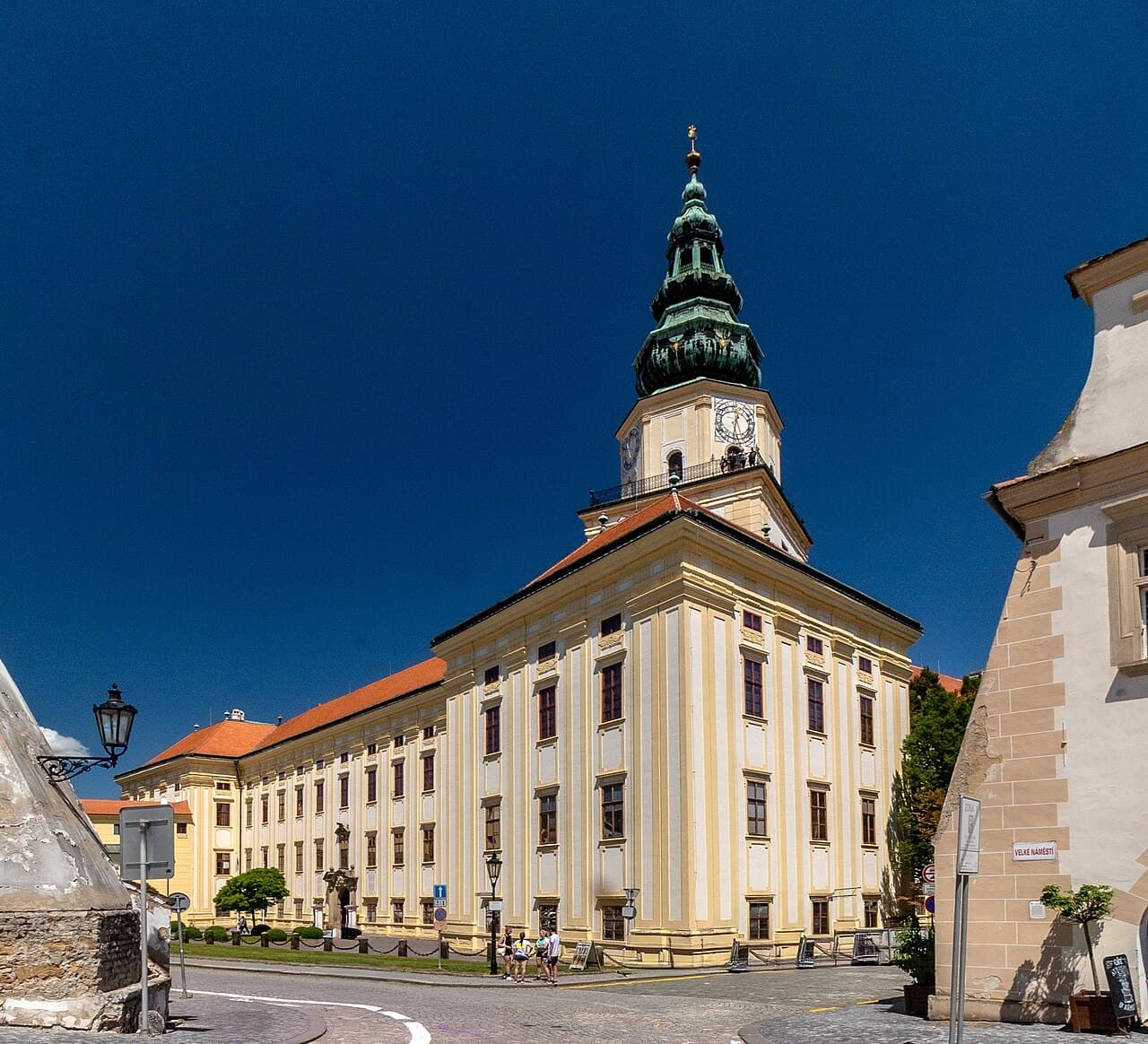
Kroměříž Castle stands as a remarkable example of a Baroque episcopal residence in the town of Kroměříž, Czechia. Its origins trace back to an early medieval stronghold linked to the powerful Slavic state of Great Moravia in the 9th and early 10th centuries. This site evolved over centuries from a defensive fortress to a grand ducal court and bishop's palace, reflecting the shifting political and religious landscape of Central Europe.
The castle's earliest recorded ownership dates to Bishop Jan II of Olomouc, who acquired the settlement in 1110. By the mid-13th century, under Bishop Bruno of Schauenburg, the settlement was elevated to town status in 1261, and a Gothic castle was constructed to serve as the administrative and defensive center of the bishopric. This medieval fortress embodied ecclesiastical power and regional governance.
In the early 16th century, Bishop Stanislav Thurzo initiated a transformation of the austere medieval fortress into a Renaissance-style residence, marking a shift towards comfort and aesthetic refinement that mirrored broader European architectural trends. This renovation introduced Renaissance elements while maintaining the castle's defensive capabilities.
Destruction and baroque reconstruction
The castle suffered significant damage during the Thirty Years’ War when Swedish forces led by General Lennart Torstenson captured and devastated the town and castle in 1643. This event marked a turning point, leading to extensive rebuilding efforts.
Later in the 17th century, Bishop Karel II of Lichtenstein-Castelcorn commissioned an ambitious reconstruction that reshaped the castle into its current early Baroque form. Renowned imperial architects Filiberto Lucchese and Giovanni Pietro Tencalla contributed to this transformation, which included the addition of four bastion-like risalits at the corners and a central courtyard that enhanced both the castle's defensive and residential functions.
A catastrophic fire in 1752 damaged the upper floors and interiors, prompting a two-decade restoration led by Bishop Hamilton. This restoration not only repaired the damage but also enriched the castle's architectural and decorative features, including the installation of copper roofing on the prominent 84-meter-high tower originally built as a medieval keep.
Architectural layout and features
Kroměříž Castle is a two-story rectangular building measuring approximately 75 by 80 meters. Its layout is distinguished by the four corner risalits, which resemble bastions, and a spacious central courtyard that provides natural light and access to various parts of the castle. The castle's most striking architectural element is its tall tower, which has endured multiple fires but remains a dominant feature of the skyline.
The castle's interior is organized according to function and status. The ground floor housed economic and service areas, the second floor contained grand state rooms for official ceremonies, and the third floor emphasized the bishop's secular and ecclesiastical authority.
Sala terrena and garden connection
The garden wing on the ground floor includes the Sala terrena, a late 17th-century space connecting the castle to the adjacent Podzámecká Garden. This area boasts three large halls richly decorated with stucco by Baldassare Fontana and Jean Baptiste Dusart, frescoes by Paolo Antonio Pagani, and two artificial grottoes adorned with stalactite-like formations, shells, and a fountain centered on a statue of Apollo.
Representative interiors
The Assembly Hall is a highlight of the castle's interiors, designed in a Rococo style and measuring 30 by 14 meters with a height of 16 meters. It features elaborate ceiling oil paintings by Franz Adolph von Freenthal and is illuminated by twenty-two chandeliers. Originally used for grand dining and ceremonies, it was adapted during the Imperial Diet of 1848–1849 with a wooden tiered podium.
The Small Dining Room contains 18th-century furnishings and wall paneling decorated with 111 paintings depicting animal, biblical, and mythological scenes. The Throne Hall, once home to Titian's original painting "Apollo and Marsyas," served as a reception room for distinguished guests and features ornamental stucco ceilings and painted wood paneling.
Other notable rooms include the Council Room, furnished in neo-Baroque style and used during the 1848 Diet by Slavic deputies, and the Imperial Room, commemorating the 1885 meeting between Tsar Alexander III and Emperor Franz Joseph I.
The Feudal Hall symbolized the bishops' temporal power and hosted feudal courts and assemblies. Its walls are decorated with artificial marble and gilded Rococo carvings, and the ceiling features frescoes by Franz Anton Maulbertsch. The Old Library, dating from the late 18th century, is adorned with frescoes by Josef Stern and houses four large 17th-century globes.
The private Chapel of St. Sebastian, consecrated in 1766, contains sculptures, stuccoes, an altar crafted by the workshop of František Ondřej Hirnle, and paintings by Josef Stern. The altar painting depicting St. Sebastian's martyrdom likely originated from Vienna.
Art collections and cultural significance
Kroměříž Castle houses an extensive art collection of 538 paintings, including masterpieces by Titian, Lucas Cranach the Elder, and Paolo Veronese. Its music archive preserves manuscripts by composers such as Haydn and Mozart. The castle library holds nearly 90,000 volumes, including valuable medieval manuscripts. Additionally, the numismatic collection contains over 10,000 coins and medals.
Gardens and landscape architecture
The castle is complemented by two significant gardens: the Podzámecká Garden, designed in a romantic style, and the Květná Garden, a Baroque garden featuring geometric layouts and ornamental elements. Both gardens were developed under Bishop Karel II of Lichtenstein-Castelcorn, with design contributions from architects Lucchese and Tencalla. These gardens enhance the castle's architectural ensemble and reflect the evolving landscape design trends of the 17th century.
Historical events and modern status
The castle played a pivotal role in the 1848–1849 Imperial Diet of the Austrian nations, known as the Kroměříž Diet, hosting important political assemblies that shaped regional governance.
During World War II, retreating German troops set fire to the castle tower, causing significant damage. Restoration efforts between 1947 and 1948 repaired the damage and preserved the castle's historic character.
In recognition of its cultural and historical importance, the castle complex, along with the adjacent gardens, was declared a national cultural monument in 1995 and inscribed on the UNESCO World Heritage List in 1998.
Today, Kroměříž Castle remains under the ownership of the Olomouc Archbishopric and functions as a center for research and cultural preservation. It houses extensive collections of art, manuscripts, music, and books accumulated over centuries, attracting scholars and visitors interested in its rich heritage.
Frequently asked questions (FAQ)
- When was Kroměříž Castle originally built?
- Kroměříž Castle was originally built in 1261 under Bishop Bruno of Schauenburg, replacing an earlier medieval stronghold.
- What architectural styles are featured in Kroměříž Castle?
- The castle features Gothic origins with significant Renaissance and Baroque renovations, culminating in its current early Baroque appearance.
- Can visitors explore the castle's art collections?
- Yes, visitors can view the castle's extensive art collections, including paintings by Titian and Cranach, as well as manuscripts and music archives.
- What gardens are associated with Kroměříž Castle?
- The castle is surrounded by the romantic Podzámecká Garden and the Baroque Květná Garden, both designed in the 17th century.
- Is Kroměříž Castle open year-round for visitors?
- Visiting hours vary seasonally; it is advisable to check the official website for current opening times before planning a visit.
Photo gallery

Information
Sources & official resources
Verify the information above using these authoritative references.
Loading map...
Visitor reviews
No reviews yet. Been here? Write the first review and help other travelers!
Write the first reviewVisited this castle? Share your experience
Your review helps other travelers and adds first-hand knowledge to our encyclopedia.