Buchlov Castle
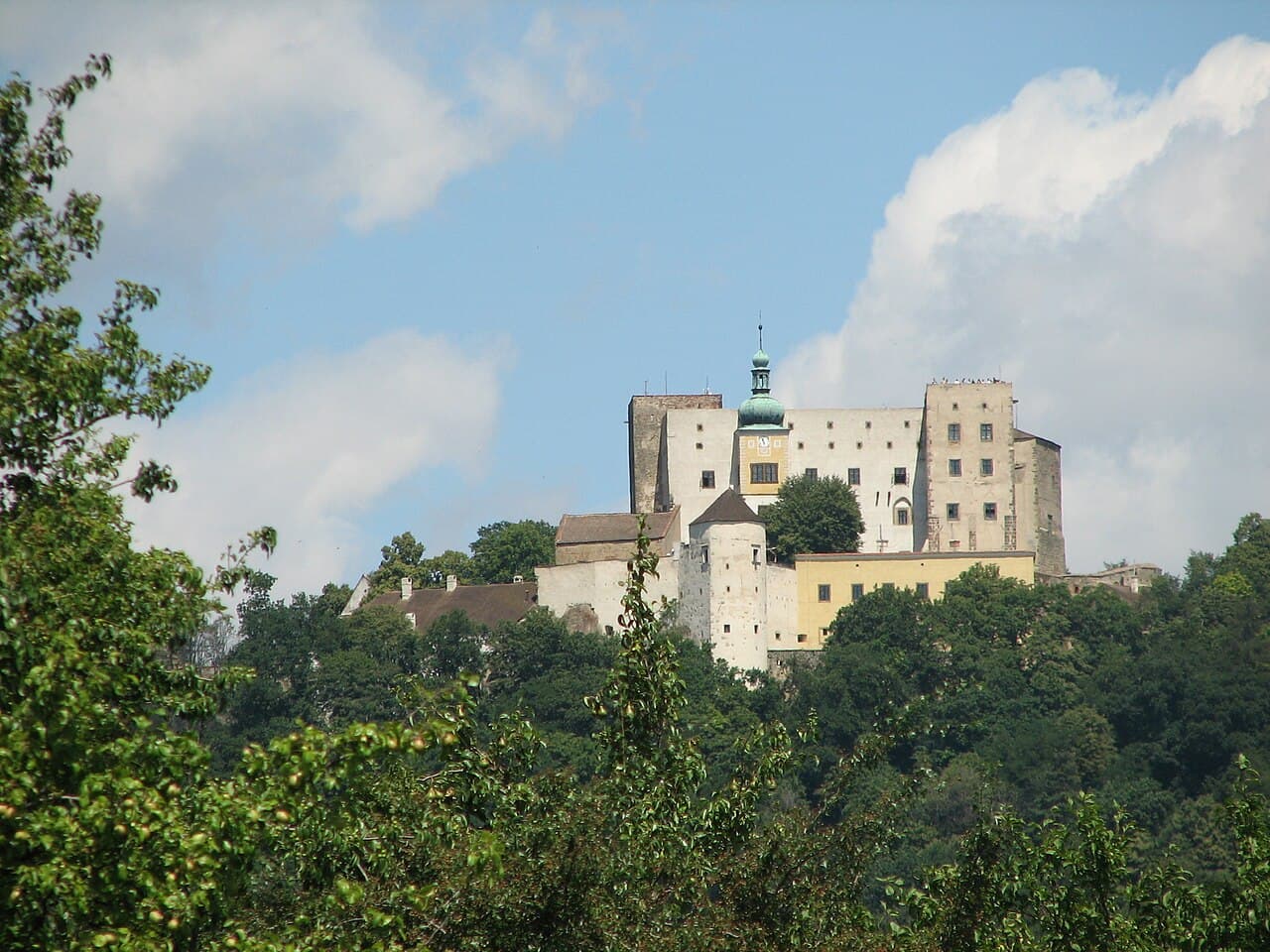
Buchlov Castle stands as a remarkable example of a high medieval hill castle with a rich history spanning several centuries in the heart of the Czech Republic. Constructed in the first half of the 13th century, this fortress was strategically positioned atop a rocky plateau in the Chřiby mountains, near the village of Buchlovice. Its elevated location, approximately 510 to 522 meters above sea level, provided a commanding view and formidable defense, making it a vital royal stronghold for the medieval Bohemian kingdom.
The castle's origins are intertwined with the early settlement of the area, as archaeological evidence suggests human activity dating back to the oldest periods of civilization. The initial construction featured two massive prismatic towers located at opposite ends of the plateau, connected by defensive walls enclosing a high palace on the southern side of the courtyard. This early layout reflects a transitional architectural style blending Romanesque and Gothic elements, characteristic of 13th-century fortifications.
Architectural evolution and medieval significance
During the 1370s, Buchlov Castle underwent significant expansion, including the addition of a new tower with a chapel on its second floor. This chapel housed precious examples of early Gothic architecture, which were later lost when the castle was captured by Hungarian King Matthias Corvinus in the late 15th century. Following this event, the chapel was destroyed and repurposed into storage rooms, marking a shift in the castle's functional use.
Throughout the Middle Ages, Buchlov remained a royal possession but was frequently pawned to various aristocratic families, including the nobles of Cimburk in the late 15th century. This period saw the construction of a representative chivalric hall, emphasizing the castle's role not only as a military fortress but also as a noble residence and administrative center.
Judicial and administrative roles
Buchlov Castle held a unique position in local governance, particularly in enforcing hunting laws known as "lovecké právo". From the 14th century until 1749, the castle's administrators exercised judicial authority over hunting crimes, a privilege that underscored the castle's importance in regional legal and economic affairs. This role complemented its military and residential functions, highlighting its multifaceted significance in medieval Moravia.
Renaissance transformations and later ownership
In 1511, the castle transitioned from royal to private ownership when King Vladislav II Jagellonský granted it to Arkleb Trnavský of Boskovice as a reward for military service against the Ottoman Turks. The castle changed hands multiple times in the following decades, notably to the Žerotín family in 1520 and then to Jan Ždánský of Zástřizl in 1542. Under the Ždánský family, Buchlov Castle was extensively renovated, incorporating Renaissance architectural styles that softened its fortress character and enhanced its residential comfort and aesthetic appeal.
The Petřvald family held the castle from 1644 to 1800, during which time they fortified the structure against renewed threats, including the addition of a bastion and a tower gate in the 17th century. Despite these defensive upgrades, the castle gradually lost its role as a permanent noble residence, ceasing regular habitation by 1751.
Berchtold family and cultural preservation
The final private owners, the Berchtold family, preserved Buchlov Castle's historical integrity and enriched its cultural heritage. Brothers Leopold and Bedřich Berchtold established a family museum within the castle, showcasing an extensive collection of natural history and archaeological artifacts gathered during their scholarly pursuits and travels. Leopold Berchtold, notably the foreign minister of Austria-Hungary at the outset of World War I, was interred at Buchlov after his death in 1942.
Following World War II, the castle was confiscated under the Beneš decrees and became state property in 1945. It was later designated a national cultural monument in 2002, ensuring its protection and public accessibility. Today, Buchlov Castle hosts numerous cultural events and remains a significant tourist attraction in the region.
Architectural features and interior highlights
Buchlov Castle's complex architectural layout reflects its layered history. The castle's most prominent feature is its 35-meter-high tower with a square base and an open viewing platform, offering panoramic views of the surrounding Chřiby hills and valleys. The castle comprises multiple courtyards accessed through a Baroque gate and connected by a wooden bridge and Baroque passage, illustrating the blend of medieval and later period modifications.
The Renaissance tower "Andělka", named after a prisoner once held there, stands within the second courtyard, which originally served economic and farm functions. The inner courtyard is surrounded by buildings from various periods, including a Renaissance structure dating to 1602 featuring a terrace and clock tower.
Inside, many noble chambers retain furnishings and artworks from the Gothic and Renaissance periods. Notable pieces include the Buchlov Madonna, a mid-14th-century religious sculpture of high artistic value, and Baroque paintings by Petr Brandl. An early Gothic chapel within the southeast entrance tower adds spiritual significance to the castle's interior.
The Berchtold family's contributions are evident in the natural history and archaeological collections displayed throughout the castle. Despite a damaging fire in 1931, careful restoration efforts have preserved the castle's architectural and cultural heritage under the stewardship of the National Heritage Institute.
Chapel of saint barbara and surrounding landmarks
Approximately one kilometer from Buchlov Castle stands the Chapel of Saint Barbara, also known as Barborka. Originally built in the 13th century and rebuilt in early Baroque style by 1672, this chapel serves as a funeral crypt for the Petřvald and Berchtold families. Its cruciform plan and central cupola are characteristic of early Baroque ecclesiastical architecture.
The chapel remains an active site of pilgrimage, with divine services held regularly, linking the spiritual traditions of the region to the castle's historical narrative. Together, Buchlov Castle and the Chapel of Saint Barbara form an important cultural and historical ensemble that reflects the evolution of Moravian noble life and religious practices over several centuries.
Legends and cultural significance
Local folklore enriches Buchlov Castle's historical tapestry. One famous legend involves a lime tree purportedly instrumental in proving the innocence of a soldier condemned to death, symbolizing the castle's judicial authority and its role in enforcing hunting laws. Such stories highlight the castle's enduring place in regional identity and cultural memory.
Today, Buchlov Castle is not only a monument of architectural and historical importance but also a vibrant cultural venue. It hosts exhibitions, concerts, and educational programs, inviting visitors to explore its storied past and appreciate its artistic treasures. The castle's preservation as a national cultural monument ensures that its legacy will continue to be celebrated for generations to come.
Frequently asked questions (FAQ)
- How do I get to Buchlov Castle from Buchlovice?
- Buchlov Castle is located about 3 kilometers from the center of Buchlovice. Visitors can reach the castle by car, taxi, or on foot via marked hiking trails through the Chřiby hills, offering scenic views along the way.
- What are the opening hours for Buchlov Castle?
- Buchlov Castle is typically open to visitors from April to October, with daily hours from 9:00 AM to 5:00 PM. It is advisable to check the official website for seasonal variations and special event closures.
- Is there an entrance fee to visit Buchlov Castle?
- Yes, there is an entrance fee to visit Buchlov Castle. Ticket prices vary, with discounts available for children, students, and seniors. Group rates and guided tours may also be offered.
- What architectural styles are represented at Buchlov Castle?
- Buchlov Castle showcases a blend of architectural styles, including early <strong>Romanesque-Gothic</strong> elements from its original 13th-century construction, significant <strong>Renaissance</strong> renovations in the 16th century, and later <strong>Baroque</strong> additions, reflecting its long history and evolving functions.
- Can I visit the Chapel of Saint Barbara when visiting Buchlov Castle?
- Yes, the Chapel of Saint Barbara, located about one kilometer from Buchlov Castle, is accessible to visitors. It is an early Baroque chapel with historical significance and is still used for pilgrimage services.
- What notable artifacts can be seen inside Buchlov Castle?
- Inside Buchlov Castle, visitors can see the Buchlov Madonna, a mid-14th-century Gothic sculpture, Baroque paintings by Petr Brandl, and collections of natural history and archaeological artifacts amassed by the Berchtold family.
- Is Buchlov Castle suitable for families and children?
- Yes, Buchlov Castle is family-friendly, offering guided tours that engage visitors of all ages. The castle grounds and nearby hiking trails provide ample opportunities for exploration and learning about medieval history.
Photo gallery

Photo by This image is a work by Mercy. When reusing, please credit me as: Mercy from Wikimedia Commons. I would appreciate being notified if you use my work outside Wikimedia. Do not copy this image illegally by ignoring the terms of the license below, as it is not in the public domain. If you would like special permission to use, license, or purchase the image please contact me to negotiate terms. More of my work can be found in my personal gallery.•CC BY-SA 3.0
Information
Sources & official resources
Verify the information above using these authoritative references.
Loading map...
Visitor reviews
No reviews yet. Been here? Write the first review and help other travelers!
Write the first reviewVisited this castle? Share your experience
Your review helps other travelers and adds first-hand knowledge to our encyclopedia.