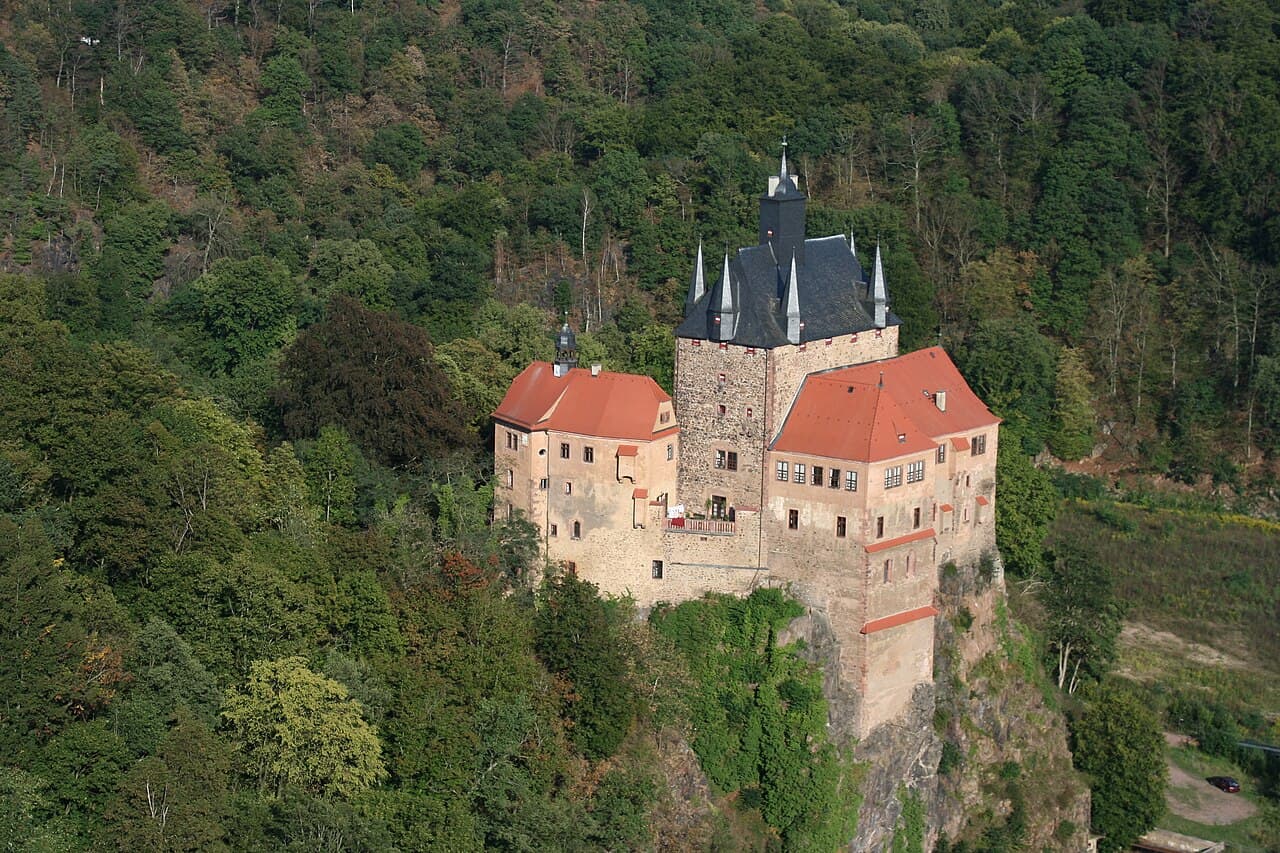
Kriebstein Castle
Kriebstein Castle stands majestically above the winding River Zschopau in the German state of Saxony. This late medieval hill castle, classified as a spur castle, is perched on a rocky spur surrounded on three sides by the river, offering natural defensive advantages enhanced by a man-made neck ditch known as the Halsgraben. Founded in 1384 by the noble Beerwalde family, Kriebstein Castle has evolved architecturally and historically to become one of the most striking examples of Gothic castle architecture in the region.
The castle typifies a hybrid of a Turmburg (tower castle) and a Ringburg (ringwork castle) with an oval ground plan. Its centerpiece is a monumental residential keep measuring 22 by 12 meters at its base and soaring to 45 meters including its weather vane. This towering structure dominates the castle's silhouette, accentuated by late medieval oriel turrets and a distinctive flèche (roof spire), which together create an unmistakable profile visible from afar.
Architectural features and layout
The castle’s layout is a masterful integration of defensive and residential elements typical of the late medieval period. The keep is strategically positioned atop the highest rocky crag, surrounded by a curtain wall enclosing various functional buildings. These include a tower-shaped gatehouse, an economic wing, a kitchen building, and a chapel wing. The kitchen is directly attached to the keep and is a notable example of Late Gothic architecture.
East of the chapel wing lies a two-bay cross-rib vaulted Gothic hall, which, together with the rear castle section, forms a continuous upper floor dating from the 17th century. This complex is situated directly above the steep slopes descending to the river, emphasizing the castle’s commanding position.
The economic wing encloses the castle complex and historically housed the great hall, now repurposed as a concert and event chamber where weddings and cultural events are held. Adjacent to this is the Brunnenstube (well house), essential for the castle’s water supply. The northern defensive wall, which once connected to the gatehouse, was partially dismantled in the 19th century but remains an important feature of the castle’s fortifications.
Historical development and ownership
The origins of Kriebstein Castle trace back to the Beerwalde family, who replaced their earlier residence at the nearby village of Beerwalde with this new stronghold in the late 14th century. The first documented mention in 1384 records Dietrich von Beerwalde’s commitment to building the castle on ancestral lands. By 1400, the main structures including the residential tower, chapel, curtain wall, and gatehouse were completed.
Following Dietrich’s death in 1408, ownership passed to his widow Elisabeth and then to their daughter Klara. The Beerwalde family controlled significant territories including the towns of Waldheim and Hartha during this period.
In 1465, the castle came under the ownership of Hugold III von Schleinitz. This marked the beginning of a second major phase of construction, with significant Gothic-style expansions led by the renowned architect Arnold von Westfalen, famed for his work on the Albrechtsburg in Meißen. Between 1471 and the end of the century, Arnold oversaw the addition of the economic wing featuring the "New Ballroom" and the "Brunnenstube," the rear castle, and a new kitchen building. These additions firmly established the castle’s Gothic character and its present footprint.
After Hugold’s death in 1490, ownership changed hands frequently, but no major building projects were undertaken. Under Georg von Carlowitz (1544-1550), the estate reached its greatest territorial extent, encompassing multiple villages and the towns of Waldheim and Hartha.
The late 17th century saw renewed building activity under the von Schönberg family. They added floors to buildings adjacent to the residential tower and gatehouse, including a new staircase connecting these structures. The von Milkau family also left their mark with inscriptions on the weather vanes atop the keep and gatehouse.
In 1825, the castle was acquired by Hanscarl von Arnim from Planitz near Zwickau, whose family retained ownership until 1945. Between 1866 and 1868, under the direction of court architect Karl Moritz Haenel, Kriebstein underwent extensive neo-Gothic renovations. These included partial interior reconfigurations, reduction of two floors from the economic wing, partial removal of the northern defensive wall, and replacement of the original half-timbered kitchen with a solid masonry structure. This renovation altered some medieval features but preserved the castle’s overall historic character.
Preservation and public access
Kriebstein Castle has been remarkably well preserved and restored, maintaining much of its Gothic architectural heritage. The castle opened to the public in 1930 under the stewardship of the von Arnim family, who undertook restoration efforts, including work on the chapel, without government funding. After the expropriation of the von Arnim family in 1945, the castle served various functions such as residential housing and forestry administration. The museum within the castle reopened in 1949.
A significant archaeological find occurred in 1986 with the discovery of the "Kriebstein Treasure" hidden within the residential tower’s fireplace. This collection of valuable objects was originally concealed in 1944 by Heinrich Graf von Lehndorff-Steinort. Between 2010 and 2011, many of these art objects and family furnishings were returned to the Lehndorff descendants.
Since 1993, Kriebstein Castle has been owned by the Free State of Saxony and managed by the State Palaces, Castles and Gardens authority. It is a notable cultural landmark and a station on the Lutherweg pilgrimage route. The castle has also served as a filming location for productions such as "The Grand Budapest Hotel" and the 2009 "Snow White" film.
Interior features and artistic heritage
The castle’s interior reflects its long history, with decorative elements spanning from the late medieval period to 19th-century historicism. Noteworthy are the colorfully painted Bohlenstube (plank room) and the richly adorned Kriebsteinzimmer, which showcase different eras of interior design and craftsmanship.
The castle chapel contains valuable wall paintings and architectural details that highlight the religious and cultural significance of the site through the centuries.
Defensive elements and strategic location
Kriebstein Castle’s strategic position on a rocky spur surrounded by the River Zschopau provided natural defenses augmented by man-made fortifications. The Halsgraben neck ditch separated the castle rock from the rising hinterland, creating a formidable barrier against attackers.
The combination of a tall, imposing residential tower and a surrounding ring wall typifies the castle’s defensive design. The gatehouse and northern defensive wall further strengthened the fortress, controlling access and providing vantage points for defense.
While some defensive structures were partially dismantled in the 19th century, the castle’s overall fortifications remain impressive and contribute to its reputation as one of Saxony’s best-preserved medieval castles.
Frequently asked questions (FAQ)
- How do I get to Kriebstein Castle?
- Kriebstein Castle is located in the municipality of Kriebstein, Saxony, Germany. It is accessible by car and local public transport from nearby towns such as Waldheim and Chemnitz. Clear signage guides visitors to the castle parking area.
- What are the opening hours of Kriebstein Castle?
- The castle is generally open to visitors from 10:00 to 16:00 daily, but it is advisable to check the official website or contact the visitor center for seasonal variations and special events.
- Is Kriebstein Castle suitable for family visits?
- Yes, Kriebstein Castle offers a family-friendly environment with guided tours, exhibitions, and cultural events suitable for all ages. The castle grounds and event spaces provide engaging experiences for children and adults alike.
- Can I host weddings or events at Kriebstein Castle?
- Kriebstein Castle has facilities such as a concert and event hall that are available for weddings and other private events. Interested parties should contact the castle administration for booking details and availability.
- What architectural styles are represented at Kriebstein Castle?
- Kriebstein Castle primarily exhibits late medieval Gothic architecture, with later neo-Gothic renovations from the 19th century that preserved and enhanced its historic character.
- When was Kriebstein Castle built?
- The castle was founded in 1384 by the Beerwalde family and completed around 1400, with significant expansions in the late 15th century.
- Are guided tours available at Kriebstein Castle?
- Yes, guided tours are offered regularly, providing insights into the castle’s history, architecture, and cultural significance. Visitors can check the schedule and book tours through the official castle website.
Photo gallery

Information
Sources & official resources
Verify the information above using these authoritative references.
Loading map...
Visitor reviews
No reviews yet. Been here? Write the first review and help other travelers!
Write the first reviewVisited this castle? Share your experience
Your review helps other travelers and adds first-hand knowledge to our encyclopedia.



