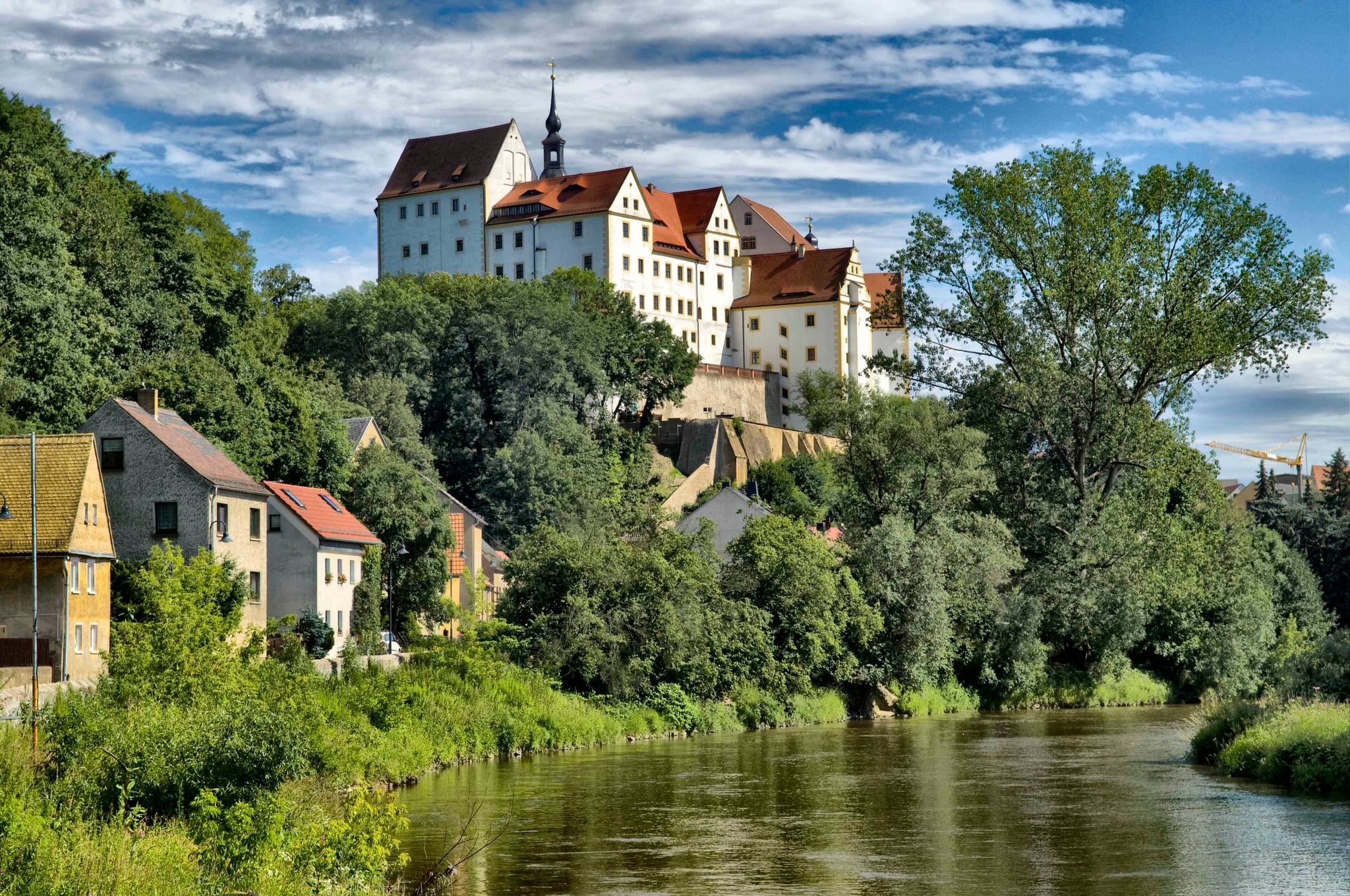
Mildenstein Castle
Mildenstein Castle stands prominently on a rocky spur above the Freiberger Mulde river at the northern edge of Leisnig in Saxony, Germany. This hill castle, built in the 10th century, is among the oldest fortifications in the Saxon settlement region and has played a significant role in the region's medieval and early modern history.
Early origins and imperial foundation
The site of Mildenstein Castle was settled in prehistoric times, located on an ancient lava dome composed of rhyolite, locally known as Leisniger Quarzporphyr. The castle itself was constructed as an imperial fortress (Burgward) in the 10th century, part of the German eastward expansion and consolidation efforts. The first documented mention of the castle dates to 1046, when Emperor Heinrich III included the Burgwards of Colditz, Rochlitz, and Leisnig in a deed gifting them to his wife Agnes of Poitou.
In 1084, Emperor Heinrich IV enfeoffed the castle to his loyal servant Wiprecht von Groitzsch, a notable figure in the region. Around 1100, Wiprecht commissioned the construction of the Romanesque chapel, the oldest surviving building within the castle complex, showcasing early medieval ecclesiastical architecture.
Medieval ownership and architectural development
The castle passed through several hands in the 12th century. In 1143, it came by marriage to the Franconian earl Rapoto von Abenberg, who sold it in 1148 to Duke Friedrich III of Swabia, later crowned Emperor Frederick I Barbarossa. In 1158, Barbarossa declared Mildenstein an imperial property tied to the emperor's office and granted it as a fief to the Burgraves of Leisnig. This elevated the castle's status as a center of governance within the Imperial Territory of Pleißenland.
During Barbarossa's reign, significant construction took place, including rebuilding the chapel and erecting the imposing keep (Bergfried) in the inner courtyard in the late 12th century. The lower portion of this tower was built from massive local quartzite blocks, typical of the period, while the upper sections were constructed with painted bricks, a technique more common in the 14th century. The original entrance to the keep was located approximately 13 meters above the courtyard floor, accessible only by ladders or removable staircases, emphasizing its defensive design.
The castle's gatehouse dates from the late 12th to early 13th century, while a second keep in the outer bailey was built in the first half of the 13th century. Between 1400 and 1420, the Romanesque chapel was expanded with a Gothic choir, reflecting the evolving architectural styles and religious practices.
The burgraves of leisnig and political shifts
The Burgraves of Leisnig were influential rulers in the Muldenland region, founding Buch Abbey in 1192 and acquiring several lordships. However, their power waned in the 14th century under pressure from the expanding Margraves of Meissen. In 1365, the Margraves conquered the castle, compelling the Burgraves to sell their burgraviate. Under Margrave Wilhelm I, the castle underwent a fundamental rebuilding at the end of the 14th century, including the construction of the granary, manor house (Herrenhaus), and page house (Pagenhaus). These additions were designed for administrative rather than residential purposes, and the castle ceased to be a noble residence, serving instead as the seat of the local government (Amt Leisnig).
Early modern period and later uses
Mildenstein Castle suffered heavy damage during the Thirty Years' War in the 17th century but remained a significant administrative center. In 1706-1707, it briefly served as the residence of Stanisław Leszczyński, the Polish anti-king allied with Sweden during the Great Northern War, when the Electorate of Saxony was occupied by Swedish forces.
Throughout the 18th and 19th centuries, the castle housed the district court, prison, and apartments for officials. Beginning in 1798, the local Mirus family developed a romantic park around the castle hill, notable for its artificial ruins and a rock tunnel constructed in 1866, enhancing the picturesque landscape and reflecting 19th-century romanticism in castle grounds.
From 1964 to 1990, a small zoo operated on the castle grounds, at times hosting over 150 animals including monkeys, brown bears, and wolves. The zoo's closure marked a return to focusing on the castle's historical and cultural significance.
Museum and cultural significance today
Since 1890, Mildenstein Castle has functioned as a museum, managed by the Free State of Saxony through the state enterprise "State Palaces, Castles and Gardens of Saxony." The museum features permanent exhibitions on Christian art, the lifestyle of the castle's noble inhabitants, the administrative functions during the early modern period, and the history of the prison system. Special exhibitions vary annually, offering diverse cultural programming.
The castle hosts guided tours, concerts, historical reenactments, and thematic events for families and children, making it a vibrant cultural venue. Visitors can climb the 32-meter-high inner keep, which serves as an observation tower offering panoramic views of Leisnig and the Mulde valley.
Architectural features and layout
The castle complex is divided into several wards: the Hinterschloss (inner ward), Mittelschloss (middle ward), and Vorderschloss (outer ward). A former second outer ward called Burglehn has mostly merged into the town. The two Bergfriede (keeps) are notable features, with the inner courtyard keep built in the late 12th century and the outer ward keep from the early 13th century, an unusual configuration in Saxony.
The gatehouse controls access to the castle and dates from the late 12th or early 13th century. The granary, Herrenhaus, and Pagenhaus were added in the late 14th century under Margrave Wilhelm I, reflecting the castle's administrative role. The chapel, originally Romanesque, was expanded with a Gothic choir in the early 15th century.
Historical artifacts and unique exhibits
The museum houses unique artifacts such as the Döbelner giant boot, once the world's largest boot at 3.7 meters tall until surpassed in 1996 by a 4.9-meter boot made by local shoemakers for Leisnig's 950th anniversary. These exhibits highlight regional craftsmanship and cultural heritage.
Mildenstein Castle remains a well-preserved example of a medieval hill castle with a rich history spanning over a millennium. Its architectural evolution from a 10th-century imperial fortress to a Renaissance administrative center, and finally a modern museum, reflects the broader historical and cultural shifts in Saxony and Germany. The castle's combination of Romanesque and Gothic architectural elements, its strategic location, and its role in regional governance make it a significant heritage site and a compelling destination for visitors interested in medieval history, architecture, and culture.
Frequently asked questions (FAQ)
- How do I get to Mildenstein Castle in Leisnig?
- Mildenstein Castle is located at the northern edge of Leisnig, Saxony, easily accessible by car and local public transport. The town center is within walking distance of the castle.
- What are the opening hours and ticket prices for Mildenstein Castle museum?
- The castle museum typically opens daily from 10:00 to 16:00, but visitors should check the official website for seasonal variations. Ticket prices are modest, with discounts for children, seniors, and groups.
- What can I see in the Mildenstein Castle museum?
- The museum features permanent exhibitions on Christian art, noble life in the castle, early modern administration, and the history of the prison system. Special exhibitions change yearly, offering fresh perspectives on regional history.
- Can visitors climb the keep at Mildenstein Castle?
- Yes, the 32-meter-high inner keep has been restored and serves as an observation tower. Visitors can climb it for panoramic views of Leisnig and the Mulde valley.
- Is Mildenstein Castle suitable for family visits and children?
- Absolutely, the castle hosts themed events, reenactments, and concerts that are family-friendly. The romantic park and museum exhibitions also offer engaging experiences for children.
- What architectural styles are present at Mildenstein Castle?
- Mildenstein Castle showcases primarily Romanesque architecture with later Gothic additions, especially visible in the chapel's choir and some structural expansions from the 15th century.
Information
Sources & official resources
Verify the information above using these authoritative references.
Loading map...
Visitor reviews
No reviews yet. Been here? Write the first review and help other travelers!
Write the first reviewVisited this castle? Share your experience
Your review helps other travelers and adds first-hand knowledge to our encyclopedia.