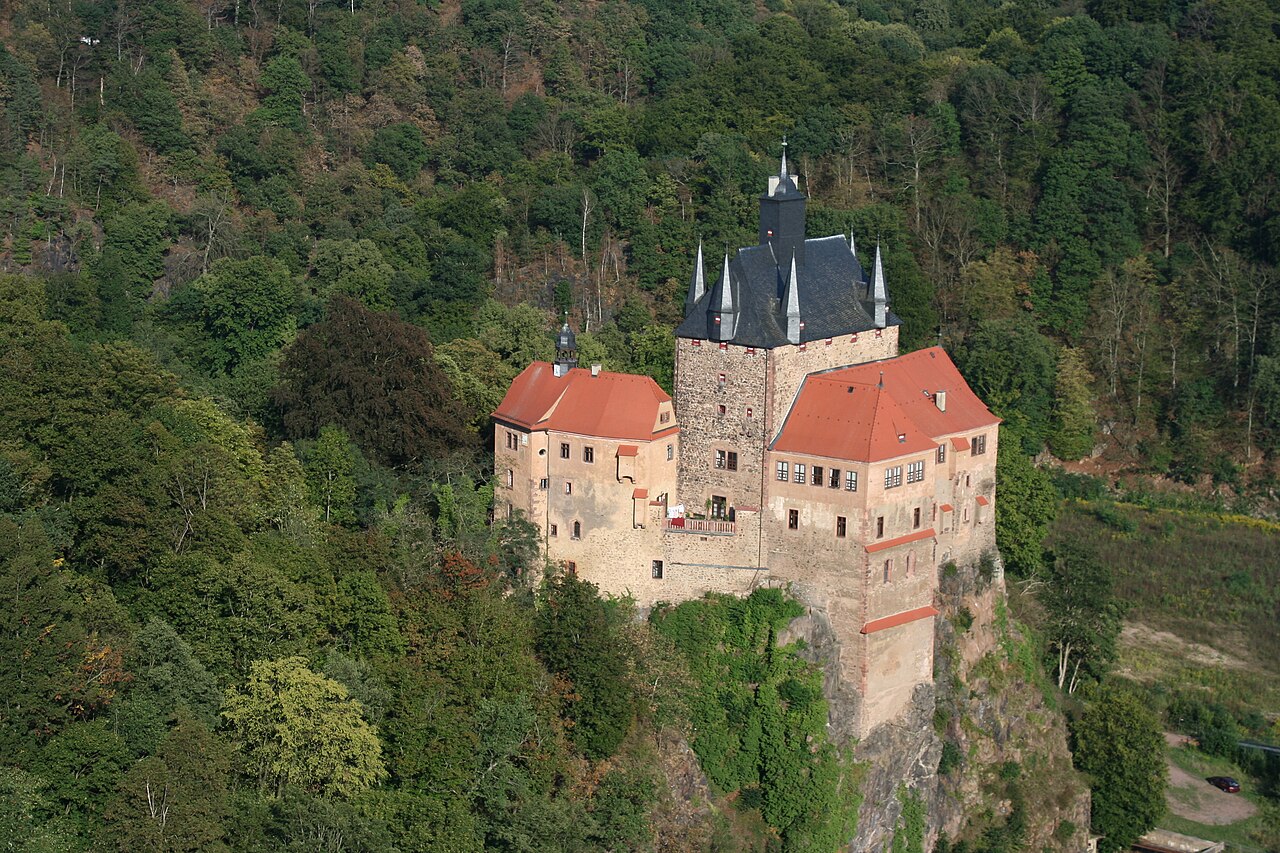
Sachsenburg Castle
Sachsenburg Castle stands prominently near Frankenberg in Saxony, Germany, perched on a rocky outcrop overlooking the Zschopau river. This fortress is a significant example of a late Gothic residential palace that has survived largely intact, offering a rare glimpse into the architectural and historical developments of the region during the High Medieval and Late Medieval periods.
The castle's origins trace back to the early 13th century, with archaeological evidence confirming its existence around 1210 to 1230. Although the Lords of Sachsenburg were first mentioned in 1197, it remains uncertain whether a castle stood at that time. The construction is attributed to the Lords of Mildenstein, who established the initial fortifications on this strategic rocky site. The castle was originally built as a defensive stronghold, taking advantage of its elevated position above the river to control the surrounding territory and trade routes.
Architectural features and development
The castle complex underwent significant transformation in the 1480s, evolving into a more comfortable residential palace while retaining its defensive capabilities. This conversion introduced characteristic elements of the late Gothic architectural style, including pointed arches, ribbed vaults, and ornamental stonework. Sachsenburg Castle is notable for being one of the few castles in Saxony that preserves this style comprehensively in its residential buildings.
The complex includes a main keep, fortified curtain walls, and several towers that provided vantage points for surveillance and defense. The castle's layout features an outer bailey and an inner courtyard, which housed various functional buildings such as living quarters, storerooms, and administrative offices. A moat or natural defensive barriers enhanced its security, typical of castles built in this period.
Historical significance and ownership
The Lords of Sachsenburg played a key role in the region's medieval history, though detailed records of their activities are sparse. By the early 17th century, specifically from 1610, the castle's function shifted from a noble residence to an administrative center for the Electoral Saxon Office of Sachsenburg with Frankenberg. This change reflected the broader political and administrative consolidation occurring in Saxony during that era.
The castle's strategic importance was highlighted during the Thirty Years War (1618–1648), when it suffered damage. The first and second outer baileys were destroyed, and the castle was looted. Despite this, the core structures endured, allowing for continued use in subsequent centuries.
Use as a correctional and detention facility
From the mid-19th century, Sachsenburg Castle's role shifted dramatically. Starting in 1864, it was repurposed as a custody facility for young female prisoners. Shortly after, in 1867, it became a penal and correctional institution. This function continued into the early 20th century, with the castle housing various categories of inmates.
During World War I, Sachsenburg Castle served as a detention center for prisoners of war, including Russians, some of whom were academics and students from the Freiberg Mining Academy, as well as English and Serbian detainees. This reflects the castle's adaptability and continued strategic use throughout changing historical contexts.
Sachsenburg Castle during the Nazi era
In the early years of the Nazi regime, Sachsenburg Castle was among the first sites used as a concentration camp. Alongside Lichtenburg, it became a facility operated by the SS from 1933 to 1937. The castle itself was not originally designed for this purpose; rather, an adjacent abandoned four-story textile mill was renovated in May 1933 to serve as a "protective custody" camp.
This camp detained political dissidents, including Jehovah's Witnesses who opposed the Nazi regime. Sachsenburg's role in this dark chapter of history marks it as a site of significant cultural and historical memory, illustrating the transformation of medieval fortifications into modern instruments of repression.
Preservation and restoration efforts
Today, Sachsenburg Castle is in a state of restoration, aiming to preserve its architectural heritage and historical significance. The ongoing work seeks to maintain the castle's structural integrity while making it accessible for educational and cultural purposes. Its preservation contributes to the understanding of Saxony's medieval architecture and its complex history through centuries of varied use.
The castle's location near Frankenberg, combined with its well-preserved late Gothic features, makes it a valuable destination for visitors interested in medieval architecture, regional history, and the evolution of castle functions over time.
Information
Loading map...
Visitor reviews
No reviews yet. Been here? Write the first review and help other travelers!
Write the first reviewVisited this castle? Share your experience
Your review helps other travelers and adds first-hand knowledge to our encyclopedia.