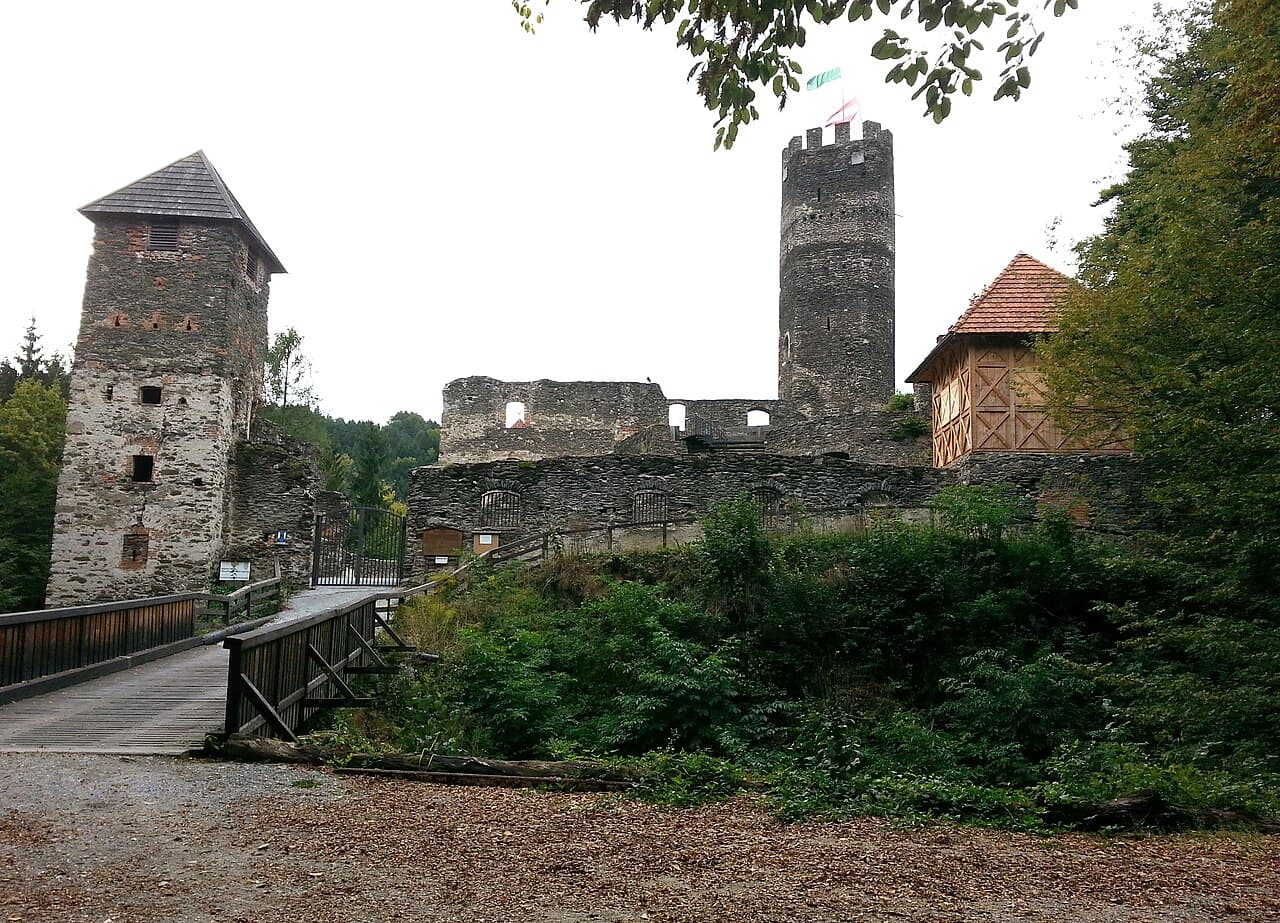
Krems Castle stands as a significant hill castle ruin located near the town of Voitsberg in the Austrian region of Styria. Positioned approximately 330 metres above sea level on a prominent ridge, it offers commanding views of the surrounding landscape. The castle's origins trace back to the 12th century, when it was constructed under the auspices of the Archbishop of Salzburg, marking it as an important ecclesiastical stronghold during the High Medieval period.
The earliest recorded mention of Krems Castle dates to 1248, confirming its strategic and administrative significance in the region. Throughout the centuries, Krems Castle was held by various noble families, although direct management was typically delegated to appointed caretakers or administrators. The castle served as a center of local governance, notably holding the lower jurisdiction rights in the 14th century.
Architectural evolution and renaissance transformation
Originally built as a medieval fortress, Krems Castle underwent substantial modifications in the 16th century during the Renaissance. This period saw the expansion of the castle into a more comfortable and stylistically refined residence, reflecting Renaissance architectural influences. Notably, the castle complex was extended to include a residential tower and two adjoining residential buildings, enhancing its domestic functionality.
The castle also featured a ring wall with embrasures, indicative of its defensive role. The outer bailey, located to the north of the core castle, represents the youngest section of the complex and includes two small corner towers, one of which remains preserved to its full height. These fortifications highlight the castle's adaptation to evolving military technologies and residential needs.
Historical ownership and decline
In the 17th century, Krems Castle came under the ownership of Count Karl Saurau, who incorporated it into his dominion of Ligist. However, after the administrative functions were transferred to Ligist Castle around 1730, Krems Castle was neglected and fell into disrepair. A significant structural failure occurred in 1817 when part of the castle collapsed following a severe rainstorm, accelerating its decline.
Later, in 1857, the castle ruins were acquired by Archduke Johann, a notable figure in Austrian history, although this did not lead to a full restoration at that time.
Preservation efforts and modern use
The ruins of Krems Castle were officially recognized as a listed building on 20 March 1936, prompting efforts to secure and make the site accessible to the public. Renovation and conservation work were undertaken in the 1960s by a dedicated castle association, focusing on stabilizing the remains and facilitating visitor access.
Since 1988, the castle has been owned by the association Licht im Leben (Light in Life), which, along with a newly founded castle association from 1993, has continued restoration projects. These efforts included constructing a perimeter path around the ruins and reopening the five-storey keep, a prominent feature built directly on the rock, which remains visible from a distance.
In May 2015, a small museum room was inaugurated within the castle grounds, providing visitors with historical context and insights into the castle's past. This museum enhances the educational value of the site and promotes the cultural heritage of the region.
Architectural features and layout
The castle's layout is typical of a hill castle, with its core defensive structures strategically placed on an advanced ridge. The five-storey keep is the centerpiece, constructed on a natural rock outcrop, which provided both a defensive advantage and a symbol of lordly power.
The southern section of the complex houses the residential tower and adjoining buildings, which were likely used for living quarters and administrative functions. The surrounding ring wall with embrasures encircles the main area, offering protection while allowing defenders to fire upon attackers.
The northern outer castle, considered the youngest part of the complex, includes two corner towers, with one tower preserved to its full height, providing insight into the castle's defensive architecture and the evolution of its fortifications over time.
Cultural significance and visitor information
Krems Castle is an important cultural landmark in Styria, reflecting the region's medieval history and architectural heritage. Its preservation as a ruin allows visitors to explore the layers of history embedded in its walls, from its High Medieval origins through its Renaissance transformation to its modern conservation.
The castle is accessible to the public, with pathways and interpretive signage enhancing the visitor experience. The on-site museum offers a focused glimpse into the castle's historical narrative, making Krems Castle a valuable destination for history enthusiasts and tourists interested in medieval architecture.
Frequently asked questions (FAQ)
- When was Krems Castle first mentioned in historical documents?
- Krems Castle was first mentioned in historical records in 1248, confirming its existence and importance during the High Medieval period.
- What architectural styles are visible at Krems Castle?
- The castle originally featured High Medieval fortress architecture and was expanded in the 16th century with Renaissance style elements, including residential expansions and decorative features.
- Is Krems Castle accessible to visitors today?
- Yes, Krems Castle is accessible to the public. Restoration efforts have made the ruins safe and visitor-friendly, including a path around the site and a small museum room opened in 2015.
- What is the significance of the five-storey keep at Krems Castle?
- The five-storey keep is a dominant feature of Krems Castle, built on a rock outcrop. It served as a defensive stronghold and a symbol of the castle's lordly power, visible from afar.
- Who owns Krems Castle currently?
- Since 1988, Krems Castle has been owned by the association Licht im Leben, which manages its preservation and public access.
Photo gallery

Information
Current owner
Licht im Leben
Loading map...
Visitor reviews
No reviews yet. Been here? Write the first review and help other travelers!
Write the first reviewVisited this castle? Share your experience
Your review helps other travelers and adds first-hand knowledge to our encyclopedia.



