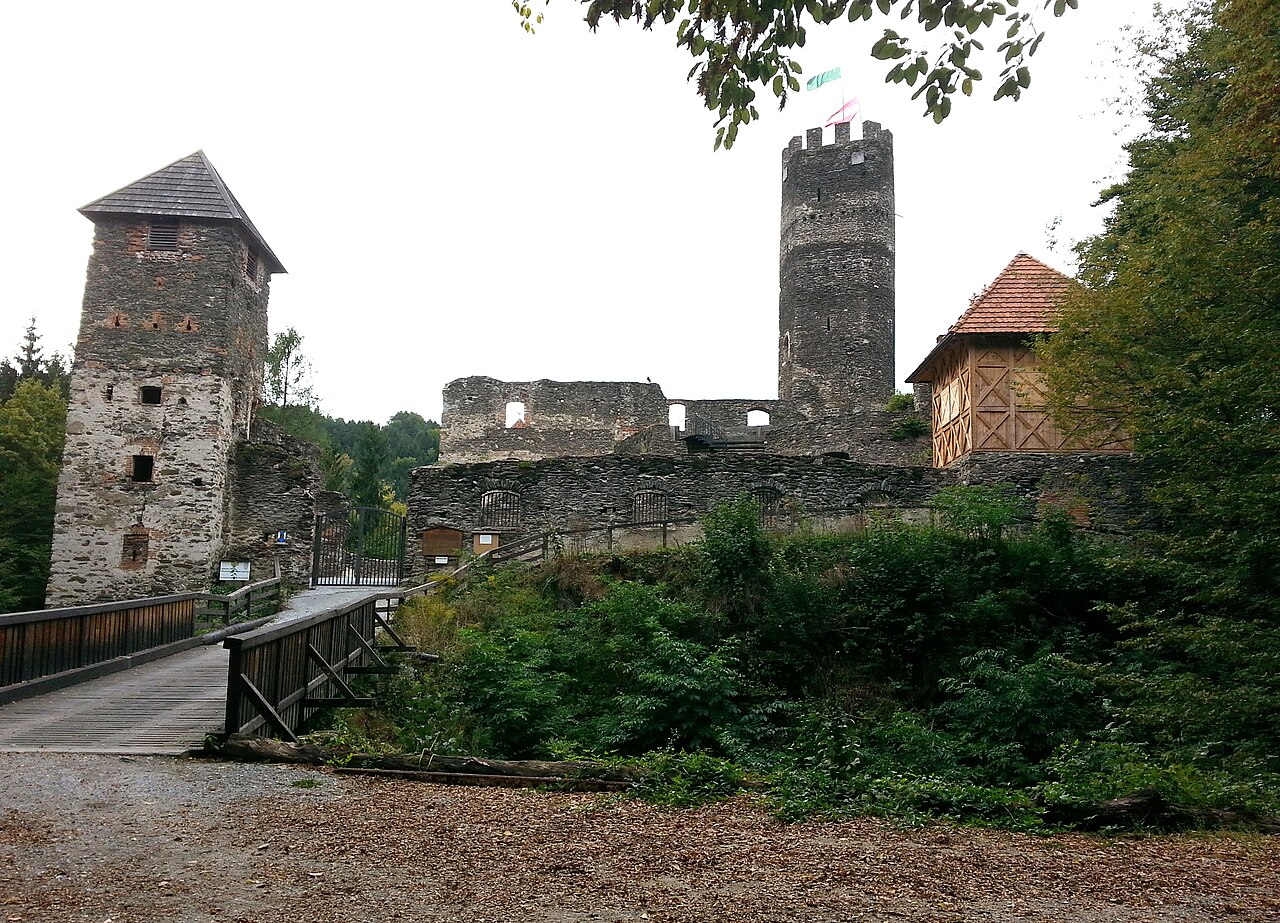
Burg Obervoitsberg
Burg Obervoitsberg stands as a significant medieval hill castle ruin located north of the town of Voitsberg in Austria. Constructed initially in 1164 under the commission of the Styrian ruler Ottokar IV, this fortress was built on lands belonging to the nearby St. Lambrecht Abbey, sparking a decade-long dispute resolved by land compensation. The castle's earliest recorded mention dates to 1183 under the names "Vogtesperch" and "castrum Voitseperch," reflecting its original function as the seat of a vogt, or bailiff, serving the abbey's interests.
Strategically positioned to control the important road linking Graz with Judenburg, Burg Obervoitsberg served not only as a military stronghold but also evolved into a local administrative center during the 12th and 13th centuries. It functioned as the seat of a regional court and oversaw an administrative district known as an Amt, managing approximately 200 taxable farms in the surrounding villages. This administrative role underscores the castle's importance in the governance and regional control exercised by the Styrian land princes.
Historical ownership and military significance
Throughout its history, Burg Obervoitsberg passed through the hands of several prominent noble families, including the Babenbergs, Heunburgs, Hanau family, Laun von Haunstein, and Greißenegg. Between 1260 and 1278, the castle was occupied by Bohemian mercenaries, reflecting the turbulent political climate of the region. During the 14th to 17th centuries, the fortress was frequently pledged to various lords, indicating its continued strategic and economic importance.
The castle also played a role in regional conflicts, notably with a possible Hungarian attack in the 15th century. Although historical records do not confirm its capture during the 1480 incursion, Burg Obervoitsberg remained a contested stronghold. By the late 16th century, the castle had fallen into disrepair but was significantly rebuilt and expanded under the ownership of Christoph and Franz von Racknitz. Subsequent owners included Balthasar Leymann von Liebenau, Balthasar von Thannhausen, and the Wagensberg family, who maintained possession into the 19th century.
Architectural features and layout
Perched on a prominent hilltop ridge, Burg Obervoitsberg originally formed part of Voitsberg's defensive system, complemented by a fortified settlement below. The castle's main enclosure follows a clear rectangular plan but notably lacks a traditional bergfried or keep, which was common in medieval castles. Instead, a fortified residential building occupies the southern side of the courtyard, combining living quarters with defensive functions.
On the northern side, a tower integrated into the curtain wall is suggested by two wall segments extending partially into the courtyard, enhancing the fortress's protection. Narrow buildings once lined the eastern and western sides, identified today by beam holes indicating where wooden structures were attached. The eastern side housed the palas, the main residential building, remodeled in the second half of the 16th century.
The northeastern corner features a residential tower-like structure considered the oldest part of the castle, dating from the late 12th or 13th century. This section contains distinctive architectural elements such as four slanting, flat-arched windows arranged in a tripartite grouping and a corner window that once opened to a small wooden chamber, highlighting the castle's medieval origins.
Defensive structures and modifications
Originally, access to the castle was through a northern gate reached by a drawbridge spanning a now-lost moat. This entrance was sealed in the 15th century, replaced by a new western gate opened in more modern times. The castle's defenses extended beyond the main walls with a ring wall descending the hillside towards the town, once connected directly to the town's fortifications. This outer wall was reinforced with towers and battlements, providing enhanced protection on the vulnerable slopes.
In the southern area, a zwinger—a narrow outer courtyard designed to trap attackers—and an accompanying round tower were likely constructed in the late 15th or early 16th century. These defensive works feature irregular rubble masonry, contrasting with the older sections. Approximately 150 meters northeast of the main castle, remains of a cannon rondel, a circular artillery platform from the late 15th century, are visible only as foundation fragments today.
Construction materials and water supply
The masonry throughout the castle varies by period. The northeast walls are constructed from large rubble stones typical of the late 13th century, while the southern and curtain walls exhibit lower courses of irregular rubble masonry from the 14th century, with finer stonework higher up. Within the courtyard, a cistern collected and stored water, supplied by a conduit channeling water from the nearby Tregistberg hill, ensuring a reliable source during sieges or droughts.
Religious and cultural aspects
A castle chapel dedicated to the Virgin Mary was part of the complex, underscoring the integration of religious observance within the castle's secular and administrative functions. This chapel would have served the spiritual needs of the castle's inhabitants and visitors.
Decline, restoration, and modern use
By the late 18th century, Burg Obervoitsberg had ceased to function as a residence and was limited to judicial purposes. Its decline culminated in 1798 when a lightning strike caused a fire, leading to abandonment. Around 1802, parts of the castle were deliberately dismantled to prevent its use by robbers.
In the late 19th century, restoration efforts were undertaken by the Graz-Köflacher Eisenbahn- und Bergbaugesellschaft, a railway and mining company. In 1910, the restored site was gifted to the town of Voitsberg. Since 1960, the castle ruins have been adapted as a venue for the Burghofspiele Voitsberg, an open-air theater festival. This cultural adaptation led to modifications such as protective roofing and landscaping, including the development of parkland with vineyards around the site.
Conservation efforts since 2003 have focused on protecting the ruins with roofing expanded in 2011 and landscaping the surrounding slopes to preserve the historical ambiance while accommodating its role as a cultural venue.
Frequently asked questions (FAQ)
- How do I visit Burg Obervoitsberg and what are the opening hours?
- Burg Obervoitsberg is accessible to the public year-round as an open-air ruin. Visiting hours may vary, especially during events like the Burghofspiele theater festival, so it is recommended to check the local tourism website or town office for current opening times and event schedules.
- What is the historical significance of Burg Obervoitsberg?
- Burg Obervoitsberg was a strategic hill castle built in 1164 to control a key regional road and served as an administrative center for the Styrian land princes. Its history includes noble ownership, military conflicts, and judicial functions, reflecting its importance in regional governance and defense.
- Can I attend events at Burg Obervoitsberg?
- Yes, since 1960, the castle ruins have hosted the Burghofspiele Voitsberg, an open-air theater festival. Visitors can enjoy cultural performances set against the historic backdrop of the castle, making it a unique venue for arts and heritage.
- What architectural features make Burg Obervoitsberg unique?
- Unlike many medieval castles, Burg Obervoitsberg lacks a traditional bergfried but features a fortified residential building, a residential tower from the 12th century, a zwinger with a round tower, and a cannon rondel foundation. These elements illustrate its mixed defensive and residential functions evolving over centuries.
- Is Burg Obervoitsberg suitable for families and accessible visitors?
- The castle ruins are located on a hilltop with uneven terrain and some steep paths, which may present challenges for visitors with mobility issues. Families can enjoy the site, especially during festival events, but should prepare for outdoor conditions and limited accessibility in some areas.
Information
Sources & official resources
Verify the information above using these authoritative references.
Loading map...
Visitor reviews
No reviews yet. Been here? Write the first review and help other travelers!
Write the first reviewVisited this castle? Share your experience
Your review helps other travelers and adds first-hand knowledge to our encyclopedia.