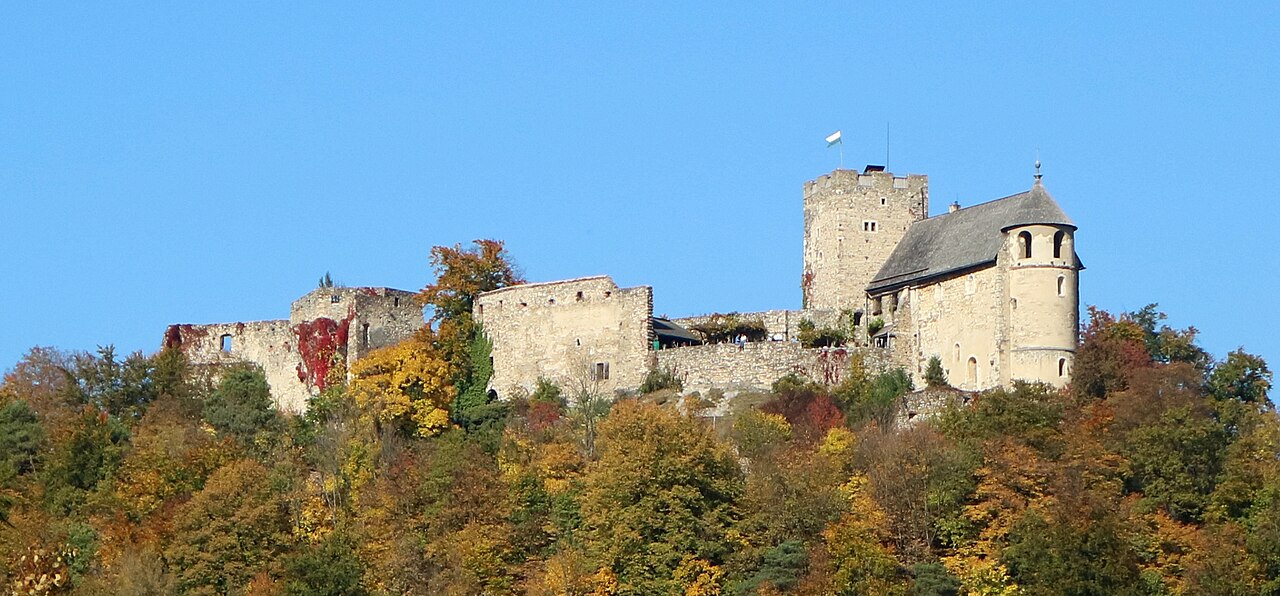
Burg Unterthal
Burg Unterthal stands as a notable example of a medieval hill castle located in the municipality of Thal, Austria. Constructed in the 13th century by the Lords of Thal, a junior branch of the influential Lords of Graben family, the castle's origins are deeply rooted in the feudal history of the region. Early historical mentions from 1259 cite Walter and Konrad I. von Graben, linking the site to the noble lineage that shaped much of the area's medieval politics and defense.
The castle's strategic hilltop position provided a commanding view of the surrounding landscape, a typical feature of hill castles designed for defense and territorial control. Its initial purpose was primarily military, serving as a fortified residence and stronghold for the Lords of Thal. In 1292, Burg Unterthal was destroyed during a noble uprising against Duke Albert I, reflecting the turbulent power struggles of the late medieval period. The castle was rebuilt in the 14th century after it came under the ownership of the Windisch-Graetz family, who were prominent in the region.
Architectural evolution and structural features
The original tower house and fortifications
The core of Burg Unterthal is centered around a large rectangular tower house, likely constructed in the early 14th century. This three-story tower was built with thick rubble masonry walls, reinforced by cornerstones, with wall thickness reaching up to 1.5 meters. These robust walls highlight the castle's defensive intent. The tower's cellar and ground floor feature stone barrel vaults, with the cellar vault remaining largely intact, showcasing medieval masonry techniques. The original entrance was positioned on the east side at the first-floor level, a common defensive design to limit access.
Defensive walls and additional structures
Encircling the tower on the northern side is a ring wall that adapts to the uneven terrain, equipped with keyhole-shaped embrasures dating from around 1500. These narrow vertical openings allowed defenders to use archery or early firearms while remaining protected. Traces of a defensive walkway along the wall suggest active patrols by guards. Within this enclosure, ruins of various auxiliary buildings indicate the complex's functional diversity, including storage, living quarters, and service areas.
Further south of the main tower, remnants of an additional ring wall with round and semicircular towers provide evidence of later fortification phases, enhancing the castle's defensive depth. A nearly vanished gate on the northeastern edge once controlled access to the southeast section, underscoring the layered complexity of the castle's layout.
Transformation through the centuries
From fortress to residential palace
During the 15th and 16th centuries, Burg Unterthal underwent significant expansions and modifications, transitioning from a purely military fortress into a more comfortable residential palace. This evolution reflects broader trends in castle architecture during the late medieval and early modern periods, where fortifications were adapted to serve noble lifestyles alongside defense. Ownership changes during this time, including the transfer to Georg von Khevenhüller and subsequently Archduke Karl III, indicate the castle's integration into the wider political and aristocratic networks of Austria.
17th-century military upgrades
The advent of gunpowder warfare necessitated further adaptations. In the 17th century, Burg Unterthal was modernized with the addition of a bastion on the northern and western sides, designed to accommodate artillery and improve defensive coverage. The bastion features a distinctive sloped plinth base and a carved stone molding separating the plinth from the wall above, indicative of contemporary military architectural styles. Dedicated shooting chambers and artillery positions were integrated, reflecting the castle's continued strategic importance.
Ownership by Hans Ulrich von Eggenberg from 1623 brought the castle into the Eggenberg family's territorial holdings. Despite its military enhancements, Burg Unterthal gradually declined in prominence. A fire in 1715 inflicted severe damage, particularly to the habitable sections, accelerating its descent into ruin. The counts of Herberstein acquired the property in 1774 but did not pursue restoration, leading to further deterioration.
Preservation and current state
Today, Burg Unterthal exists as a castle ruin with significant remains that illustrate its historical phases. The large rectangular tower house, with its thick walls and vaulted interiors, remains a central feature. The surrounding ring walls, bastions, and towers provide insight into the castle's defensive evolution from medieval to early modern periods.
Conservation efforts have focused primarily on the southern and southwestern areas, where restoration has altered some original stonework. Notably, a round tower dating from the 17th century was refurbished in 1996 and adapted for use as a summer residence, blending historical preservation with contemporary use.
Burg Unterthal's layered architectural elements—from its medieval origins through Renaissance expansions to Baroque military upgrades—offer a tangible record of changing defensive strategies and noble habitation in Austria. Its position on a hilltop continues to dominate the local landscape, marking it as a significant cultural and historical landmark within the region.
Frequently asked questions (FAQ)
- How do I get to Burg Unterthal?
- Burg Unterthal is located in the municipality of Thal in Styria, Austria. Visitors can reach the site by car or local transport, followed by a short walk uphill to the castle ruins.
- What is the best time to visit Burg Unterthal?
- The best time to visit Burg Unterthal is during the warmer months from late spring to early autumn when the weather is suitable for exploring the hilltop ruins and surrounding landscape.
- Is Burg Unterthal accessible to visitors?
- Yes, Burg Unterthal is accessible to visitors, though the terrain is uneven and may require moderate physical effort. Some areas of the ruins are partially restored, so caution is advised when exploring.
- Are there guided tours available at Burg Unterthal?
- Currently, there are no regular guided tours at Burg Unterthal. Visitors can explore the ruins independently, and local tourist offices may provide additional historical information.
- What architectural styles are represented at Burg Unterthal?
- Burg Unterthal features a mix of architectural styles, including medieval fortress elements, Renaissance residential expansions, and 17th-century military bastion fortifications.
Information
Sources & official resources
Verify the information above using these authoritative references.
Loading map...
Visitor reviews
No reviews yet. Been here? Write the first review and help other travelers!
Write the first reviewVisited this castle? Share your experience
Your review helps other travelers and adds first-hand knowledge to our encyclopedia.