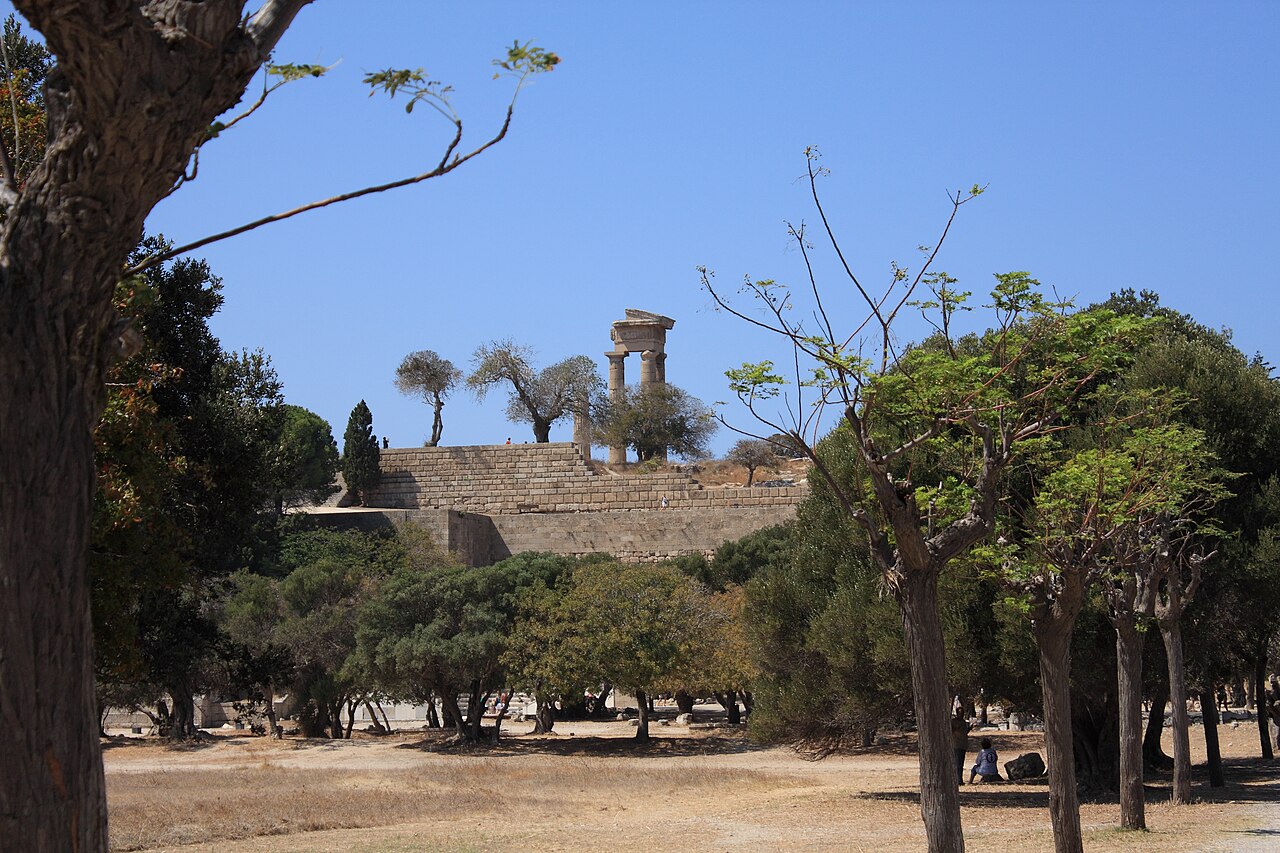
Kremasti Castle, located in the village of Kremasti on the island of Rhodes, Greece, is a modest but historically significant hill castle dating back to the 14th century. Although its remains are now largely hidden among modern buildings, the castle once played a crucial role in the defense and administration of the western coast of Rhodes. The castle's strategic position allowed it to maintain visual contact with the nearby Phileremos Castle, another important fortification on the island.
Architectural features and layout
Kremasti Castle is characterized by its compact size and simple design, covering approximately 400 square metres with a perimeter of around 80 metres. The structure resembles more a tower house than a sprawling fortress, with a square plan that emphasizes verticality and defense. The castle had a single entrance located on the northern side, which would have been easily defensible. Its walls, though now in ruins, would have formed a sturdy enclosure suitable for controlling the surrounding area.
Defensive purpose and strategic location
Built primarily for military and administrative purposes, the castle's main function was to oversee and control the western coastline of Rhodes. Its position on a hill provided a vantage point for monitoring maritime and land approaches. The castle's line of sight to Phileremos Castle facilitated communication and coordinated defense efforts between these two strongholds, which were part of the network of fortifications established by the Knights Hospitaller.
Historical significance and ownership
Historical records indicate that Kremasti Castle was in use at least since the 14th century. A document from 1479 mentions that the inhabitants of the villages of Trianda and Kremasti were instructed to seek refuge within their respective castles during times of danger. This highlights the castle's role as a local refuge and defensive structure for the surrounding population.
In the 15th century, the castle gained prominence as a summer residence for the Grand Masters of the Knights Hospitaller. This period saw the castle not only as a military installation but also as a place of retreat and governance. Renovations and repairs were carried out between 1510 and 1520, reflecting its continued strategic and residential importance during that era.
In 1914, the Italian medievalist G. Gerola conducted research at the site and discovered the coat of arms of Grand Master Fabrizio del Carretto (who served from 1513 to 1521) among the ruins. This find confirmed the castle's connection to the leadership of the Knights Hospitaller and added valuable insight into its historical timeline.
Current condition and accessibility
Today, Kremasti Castle exists as ruins that are partially obscured by the modern development of the village. The castle walls are faintly visible and can be easily overlooked by visitors. Despite its modest remains, the site holds cultural and historical value as a testament to the medieval fortifications of Rhodes and the legacy of the Knights Hospitaller on the island.
Visitors interested in medieval architecture and the history of the Knights Hospitaller will find Kremasti Castle a noteworthy, though subtle, landmark. Its small scale and ruined state offer a glimpse into the defensive strategies and residential preferences of the era.
Relationship to other fortifications on Rhodes
Kremasti Castle was part of a broader network of fortifications established by the Knights Hospitaller to secure Rhodes against various threats, including Ottoman invasions and piracy. Its proximity and line of sight to Phileremos Castle allowed for effective communication and mutual support between these fortresses.
This interconnected system of castles and towers was essential for maintaining control over the island and protecting its inhabitants. Kremasti Castle's role as both a military outpost and a summer residence underscores the multifunctional nature of such fortifications within the Hospitaller domain.
Frequently asked questions (FAQ)
- When was Kremasti Castle built?
- Kremasti Castle was built in the 14th century and served as a defensive and administrative fortification on Rhodes.
- What was the primary function of Kremasti Castle?
- The castle was primarily a control point overseeing the western coast of Rhodes and served as a summer residence for the Grand Masters of the Knights Hospitaller.
- Can visitors see the castle ruins today?
- Yes, visitors can see the ruins of Kremasti Castle, although they are partially obscured by modern buildings and can be easy to miss.
- Who discovered the coat of arms at Kremasti Castle?
- Italian medievalist G. Gerola discovered the coat of arms of Grand Master Fabrizio del Carretto among the ruins in 1914.
- How does Kremasti Castle relate to Phileremos Castle?
- Kremasti Castle was strategically positioned to maintain line of sight with Phileremos Castle, allowing for communication and coordinated defense.
Information
Loading map...
Visitor reviews
No reviews yet. Been here? Write the first review and help other travelers!
Write the first reviewVisited this castle? Share your experience
Your review helps other travelers and adds first-hand knowledge to our encyclopedia.