Acropolis of Rhodes
The Acropolis of Rhodes is a significant ancient site located on Monte Smith, a hill overlooking the west coast of Rhodes island, approximately 3 kilometers southwest of the modern city center. This hill castle is not a fortress in the traditional sense but an elevated sacred precinct and civic center dating back to the 5th century BC, during the Classical period of ancient Greece. Unlike typical acropoleis that often feature fortified walls and defensive structures, the Acropolis of Rhodes was primarily a religious and cultural complex without a walled citadel, emphasizing its role as a sanctuary and public gathering place rather than a military stronghold.
Historical significance and location
The Acropolis served as the upper town of ancient Rhodes, a city-state that flourished as a maritime power in the Aegean Sea. Its elevated position on Monte Smith provided commanding views of the surrounding landscape and sea routes, underscoring its importance as both a religious center and a symbol of civic pride. The site was developed during the Classical era, a period marked by the rise of democracy, art, and architecture in Greece, and it continued to be a focal point through the Hellenistic and Roman periods.
Architectural features and monuments
Temples
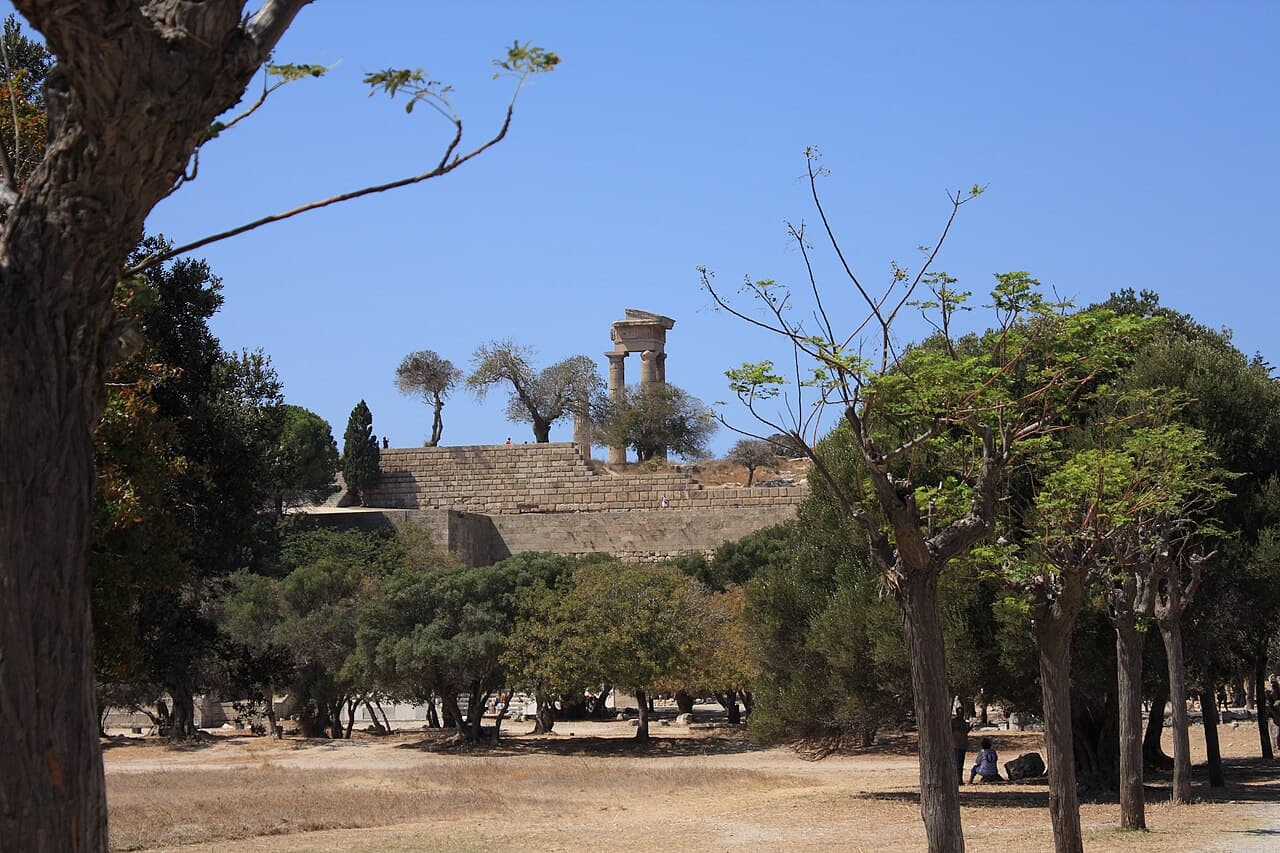
The Acropolis contains several major temples dedicated to important deities. The most prominent are the Temple of Athena Polias and Zeus Polieus, which reflects the dual worship of Athena, goddess of wisdom and warfare, and Zeus as protector of the city. Another key temple is the Temple of Apollo, situated on a lower terrace, which was central to religious festivals and oracular activities.
Public buildings and recreational structures
Beneath the temples lies a complex of public buildings including a stadium used for athletic competitions, an odeon which served as a covered theater for musical performances and assemblies, and a gymnasium that functioned as a training ground for athletes and a social hub for citizens. These structures highlight the Acropolis’s role as a multifaceted center for religion, culture, sport, and education.
Architectural style and construction
The buildings on the Acropolis of Rhodes exhibit characteristics of Classical Greek architecture, including the use of Doric and Ionic columns, proportional design, and emphasis on harmony and balance. The temples were constructed with local stone and marble, featuring sculptural decorations and reliefs that celebrated mythological themes and civic ideals. The layout of the site reflects careful urban planning to integrate religious, cultural, and athletic functions within a cohesive sacred precinct.
Later history and preservation
Over the centuries, the Acropolis underwent changes during the Hellenistic and Roman periods, including additions and renovations to its buildings. Despite damage from natural disasters and human activity, many ruins remain well-preserved, allowing for ongoing archaeological study. The site does not have defensive walls, which is unusual for an acropolis, but this absence emphasizes its role as a peaceful sanctuary rather than a military fortress.
Visiting the Acropolis of Rhodes
Today, the Acropolis of Rhodes is an important archaeological site open to visitors interested in ancient Greek history and architecture. Its location on Monte Smith offers panoramic views of the city of Rhodes and the surrounding sea, making it a popular destination for tourists and scholars alike. The site provides insight into the religious practices, civic life, and architectural achievements of ancient Rhodes.
Frequently asked questions
- What is the Acropolis of Rhodes? It is the ancient upper town of Rhodes featuring temples, a stadium, an odeon, and a gymnasium from the 5th century BC.
- When was the Acropolis of Rhodes built? Construction began in the 5th century BC during the Classical period of ancient Greece.
- Can I visit the Acropolis of Rhodes today? Yes, it is open to the public as an archaeological site with accessible ruins and scenic views.
- Why does the Acropolis of Rhodes lack defensive walls? Unlike typical acropoleis, it was designed as a religious and cultural center rather than a military fortress.
- What architectural styles are present at the site? The site features Classical Greek architectural styles, including Doric and Ionic elements.
- What notable structures are found on the Acropolis? Key monuments include the Temples of Athena Polias and Zeus Polieus, the Temple of Apollo, a stadium, an odeon, and a gymnasium.
- Is the Acropolis of Rhodes located within the modern city? It is located about 3 kilometers southwest of the modern city center on Monte Smith hill.
Frequently asked questions (FAQ)
- What is the Acropolis of Rhodes?
- It is the ancient upper town of Rhodes featuring temples, a stadium, an odeon, and a gymnasium from the 5th century BC.
- When was the Acropolis of Rhodes built?
- Construction began in the 5th century BC during the Classical period of ancient Greece.
- Can I visit the Acropolis of Rhodes today?
- Yes, it is open to the public as an archaeological site with accessible ruins and scenic views.
- Why does the Acropolis of Rhodes lack defensive walls?
- Unlike typical acropoleis, it was designed as a religious and cultural center rather than a military fortress.
- What architectural styles are present at the site?
- The site features Classical Greek architectural styles, including Doric and Ionic elements.
- What notable structures are found on the Acropolis?
- Key monuments include the Temples of Athena Polias and Zeus Polieus, the Temple of Apollo, a stadium, an odeon, and a gymnasium.
- Is the Acropolis of Rhodes located within the modern city?
- It is located about 3 kilometers southwest of the modern city center on Monte Smith hill.
Photo gallery

Information
Loading map...
Visitor reviews
No reviews yet. Been here? Write the first review and help other travelers!
Write the first reviewVisited this castle? Share your experience
Your review helps other travelers and adds first-hand knowledge to our encyclopedia.