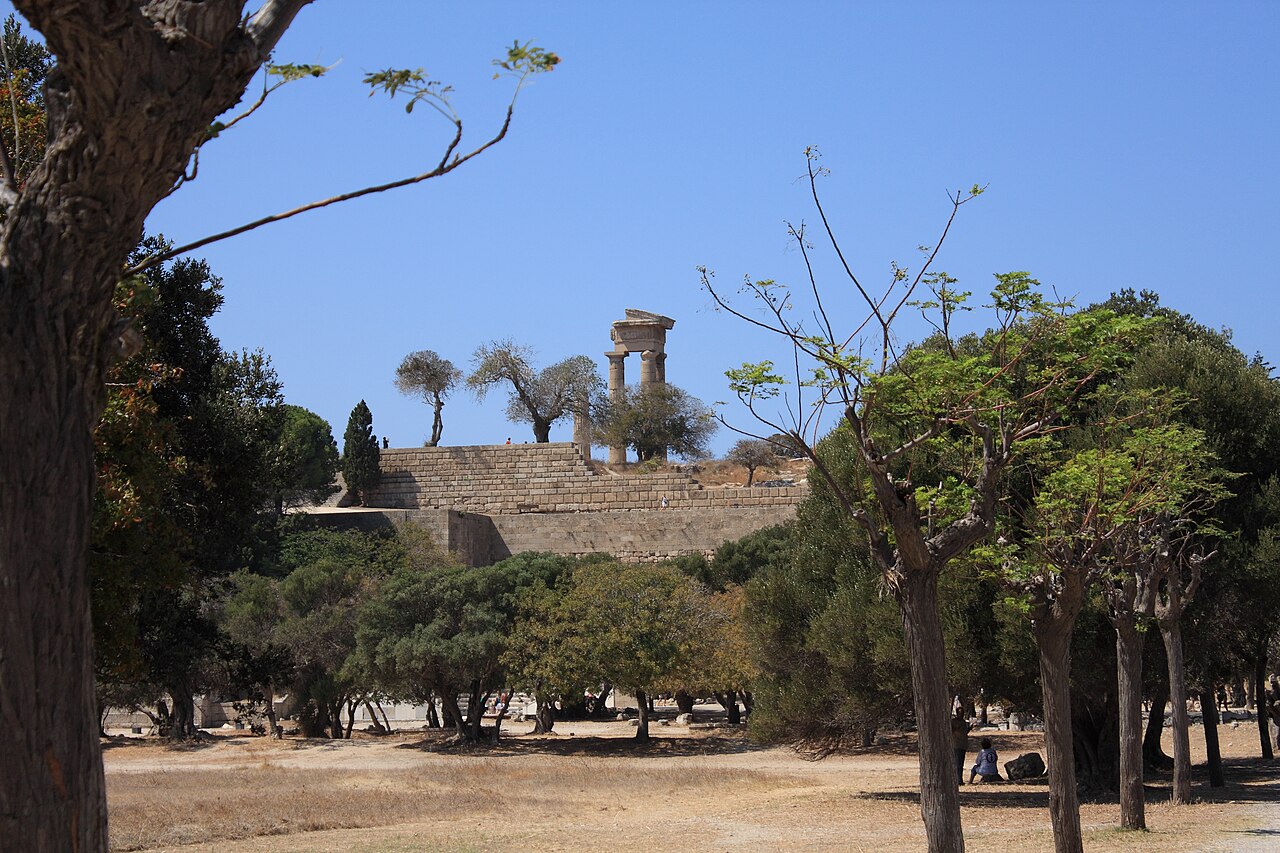
Filerimos
Filerimos Castle, located on the pine-forested hill of Filerimos on the island of Rhodes, Greece, stands as a significant historic site with layers of occupation spanning from the ancient to the medieval periods. This hill, one of the oldest archaeological sites on Rhodes, was originally home to the ancient city of Jalisos, one of the island's three wealthiest cities in antiquity. The strategic location of the hill overlooking the coastline and inland routes made it a coveted site for successive civilizations.
Ancient origins and early constructions
The earliest known settlers to exploit the hill's natural advantages were the Minoans, who arrived on Rhodes around 1550 BCE. They established an Achaean acropolis at the summit, marking the beginning of the site's long history of fortification and religious significance. During the Hellenistic period, the hill saw the construction of important temples dedicated to Athena Pallas and Zeus Polieus, underscoring its cultural and religious importance.
At the transition from the 5th to 6th century CE, the ancient temples were replaced by an early Christian basilica, reflecting the spread of Christianity and the changing religious landscape of the region.
Byzantine fortress and medieval transformations
In the 11th century, the Byzantines recognized the defensive potential of Filerimos hill and constructed a fortress at its eastern end. This fortress incorporated building materials salvaged from the ruins of earlier ancient structures, demonstrating continuity and adaptation in the use of the site. The Byzantine castle served as a strategic military post, enabling control over a substantial portion of the surrounding coastline and inland routes.
In 1248, during a siege by Genoese forces, the fortress was defended by John Kantakouzenos. The castle's position was crucial for regional control, which later attracted the attention of the Knights Hospitaller (the Order of St. John) who arrived on Rhodes in 1306 with the aim of conquering the island. The knights captured the fortress on 11 November 1306 through the betrayal of the Greek garrison commander. The Turkish mercenaries hired by the Byzantine emperor to defend the castle were massacred, allowing the knights to use Filerimos as a base for their assault on the city of Rhodes.
Knights Hospitaller enhancements
Following their conquest of Rhodes, the Knights Hospitaller undertook significant expansions and fortifications of Filerimos Castle. The fortress was redesigned with an irregular quadrilateral plan covering approximately 2000 square meters. The perimeter walls extended to about 700 meters, featuring multiple towers at strategic points. Notably, the northwest and southeast corners housed polygonal towers of Byzantine origin, while the northeast corner contained a square tower. The main entrance was located on the western side.
Amid rising threats from the Ottoman Empire, the castle's defenses were further reinforced in 1480 under the orders of Grand Master Pierre d’Aubusson. A new northern wall was constructed, equipped with round towers on the eastern and western flanks, enhancing the fortress's ability to withstand artillery and siege warfare.
Ottoman conquest and decline
In 1522, the island of Rhodes fell to the forces of the Ottoman Empire led by Sultan Suleiman the Magnificent. Filerimos Castle became the headquarters of the Ottoman military command during the island's conquest. However, under Ottoman rule, the fortress gradually lost its strategic importance and fell into disrepair, reflecting the changing military and political landscape of the region.
Modern conservation and archaeological significance
During the Italian occupation of Rhodes (1912–1943), the first conservation efforts were undertaken to preserve the ruins of Filerimos Castle. These efforts were continued after World War II by the British administration and later by the Greek authorities. Today, the remains primarily reflect the extensive modifications made by the Knights Hospitaller, although Byzantine construction phases are still evident.
The hill of Filerimos is also notable for several religious and archaeological sites, including the ruins of the ancient Temple of Athena, a subterranean Byzantine chapel dedicated to Saint George Chosty, the remains of the early Christian basilica, the Knights Hospitaller church with its bell tower, and a monastery rebuilt by the Italians. The site offers panoramic views over the coastline and the tourist area of Jalisos, making it a popular destination for visitors interested in history, archaeology, and architecture.
Architectural features and layout
The castle's irregular quadrilateral layout, extensive curtain walls, and multiple defensive towers exemplify medieval military architecture adapted to the terrain. The combination of Byzantine and Knights Hospitaller construction techniques is visible in the masonry and design of the towers and walls. The addition of round towers in the late 15th century reflects the evolving needs of fortification against gunpowder artillery.
Religious and cultural heritage
Filerimos Castle's location atop a hill that has served as a religious center since antiquity highlights its dual military and spiritual significance. The site's layered history from ancient temples to Christian basilicas and knightly churches illustrates the cultural transformations of Rhodes over millennia.
Frequently asked questions (FAQ)
- How do I get to Filerimos Castle on Rhodes?
- Filerimos Castle is located on a hill near the village of Filerimos on Rhodes island. Visitors can reach it by car or local bus from Rhodes town or nearby resorts. The site is accessible via a short uphill walk through pine forests.
- What is the historical significance of Filerimos Castle?
- Filerimos Castle has a rich history dating back to ancient times, serving as a religious center and a strategic fortress for the Byzantines, Knights Hospitaller, and Ottomans. It played a key role in the medieval defense of Rhodes.
- Can I visit the ruins of Filerimos Castle year-round?
- Yes, the ruins of Filerimos Castle are open to visitors year-round. The best time to visit is during the spring and autumn months when the weather is mild. There are no strict opening hours, but daylight visits are recommended for safety and visibility.
- Are there guided tours available at Filerimos Castle?
- Guided tours are sometimes available through local tourist agencies or the Rhodes archaeological services. These tours provide in-depth historical and architectural insights into the castle and surrounding archaeological sites.
- Is Filerimos Castle suitable for children and families?
- The site is generally suitable for families, though some areas involve uneven terrain and stairs. Children should be supervised, especially near ruins and elevated sections. The surrounding pine forest and open spaces offer a pleasant environment for family visits.
Information
Loading map...
Visitor reviews
No reviews yet. Been here? Write the first review and help other travelers!
Write the first reviewVisited this castle? Share your experience
Your review helps other travelers and adds first-hand knowledge to our encyclopedia.