Kostomlaty Castle
Kostomlaty Castle stands as a significant medieval fortress located in the municipality of Kostomlaty pod Milešovkou in the Czech Republic. Established in the early 14th century by the noble lords of Rýzmburk, also known as the lords of Osek, who descended from the Hrabišici family, the castle exemplifies the strategic and architectural developments of its time. Its history is deeply intertwined with the political and military upheavals of medieval Bohemia, reflecting the turbulent era of the Hussite Wars and the shifting ownership among prominent noble families.
The earliest documented mention of Kostomlaty Castle dates to 1333, when Boreš of Osek sold the fortress to Chotěbor of Herštejn. Shortly thereafter, in 1335, the castle entered royal possession under Charles IV, then Moravian margrave and later King of Bohemia and Holy Roman Emperor. This transition marked Kostomlaty as part of the royal estates, subsequently managed as a fief. By 1370, records indicate the involvement of the influential Žerotín family, highlighting the castle's role in local ecclesiastical and administrative affairs.
Medieval history and ownership
Throughout the late 14th and early 15th centuries, Kostomlaty Castle experienced frequent changes in ownership. In 1388, it was acquired by Jindřich Škopek of Dubá, whose family played a pivotal role during the Hussite Wars. The castle's strategic hilltop location made it a key defensive site during this period of religious and political conflict. Albrecht Škopek, a successor, notably defended the castle against repeated Hussite attacks. However, in 1434, the fortress was captured by the Hussite leader Jakoubek of Vřesovice, who became its owner the following year. The Vřesovice branch of the Kostomlaty family maintained control until the early 17th century.
By the early 1600s, Kostomlaty Castle had fallen out of favor as a noble residence, deemed outdated compared to emerging architectural standards. Nobles relocated to more modern estates in the surrounding village, leading to the castle's abandonment by 1606. The outbreak of the Thirty Years’ War in 1618 resulted in the confiscation of the estate, which was then granted to the Černín family, who retained ownership for centuries.
Architectural features and layout
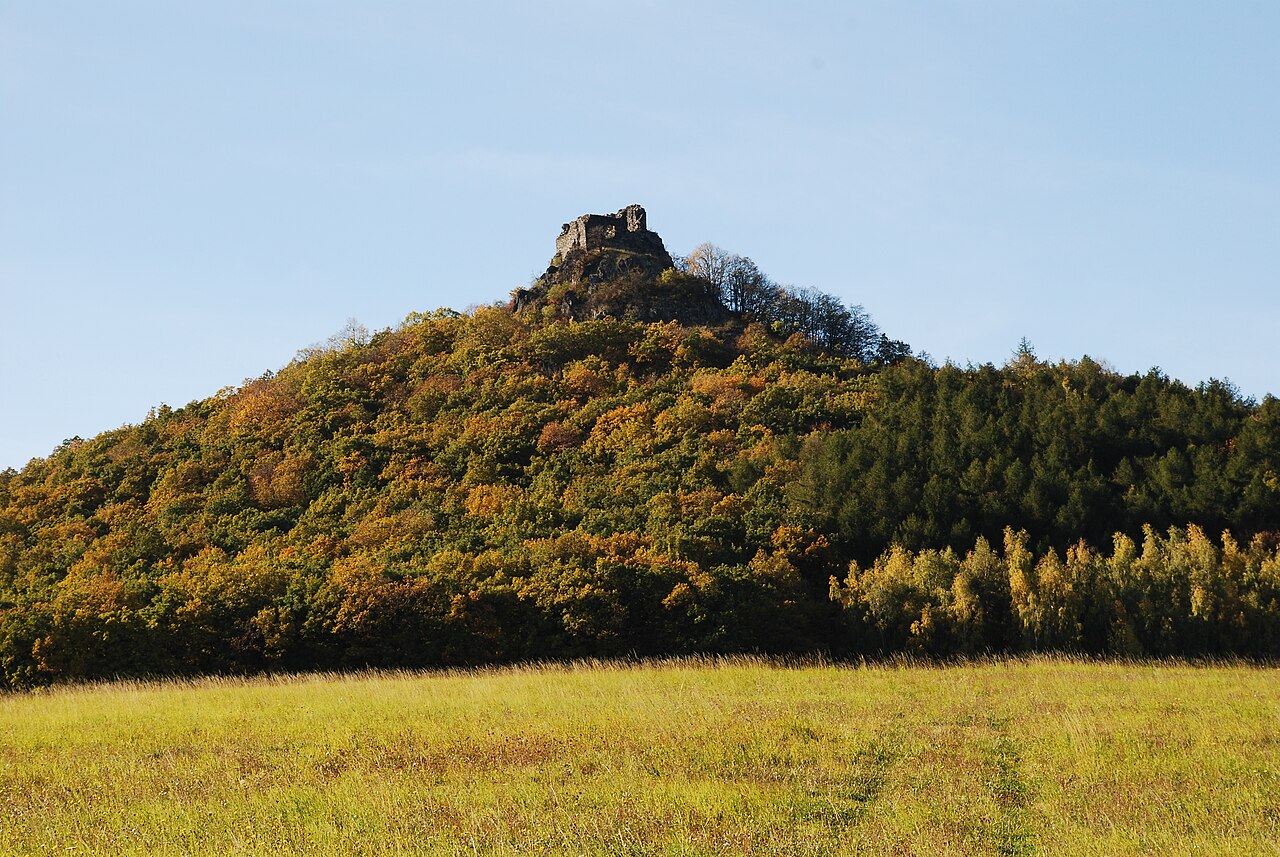
Kostomlaty Castle is a classic example of a bergfried-style hill castle, a common fortification type in medieval Central Europe. Its design comprises two main parts: the upper castle and the lower castle. The upper castle features the central defensive bergfried tower flanked by two palatial buildings arranged around an irregular trapezoidal courtyard. The lower castle served as a spacious outer bailey, containing various economic and service buildings essential for the castle's operation.
Defensive structures
Access to the lower castle was secured through a rectangular gatehouse, protected by a distinctive round tower notable for its square interior and a machicolation supported by robust stone corbels. This defensive feature allowed defenders to drop projectiles or boiling substances on attackers below. Remnants of the original approach road and a section of a barbican gate survive, illustrating the layered defenses employed.
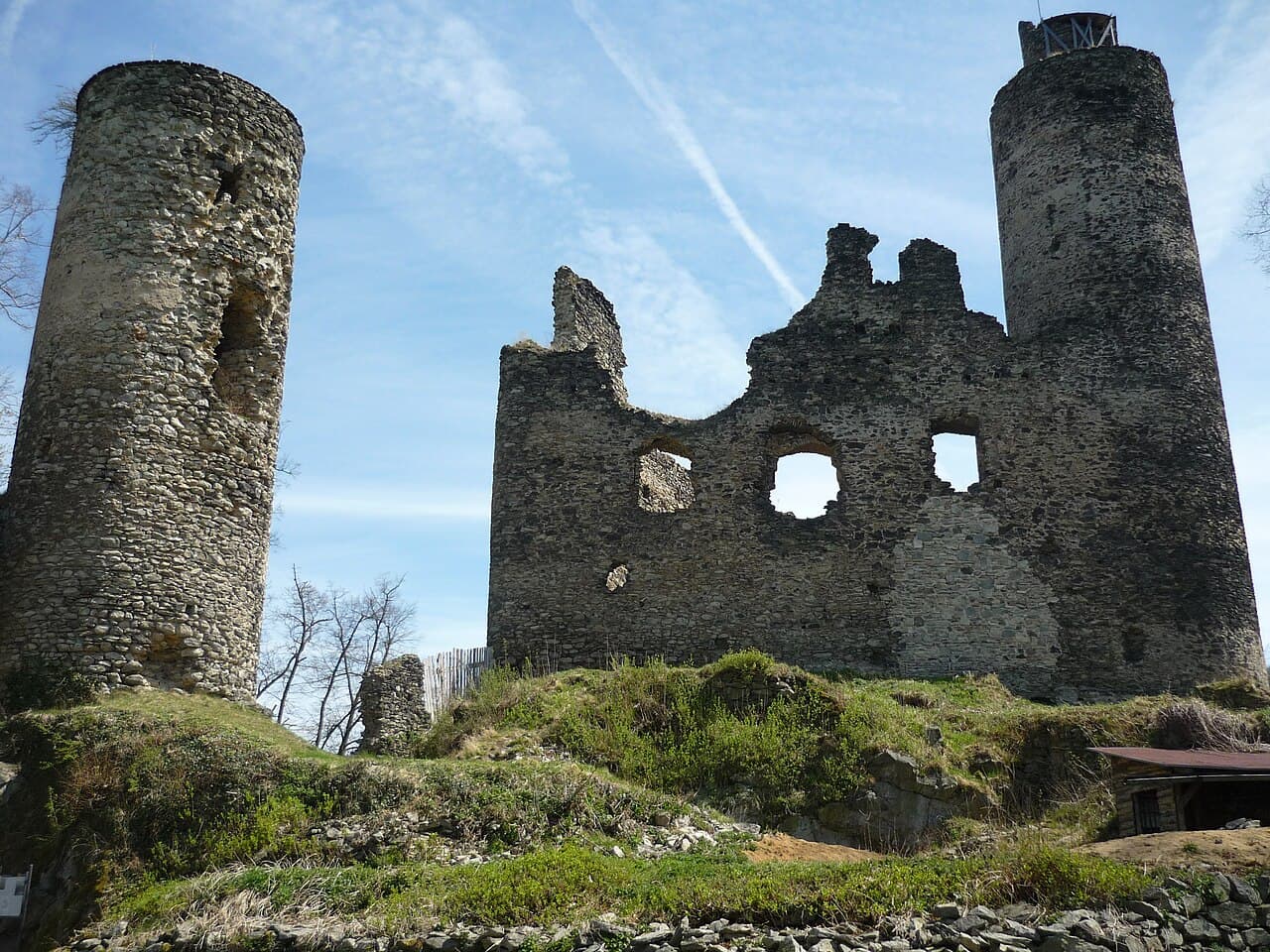
A transverse moat and a curtain wall separated the upper and lower castles, forming a formidable defensive barrier. A third gate faced the bergfried, providing controlled access to the inner sanctum. In the mid-15th century, the western palace was heightened by an additional storey, identifiable today by three large windows and a door connecting it directly to the bergfried's entrance. The bergfried itself is crowned by a slender upper structure encircled by a gallery, often described as resembling a "máselnice" or butter churn, a local architectural term. A wooden spiral staircase was added inside the tower during the 19th century, enhancing access to the upper levels.
Fortifications and outworks
The castle's defense was reinforced by two main rings of curtain walls. The outer wall, known as the parkán wall, enclosed the broader castle complex, while an inner curtain wall provided a secondary line of defense. Mid-15th-century enhancements included two square bastions on the southern parkán wall facing inward, and a two-room building adjoining the eastern section of the parkán, likely serving as additional defensive or service spaces.
Archaeological investigations have uncovered two fortified enclosures related to siege activities surrounding the main castle. The larger enclosure, approximately 370 meters southwest, is roughly oval-shaped and measures about 210 by 70 meters. It is surrounded by a substantial earthen rampart up to five meters high and fourteen meters thick, with a double ditch system protecting its southern boundary. A smaller enclosure lies about 175 meters west of the castle, its function less clear but considered part of the defensive complex.
Archaeological finds and cultural significance
Excavations in the siege enclosures have yielded a variety of metal artifacts, including arrowheads, axes, nails, chain links, padlocks, horseshoes, knives, crossbow bolts, and early gunpowder weapon projectiles. These finds provide tangible evidence of the military engagements and the evolution of medieval warfare at Kostomlaty.
In the 19th century, the lower castle's courtyard saw the construction of a recreational inn by Josef Fenzel in 1841, who also displayed archaeological finds on-site. Although this development disturbed potential archaeological layers, it contributed to the site's cultural heritage. The inn and an associated lookout tower were destroyed in the 1950s, but the site remains a focal point for historical interest.
Today, the castle exists mainly as ruins, with fragments of the bergfried, palaces, curtain walls, and gate structures still visible. The remains of the 19th-century inn and cellar also survive in the lower castle area. Located at an elevation of 566 meters above sea level, the castle offers panoramic views of nearby mountain ranges and settlements, enhancing its appeal as a historical and tourist site.
Local folklore adds a mystical dimension to Kostomlaty, with tales of a nearby spring reputed for its healing properties. The castle also featured as a filming location in 2007 for a movie inspired by the fairy tales of Jan Drda, linking the site to Czech cultural traditions and storytelling.
Conservation and modern use
Interest in preserving Kostomlaty Castle revived towards the end of the 20th century. Since 1998, a civic organization has led conservation efforts focused on stabilizing the remaining structures and preventing further decay. These initiatives culminated in the restoration and reopening of the main bergfried tower as a lookout point in 2014, allowing visitors to appreciate both the castle's architecture and its commanding views.
The castle's preservation highlights the importance of medieval hill castles in Czech heritage, offering insights into feudal life, military architecture, and regional history. Kostomlaty remains an evocative site where history, archaeology, and legend converge, attracting scholars, tourists, and cultural enthusiasts alike.
Frequently asked questions (FAQ)
- How do I get to Kostomlaty Castle?
- Kostomlaty Castle is located in Kostomlaty pod Milešovkou, Czechia, easily accessible by car or public transport. The nearest train station is in the town of Milešovka, from where you can take a bus or taxi to the castle. For those driving, there is parking available near the entrance.
- What is the historical significance of Kostomlaty Castle?
- Kostomlaty Castle dates back to the 14th century and has served various purposes throughout its history, including as a noble residence and a defensive structure. It showcases the architectural evolution from Gothic to Renaissance styles, reflecting the region's rich history. The castle is a testament to the cultural heritage of Czechia and has been preserved as a historical monument.
- When was Kostomlaty Castle built?
- Kostomlaty Castle was originally constructed in the 14th century, with significant renovations occurring in the 16th century. Over the years, it has undergone various modifications, which have contributed to its unique architectural style. The castle's enduring presence makes it a fascinating site for those interested in medieval history.
- Can I take guided tours of Kostomlaty Castle?
- Yes, guided tours are available at Kostomlaty Castle, providing visitors with in-depth information about its history and architecture. These tours are typically conducted by knowledgeable guides who can share fascinating stories and insights. It's recommended to check the castle's official website for tour schedules and availability.
- Why is Kostomlaty Castle a popular tourist destination?
- Kostomlaty Castle attracts visitors due to its stunning architecture, rich history, and beautiful surrounding landscape. Its picturesque setting in the Czech countryside offers a tranquil escape, along with opportunities for photography and exploration. Additionally, the castle often hosts cultural events and exhibitions, enhancing its appeal to tourists.
- Is it possible to visit Kostomlaty Castle year-round?
- Kostomlaty Castle is typically open to visitors from spring through autumn, with limited access during the winter months. Opening hours may vary, so it's best to check the official website for the most current information. Visiting during the warmer months allows you to enjoy the beautiful gardens and outdoor areas surrounding the castle.
- What are the ticket prices for visiting Kostomlaty Castle?
- Ticket prices for Kostomlaty Castle are generally affordable, with discounts available for students and seniors. Children under a certain age may enter for free, making it a family-friendly destination. For the latest ticket prices and any special offers, please refer to the castle's official website.
- What is the best time to visit Kostomlaty Castle?
- The best time to visit Kostomlaty Castle is during the spring and early autumn when the weather is mild, and the gardens are in full bloom. These seasons also coincide with various events and exhibitions held at the castle. Summer can be crowded, but it offers vibrant activities and tours for visitors.
- Are there any nearby attractions to explore while visiting Kostomlaty Castle?
- Yes, the area surrounding Kostomlaty Castle is rich in attractions, including scenic hiking trails and historical sites. The nearby town of Milešovka features lovely restaurants and shops, making it a great spot to relax after your visit. Additionally, the beautiful Milešovka Mountain offers stunning views and outdoor activities for nature enthusiasts.
Photo gallery

Information
Website
Visit websiteSources & official resources
Verify the information above using these authoritative references.
Loading map...
Visitor reviews
No reviews yet. Been here? Write the first review and help other travelers!
Write the first reviewVisited this castle? Share your experience
Your review helps other travelers and adds first-hand knowledge to our encyclopedia.