Kongsvinger Fortress
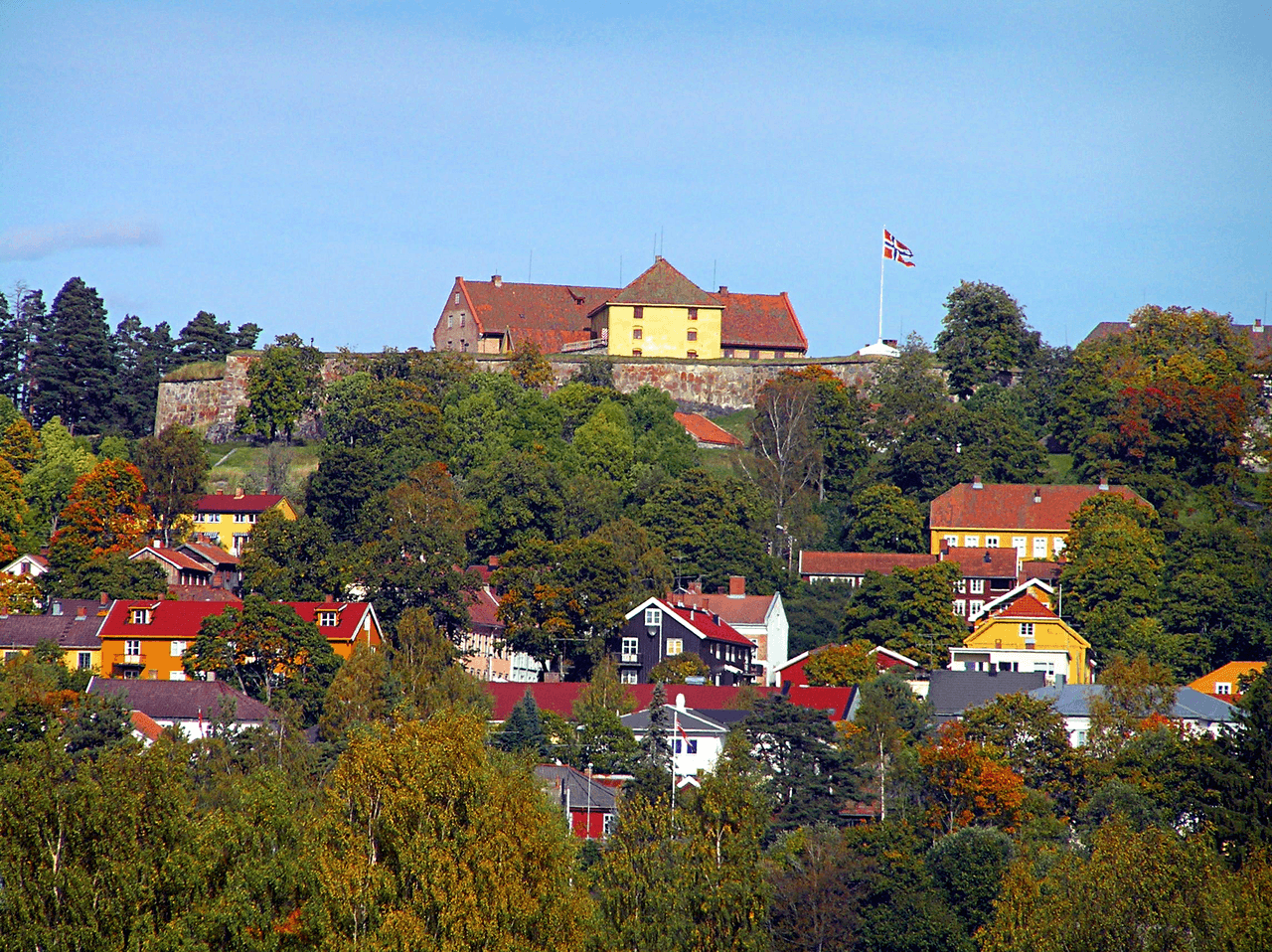
Kongsvinger Fortress stands as a prominent historical military structure in Kongsvinger, Innlandet, Norway. Perched on a strategic hill west of the Glomma River in the area known as Glommakneet near Tråstad, the fortress commands an extensive view of the surrounding landscape. Originally developed from the earlier Vingersundet fort dating back to 1658, Kongsvinger Fortress evolved into a key defensive installation along Norway's southeastern border. The fortress is often referred to as Tråstad Fort in historical documents, reflecting its location on Tråstadbjerget hill.
The origins of the fortress trace back to the mid-17th century, during a period of military tension between Denmark-Norway and Sweden. Early fortifications in the area included a sconce near the ferry crossing and possibly a smaller fortification where the later Vinger church was built. However, these were superseded by the more formidable fortress constructed on higher ground to better control the vital river crossing and surrounding territory.
Construction and architectural design
Construction of the new fortification began in 1673 under the supervision of Lieutenant Anthony Coucheron. The initial design featured a keep surrounded by a square curtain wall with batteries positioned at three corners, enabling effective artillery coverage. This early phase was overseen by Governor Ulrik Frederik Gyldenløve, after whom the fort was colloquially named Gyldenborg. The first garrison, commanded by Captain Ole Ellingsen, was stationed there in 1674.
Recognizing the need for stronger defenses against evolving siege artillery, plans were made in 1681 to transform the fortress into a more modern bastioned fortification. Initial proposals by Johan Caspar de Cicignon were deemed too costly, leading to a revised plan by Anthony Coucheron that was approved by King Christian V on October 8, 1681. The resulting fortress adopted an irregular star-shaped layout, a hallmark of Renaissance military architecture, designed to deflect and absorb artillery fire while maximizing defensive coverage.
By January 1683, the fortress was officially named Kongens Vinger, later shortened to Kongsvinger, meaning "King's Vinger." The fortress was largely completed by 1684, with ongoing construction continuing for several years. The visit of Christian V in 1685 underscored its strategic importance.
Fortress layout and features
The fortress complex includes several key architectural features typical of star forts, such as bastions projecting outward to cover adjacent walls, curtain walls, and a central keep. The irregular star shape allowed defenders to cover all approaches with overlapping fields of fire. The fortress was surrounded by a moat formed naturally and enhanced by the proximity of the Glomma River, which acted as a natural defensive barrier.
Within the fortress and its immediate surroundings, additional buildings were constructed over time, including barracks, storerooms, and command facilities. South of the fortress, a camp developed where soldiers, their families, and civilian suppliers lived, laying the foundation for the growth of the town of Kongsvinger. The urban area known as Øvrebyen features wooden buildings from the 18th and 19th centuries arranged in a grid pattern designed by Major General Johan Caspar von Cicignon, reflecting the military origins of the settlement.
Historical significance and military role
Kongsvinger Fortress played a significant role in the defense of Norway's border against Sweden during several conflicts from the 17th through the 19th centuries. Despite its strategic position and formidable design, the fortress was never directly besieged or captured in battle. Its powerful artillery coverage and the natural defense provided by the Glomma River deterred enemy crossings. Notably, during the Scanian War (1675-1679), the fortress fired upon Swedish reconnaissance units and served as a base for Norwegian incursions into Sweden, although these were limited by artillery capabilities.
During the Great Northern War (1700-1721), Kongsvinger was heavily manned in anticipation of Swedish attacks, but the fortress was bypassed in favor of other targets. The closest military engagements occurred in 1808 during the Napoleonic Wars, when Swedish forces advanced to the Glomma River near Kongsvinger but refrained from crossing to assault the fortress. An armistice signed at Kongsvinger in 1809 marked a pause in hostilities.
Following the dissolution of the union between Norway and Sweden in 1905, a demilitarized zone was established along the border, but Kongsvinger Fortress lay just outside this zone and was spared demolition. Although considered obsolete by the early 20th century, the fortress remained a symbol of Norway's military heritage.
20th-century history and world war ii
In the lead-up to and during World War II, Kongsvinger Fortress assumed new roles. In 1939, it served as an internment site for the German crew of the "Deutschland" and German pilots, marking one of the earliest presences of uniformed German officers in Norway during the war. The fortress surrendered to German forces without resistance in April 1940, contrasting with nearby fortifications that saw combat.
During the German occupation, the fortress housed both an SS school and a Gestapo training facility, embedding it deeply in the wartime history of Norway. The battles around the nearby Vardefort are noted among the most significant Norwegian engagements of 1940, with figures such as Max Manus participating in the defense efforts.
Cultural heritage and preservation
Today, Kongsvinger Fortress is owned and managed by the National Fortifications and is recognized as a well-preserved example of Renaissance star fort architecture in Norway. Its condition is well preserved, allowing visitors to explore the extensive ramparts, bastions, and internal structures. The fortress and the adjacent historic district of Øvrebyen offer insights into the military, urban, and social history of the region.
The fortress is accessible to the public, serving both as a cultural landmark and a venue for events that celebrate Norway's heritage. Its strategic location continues to offer commanding views of the Glomma River valley, emphasizing the enduring significance of its original defensive purpose.
Frequently asked questions (FAQ)
- What is the historical significance of Kongsvinger Fortress?
- Kongsvinger Fortress played a key role in defending Norway's border against Sweden from the 17th to 19th centuries. It was never besieged but served as a deterrent due to its strategic location and artillery coverage.
- Can visitors explore Kongsvinger Fortress today?
- Yes, the fortress is well preserved and open to the public. Visitors can walk along the ramparts, explore bastions, and learn about its rich military history.
- When was Kongsvinger Fortress built and who designed it?
- Construction began in 1673, with major redesigns approved in 1681 by King Christian V. Lieutenant Anthony Coucheron was the key architect behind the star-shaped Renaissance design.
- Why was Kongsvinger Fortress never attacked directly in battle?
- Its strategic position overlooking the Glomma River and powerful artillery coverage deterred enemy forces from attempting a siege or crossing the river to attack.
- What role did Kongsvinger Fortress play during World War II?
- During WWII, it served as an internment site for German personnel and housed SS and Gestapo training schools. The fortress surrendered without a fight in 1940.
- Is Kongsvinger Fortress accessible year-round and are there any entrance fees?
- Visiting hours and ticket prices vary seasonally. It is recommended to check the official site or local tourism information for current details before planning a visit.
Photo gallery

Information
Current owner
National Fortifications
Loading map...
Visitor reviews
No reviews yet. Been here? Write the first review and help other travelers!
Write the first reviewVisited this castle? Share your experience
Your review helps other travelers and adds first-hand knowledge to our encyclopedia.