Kondapalli Fort — India castle

Kondapalli Fort

Kondapalli Fort: historic bastioned fortress in Andhra Pradesh
Andhra Pradesh, India
Late Medieval (14th–15th c.)
Partially Preserved

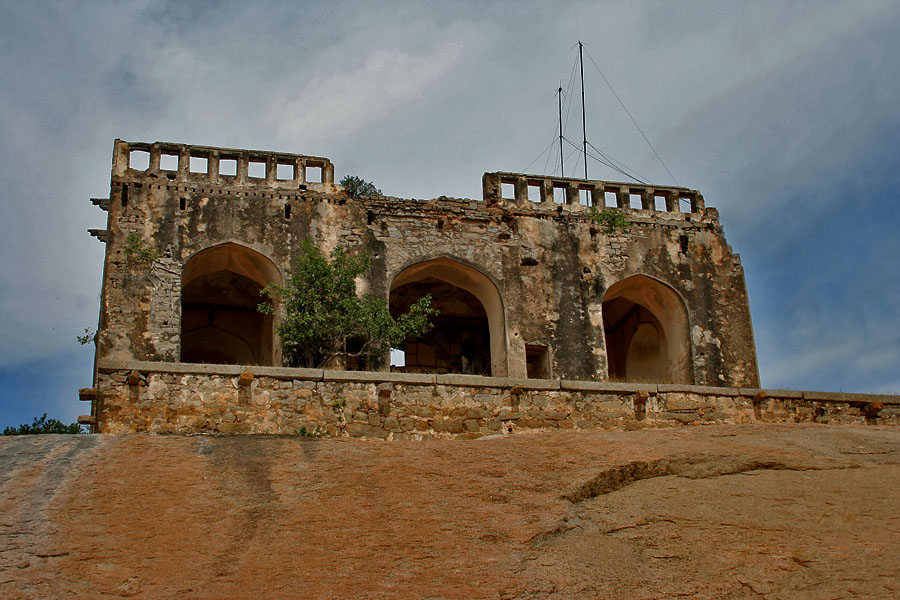
Kondapalli Fort, also known locally as Kondapalli Kota and Kondapalli Quilla, is a significant bastioned fortress located near the village of Kondapalli in the Ibrahimpatnam mandal of NTR district, Andhra Pradesh, India. Constructed during the 14th century, this fort was originally established by Prolaya Vema Reddy of the Reddi Kingdom. Some historical accounts attribute its construction to Anna Vema Reddy in 1360 CE, following his conquest of Kondapalli from the Mudigonda Chalukyas. The fort's strategic location and robust architecture made it a focal point for various ruling dynasties over the centuries.

Historical background and dynastic significance

The fort's inception as a leisure and business center reflects the dual role it played in the socio-economic landscape of the region. Over time, it evolved into a military training base during the British colonial period. Kondapalli Fort has witnessed the rule of several prominent dynasties, including the Reddi rulers, the Gajapati dynasty, the Nizam Nawabs, and eventually the East India Company. Each of these powers contributed to the fort's architectural and strategic enhancements, adapting it to the needs of their respective eras.

Architectural features and fortifications

Kondapalli Fort is characterized by its bastioned design, a style that incorporates projecting bastions at intervals along the curtain walls. These bastions allowed defenders to cover adjacent walls with gunfire, improving the fort's defensive capabilities. The fort's walls are constructed from locally sourced stone, designed to withstand sieges and attacks common in the late medieval period.

The entrance to the fort is marked by imposing gates that would have been heavily fortified to control access. Inside, the fort complex includes residential quarters, granaries, and armories, reflecting its role as both a military stronghold and an administrative center.

Strategic location and natural defenses

Situated on a rocky hillock, Kondapalli Fort benefits from natural elevation, providing commanding views of the surrounding landscape. This vantage point was crucial for early warning against invading forces. The terrain around the fort includes dense forests and rugged hills, which acted as natural barriers enhancing its defense.

Role during colonial and modern periods

During British rule, Kondapalli Fort was repurposed as a military training base, highlighting its continued strategic importance. The British made modifications to the fort's defenses to accommodate modern artillery and military tactics of the time.

Today, Kondapalli Fort stands as a partially preserved monument, attracting visitors interested in its rich history and architecture. The fort is also known for its association with the famous Kondapalli toys, traditional wooden toys crafted in the nearby village, which adds cultural significance to the site.

Cultural and heritage significance

The fort is not only a relic of military and political history but also a symbol of the region's cultural heritage. It reflects the architectural styles and construction techniques of the late medieval period in South India. Preservation efforts aim to maintain the fort's structural integrity while promoting it as a tourist destination.

Visitor experience and accessibility

Visitors to Kondapalli Fort can explore the extensive fortifications, enjoy panoramic views from the bastions, and learn about the fort's history through local guides. The surrounding area offers opportunities for hiking and experiencing the natural beauty of the region.

Frequently asked questions (FAQ)

When was Kondapalli Fort built and by whom?
Kondapalli Fort was built in the 14th century, primarily attributed to Prolaya Vema Reddy of the Reddi Kingdom, with some sources crediting Anna Vema Reddy around 1360 CE.
What architectural style characterizes Kondapalli Fort?
The fort features a bastioned fortress design typical of the late medieval period, with strong stone walls and projecting bastions for defense.
Can visitors explore Kondapalli Fort today?
Yes, Kondapalli Fort is partially preserved and open to visitors who can explore its fortifications and enjoy views from its bastions.
What is the cultural significance of Kondapalli Fort?
Besides its military history, Kondapalli Fort is linked to the traditional Kondapalli wooden toys, reflecting the region's cultural heritage.
How did Kondapalli Fort serve during British rule?
During British rule, the fort was used as a military training base and was modified to suit contemporary military needs.

Photo gallery

Kondapalli Fort
Click to view

Photo by Quest prithvi•Public domain

1 photo • Click any image to view in full screen

Information

Bastioned Fortress

Loading map...

Visitor reviews

No reviews yet. Been here? Write the first review and help other travelers!

Write the first review

Visited this castle? Share your experience

Your review helps other travelers and adds first-hand knowledge to our encyclopedia.
Write a review

(5/5)

0/2000 characters

Your review will be visible after admin approval

Nearby castles

49.5 km
Kondaveedu Fort — India castle

Kondaveedu Fort

, India

Kondaveedu Fort is an ancient hill fortress located near the village of Kondaveedu in the Palnadu district of Andhra Pradesh, India. Positioned about 16 miles west of the city of Guntur, this fortification stands on a rugged hill range that provided a strategic vantage point for controlling the surrounding region. The fort complex includes massive bastioned walls, defensive ramparts, and extensive ruins of magazines and storehouses, reflecting its military importance during the medieval and early modern periods. The fort was originally constructed by Prolaya Vema Reddy in the early 14th century, around 1328, as a stronghold for the Reddy dynasty. It served as their capital until 1482, after they shifted from their previous seat at Addanki. The fortifications were designed to utilize the natural rocky terrain, enhanced with bastions and thick walls to withstand sieges. The location atop hills offered natural defenses and panoramic views, essential for spotting approaching enemies. Historical significance and rulers Kondaveedu Fort played a key role in the power struggles of the Deccan region. In 1516, it was captured by the famed Vijayanagara emperor Krishnadevaraya, who recognized its strategic value. Later, the fort became contested by the Golconda Sultanate, with battles fought in 1531, 1536, and 1579. Ultimately, Sultan Quli Qutb Shah seized the fort in 1579, renaming it Murtazanagar. This marked a shift in control from Hindu to Muslim rulers, reflecting the turbulent political landscape of the time. Colonial period and decline In the 18th century, Kondaveedu Fort came under the control of the French colonists in 1752. The French undertook extensive fortification efforts, adapting the defenses to contemporary military needs. However, by 1788, the fort passed to the British East India Company, who eventually abandoned it in the early 19th century in favor of developing the nearby Palnadu district. Since then, the fort has fallen into ruin, though its imposing walls and bastions still dominate the hilltop. Architectural features and layout The fort is classified as a bastioned fortress, characterized by angular bastions projecting from the curtain walls to provide overlapping fields of fire. Its design reflects a blend of indigenous and later military architectural influences. The fort complex includes multiple gates, defensive walls, and watchtowers strategically placed to control access and enhance security. Inside the fort, visitors can find the remains of several magazines and storehouses, which were used to store ammunition and supplies. Although much of the internal structures are in ruins, their foundations reveal the scale and complexity of the fort's logistical arrangements. The fort's position on a hill range made it difficult to besiege, contributing to its long military significance. Conservation and heritage status Efforts are underway to preserve Kondaveedu Fort and promote it as a cultural heritage site. There are ongoing initiatives to classify it as a UNESCO World Heritage Site, recognizing its historical and architectural importance. The fort is a popular destination for history enthusiasts and trekkers who explore its rugged terrain and extensive ruins. Despite its ruined state, Kondaveedu Fort remains a significant monument illustrating the military architecture and regional history of medieval Andhra Pradesh. Its layered history of dynastic rule, colonial occupation, and eventual abandonment offers valuable insights into the evolving political and military strategies of South India.

Late Medieval (14th–15th c.)
Details
177.2 km
Warangal Fort — India castle

Warangal Fort

Warangal, India

Warangal Fort is a significant historical bastioned fortress located in the Warangal District of Telangana, India. It served as the capital of the Kakatiya dynasty and later the Musunuri Nayakas. The fort complex dates back to at least the 12th century, marking it as a key medieval stronghold in South India. Historical significance and background Warangal Fort was the political and military center of the Kakatiya dynasty, which ruled large parts of present-day Telangana and Andhra Pradesh from the 12th to the 14th centuries. The fort's strategic location and formidable defenses made it a vital bastion against invasions. After the decline of the Kakatiyas, the fort was controlled by the Musunuri Nayakas, who played a role in regional resistance against the Delhi Sultanate. Architectural features and layout The fort is renowned for its impressive four monumental gates, locally known as the Kakatiya Kala Thoranam. These intricately carved stone arches are emblematic of Kakatiya architecture and originally served as entrances to a large Shiva temple complex that once stood within the fort. The gates feature elaborate sculptures and motifs characteristic of the period. Warangal Fort is classified as a bastioned fortress, featuring robust defensive walls reinforced with bastions at intervals. The fortifications include massive stone ramparts and moats designed to withstand sieges. The central area, known as Orugallu Fort, was the core citadel and housed royal and administrative buildings. Orugallu Fort and Shiva temple complex The Orugallu Fort was the heart of the Warangal Fort complex. It was the site of the great Shiva temple, which, although now largely in ruins, was once a grand religious center. The fort's gates and many stone carvings are remnants of this temple's grandeur. Cultural and symbolic importance The Kakatiya Kala Thoranam gates have transcended their original architectural function to become a cultural symbol of Telangana. After the bifurcation of Andhra Pradesh, the arch was officially adopted into the emblem of Telangana, symbolizing the region's rich heritage and identity. Warangal Fort is recognized for its cultural value and was included in the tentative list of UNESCO World Heritage Sites in 2010, highlighting its importance as a heritage monument worth preserving and studying. Current condition and preservation Today, Warangal Fort stands as a partially preserved monument. While much of the original temple complex is in ruins, the gates and fort walls remain prominent features. Conservation efforts have focused on maintaining the structural integrity of the gates and ramparts to protect this heritage site. Visiting Warangal Fort The fort is accessible to visitors year-round, offering a glimpse into the architectural ingenuity of the Kakatiya period. Tourists can explore the massive gates, the remains of the temple, and the fortifications. The site provides valuable insights into medieval Indian fort construction and regional history.

High Medieval (11th–13th c.)
Details
200.3 km
Bhongir Fort — India castle

Bhongir Fort

Bhongir, India

Bhongir Fort, also known as Bhuvanagiri Fort, is a significant early medieval fortress located in the town of Bhongir within the Yadadri Bhuvanagiri district of Telangana, India. This imposing fortification is strategically perched atop a massive monolithic rock formation, rising approximately 500 feet above the surrounding plains. The fort's elevated position provided a commanding view of the surrounding landscape, making it a formidable defensive stronghold in its time. Situated about 47 kilometers from Hyderabad, Bhongir Fort remains a notable historical and architectural landmark in the region. Historical context and construction The construction of Bhongir Fort dates back to the 10th century, during the early medieval period. It was initially built by the Kakatiya dynasty, a powerful ruling family known for their contributions to architecture and fortifications in the Deccan region. The fort was designed to serve both military and administrative purposes, reflecting the strategic importance of the region during that era. The fort's builders took advantage of the natural rock outcrop, integrating the rugged terrain into the fortification's design. The use of the rock as a foundation enhanced the fort's defensive capabilities, making it difficult for invaders to breach its walls. Architectural features and layout Bhongir Fort is characterized by its robust stone walls that encircle the summit of the rock, enclosing the fort's core structures. The fort's walls are punctuated by several bastions and watchtowers, which provided vantage points for surveillance and defense against attackers. The entrance to the fort is marked by a series of imposing gates designed to control access and slow down enemy advances. The gates are constructed with heavy stone blocks and feature defensive elements such as arrow slits and machicolations. Within the fort's enclosure, remnants of various structures can be found, including residential quarters, granaries, and water reservoirs. The presence of these facilities indicates that the fort was designed to sustain a garrison for extended periods during sieges. The fort also features a network of steps and pathways carved into the rock, allowing movement between different levels and sections of the fort. These pathways demonstrate the integration of natural topography with human engineering. Military significance and historical events Throughout its history, Bhongir Fort served as a strategic military outpost due to its elevated position and strong defenses. It was involved in various regional conflicts and power struggles, particularly during the rule of the Kakatiya dynasty and later under the control of the Bahmani Sultanate and the Qutb Shahi dynasty. The fort's natural defenses and man-made fortifications made it a challenging target for invading forces. Its ability to withstand sieges and attacks contributed to the control of the surrounding territories. Current condition and preservation Today, Bhongir Fort stands in a state of ruins, with many of its original structures partially preserved or collapsed. Despite this, the fort remains an important archaeological site, attracting historians, architects, and tourists interested in early medieval Indian fortifications. Efforts have been made to preserve the remaining structures and maintain the site's accessibility. Visitors can explore the fort's ruins, climb the rock to enjoy panoramic views, and study the architectural ingenuity of the early medieval builders. Visiting Bhongir Fort The fort is accessible from Hyderabad and nearby towns, making it a popular destination for day trips and historical tours. The climb to the summit involves ascending a series of steps carved into the rock, which can be moderately challenging but rewarding with scenic vistas. Visitors are advised to wear suitable footwear and carry water due to the rocky terrain and the fort's elevation. The site offers opportunities for photography, historical exploration, and experiencing a piece of India's medieval heritage.

Early Medieval (5th–10th c.)
Details