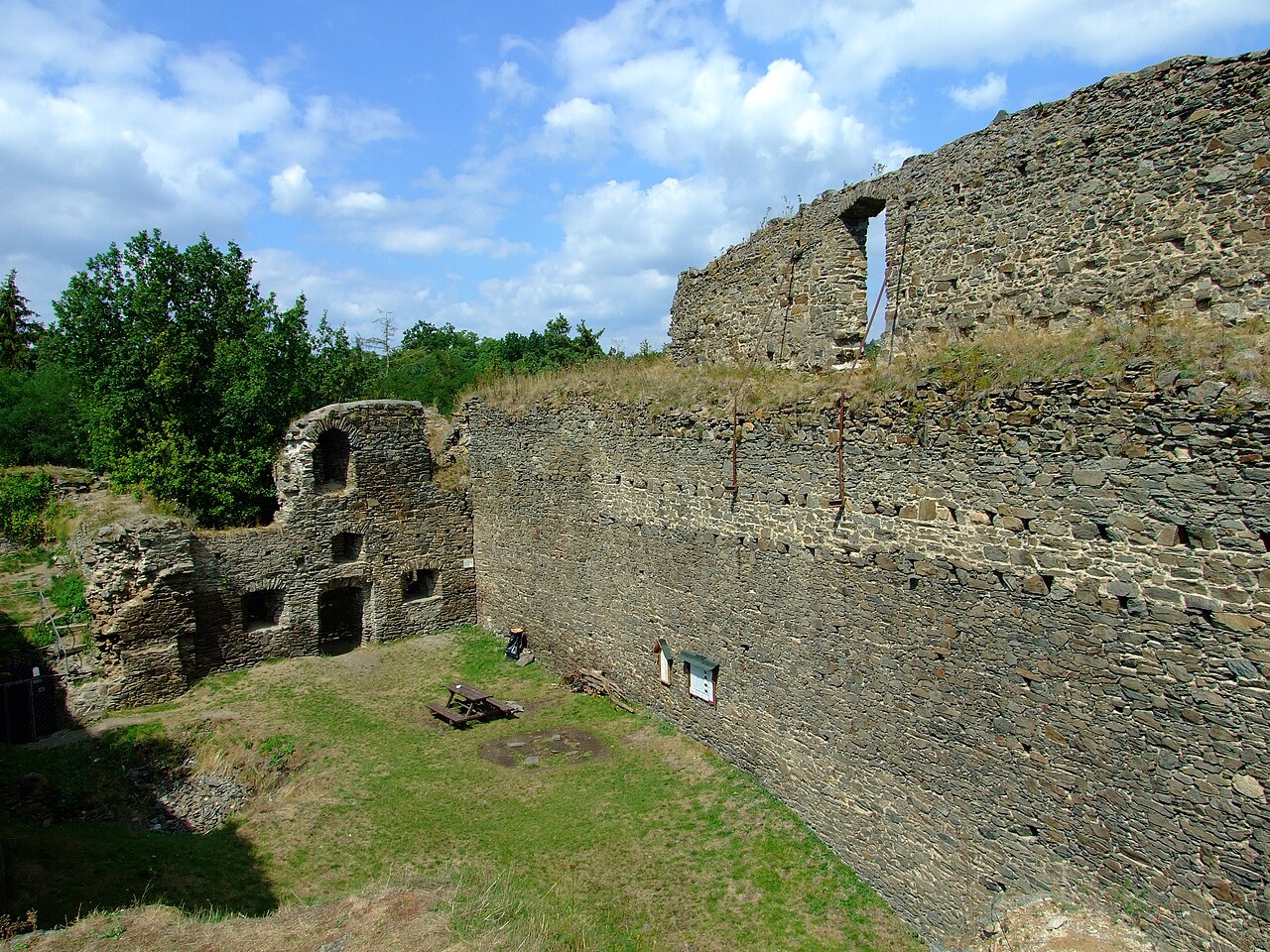
Komberk Castle
Komberk Castle is a fascinating example of a medieval hill castle located in the Czech Republic, specifically between the villages of Čeminy and Dolní Vlkýš. Its history stretches back to prehistoric times, with archaeological evidence indicating settlement during the Eneolithic period by cultures such as the Chamská group. This early occupation highlights the strategic importance of the site long before the castle's construction.
The first documented mention of Komberk dates to 1313, when it was held by Ojíř of Komberk from the noble Švihovský family of Rýzmberk. Around 1340, Ojíř sold the castle and its lands to the Teplá monastery, but this sale was contested and reversed in 1350 after protests by Ojíř's widow, Žofie. This early dispute reflects the castle's value and the complex feudal relationships of the period.
Ownership changed several times during the 14th century. In 1368, Ctibor of Švamberk acquired Komberk and exchanged it with the Kladruby monastery. The castle's strategic position became particularly significant during the early 15th century amid the Hussite Wars, when it was captured by Hussite forces in 1420. Following this turbulent period, the monastery used the estate to settle debts with local nobles, including Vilém of Nečtiny and Žlutice. Before 1447, the castle was sold to Burian I of Gutštejn, whose family maintained a military presence at Komberk but rarely resided there permanently.
In 1478, the castle was likely seized by troops under Jan Planknar of Kynšperk during regional conflicts. Historical records diverge on the castle's fate thereafter; some suggest it was abandoned soon after, while others indicate that Jan of Gutštejn lived there until selling it around 1509 to Albrecht of Kolovrat. Subsequent owners included Jan and Bernart of Waldstein, who transferred Komberk and the nearby settlement of Dolní Bělá to Václav of Roupov. By 1558, the castle was recorded as deserted and in ruins, marking the end of its active use.
Architectural features and defensive design
Komberk Castle is situated on a raised promontory above the Čeminský stream at an altitude of approximately 350 meters. The castle's core follows an oval layout adapted to the natural terrain, demonstrating the medieval builders' skill in integrating fortifications with the landscape. A notable feature in the northern part of the core is a building with a ground floor partially carved into the bedrock, illustrating the use of natural rock formations to enhance defensive capabilities.
Opposite this structure lies a circular hollow interpreted as an earth cellar or zemnice, a subterranean storage space typical of medieval castles, used for preserving food and supplies. The core area was originally enclosed by a wooden palisade, which was reinforced on the southern side by a semicircular barbican. This barbican served as an outer defensive work, protecting the main gate or vulnerable sections of the castle walls. Additionally, a second barbican was located lower on the slope, providing layered defense against attackers approaching from below.
Extending eastward from the core, a substantially larger outer bailey expanded the castle's fortified area. This outer enclosure was protected by surviving earthworks consisting of a ditch and rampart, typical defensive features designed to impede enemy advances. Between the bailey and the inner stronghold, a terraced level is believed to mark a former filled-in ditch, adding another layer to the castle's complex defensive system.
Historical significance and military role
Throughout its history, Komberk Castle played a strategic role in regional power struggles. Its location on a hillside overlooking important routes made it a valuable military asset during the medieval period. The castle's capture by Hussite forces in 1420 underscores its importance during the religious and political upheavals of the Hussite Wars, which reshaped Bohemia in the 15th century.
The castle's military function continued under the Gutštejn family, who maintained a garrison but rarely lived on site, indicating its primary use as a defensive stronghold rather than a noble residence. The contested ownership and eventual decline of Komberk reflect broader patterns of shifting power among Bohemian nobility and ecclesiastical institutions during the late medieval period.
Current condition and archaeological remains
Today, Komberk Castle exists mainly as ruins and earthworks that reveal its former defensive complexity. The visible remains include the carved bedrock foundations, the circular earth cellar, and the outlines of the palisades and barbicans. The ditch and rampart earthworks surrounding the outer bailey are well preserved, offering insight into medieval fortification techniques adapted to the natural hillside environment.
The site is recognized as a cultural monument in the Czech Republic, valued for its archaeological significance and as a testament to medieval military architecture. Visitors to Komberk can explore the remnants of this hillside fortress and appreciate the integration of natural terrain with constructed defenses.
Visiting komberk castle
Although Komberk Castle is a ruin, it remains accessible to visitors interested in medieval history and castle architecture. The site’s hillside location provides scenic views of the surrounding landscape, including the Čeminský stream valley. Visitors should prepare for uneven terrain and limited facilities, as the castle is primarily an archaeological site rather than a restored tourist attraction.
Nearby attractions and regional context
Komberk is located in the western part of the Czech Republic, a region rich in medieval castles and historical sites. Nearby villages such as Čeminy and Dolní Vlkýš offer a glimpse into rural Bohemian life, while other castles in the area provide context for Komberk’s role in regional defense networks during the High and Late Medieval periods.
For enthusiasts of medieval architecture and history, Komberk Castle represents an intriguing site where natural landscape and human ingenuity combined to create a formidable defensive position. Its layered fortifications and complex ownership history reflect the turbulent times of medieval Bohemia.
Frequently asked questions (FAQ)
- When was Komberk Castle first mentioned in historical records?
- Komberk Castle was first mentioned in historical records in 1313, associated with Ojíř of Komberk from the Švihovský family.
- What is the current condition of Komberk Castle?
- Komberk Castle is currently in ruins, with visible earthworks, carved bedrock foundations, and remnants of its defensive structures.
- Can visitors access Komberk Castle?
- Yes, visitors can access the site, but it is primarily an archaeological ruin with uneven terrain and limited visitor facilities.
- What architectural features are notable at Komberk Castle?
- Notable features include a ground floor partly carved into bedrock, a circular earth cellar (zemnice), wooden palisades, semicircular barbicans, and earthwork defenses such as ditches and ramparts.
- Why was Komberk Castle strategically important?
- Its hillside location overlooking the Čeminský stream valley made it a key defensive site during medieval conflicts, including its capture by Hussite forces in 1420.
Information
Loading map...
Visitor reviews
No reviews yet. Been here? Write the first review and help other travelers!
Write the first reviewVisited this castle? Share your experience
Your review helps other travelers and adds first-hand knowledge to our encyclopedia.