Buben Castle
Buben Castle, located near the village of Plešnice in the Czech Republic, is a remarkable example of a late medieval hill castle dating back to the 14th century. First mentioned in historical records in 1349, the castle's origins may precede this date, reflecting the architectural and feudal developments of medieval Europe. Constructed by the noble family known as the knights of Buben (whose name translates to "drum"), the castle has a rich history intertwined with the shifting dynamics of regional power and aristocratic lineage.
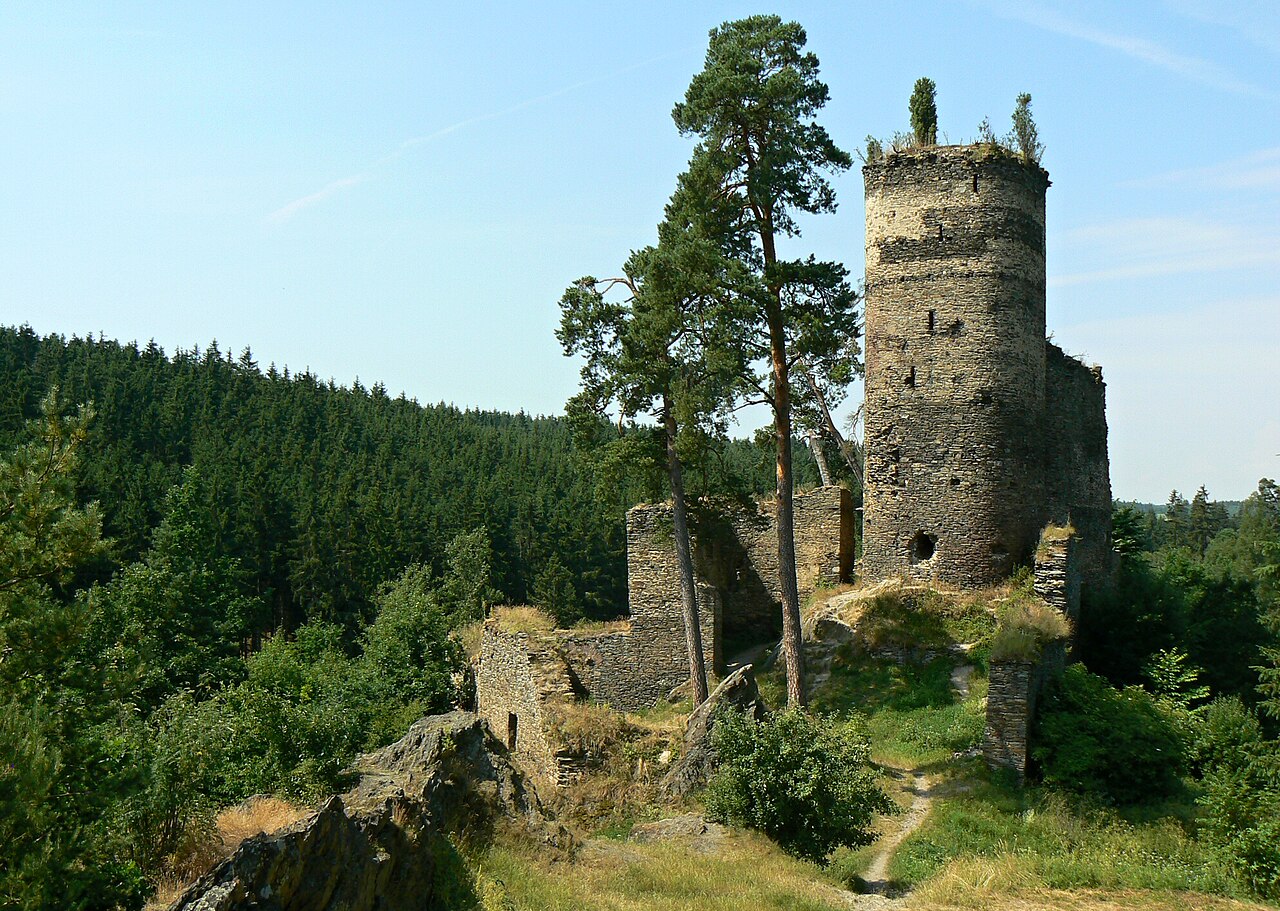
The castle's strategic position on a narrow, elongated rocky spur overlooking the confluence of the Mže River and the Plešnický (Úlický) stream provided natural defenses and commanding views, typical of hill castles built for both military and residential purposes during the medieval period. The spur, approximately 100 meters long and 30 to 40 meters wide, was originally cleared of trees to maximize visibility and defense, though modern forest growth now partially obscures the ruins.
Historical significance and ownership
The earliest documented reference to Buben Castle appears in a charter issued by King Charles IV in 1349. Architectural studies suggest the castle was built shortly after the first third of the 14th century, if not earlier. It initially belonged to the Bubnové of Hrádek, a noble family whose name influenced the castle's alternate historical name, Hrádek. This family later split into two noble branches: the Varlichy barons of Bubna and the counts Bubna of Litice, both adopting a military drum emblem in their coats of arms from the mid-1500s, reflecting their martial heritage.
Before 1379, the castle changed hands to the knights of Nečtin, who undertook expansions to strengthen its fortifications. Buben Castle endured the turbulent Hussite Wars in the early 15th century, a period marked by religious and political upheaval in Bohemia. Subsequent ownership passed among related noble families and local landowners, including knight Petr Chlumčanský of Přestavlk, who purchased the castle in 1471 and whose family retained it until 1563.
Afterwards, the castle was sold to the Úlický family of Plešnice and Úlice. By 1567, the castle was recorded as deserted, largely due to its isolated location and the owners' preference for more comfortable residences. This abandonment initiated a gradual decline, though the castle's remote position prevented rapid dismantling for building materials.
From 1648, the estate was managed by the Benedictine monastery of Kladruby. Following the monastery's suppression in 1785, ownership transferred to a Religious Fund and later to various minor proprietors. In 1912, the estate was divided, and landowner Jindřich Finger acquired the castle ruins, supporting restoration efforts led by the Czech Tourist Club, which purchased the site and surrounding land in 1927.
Architectural features and layout
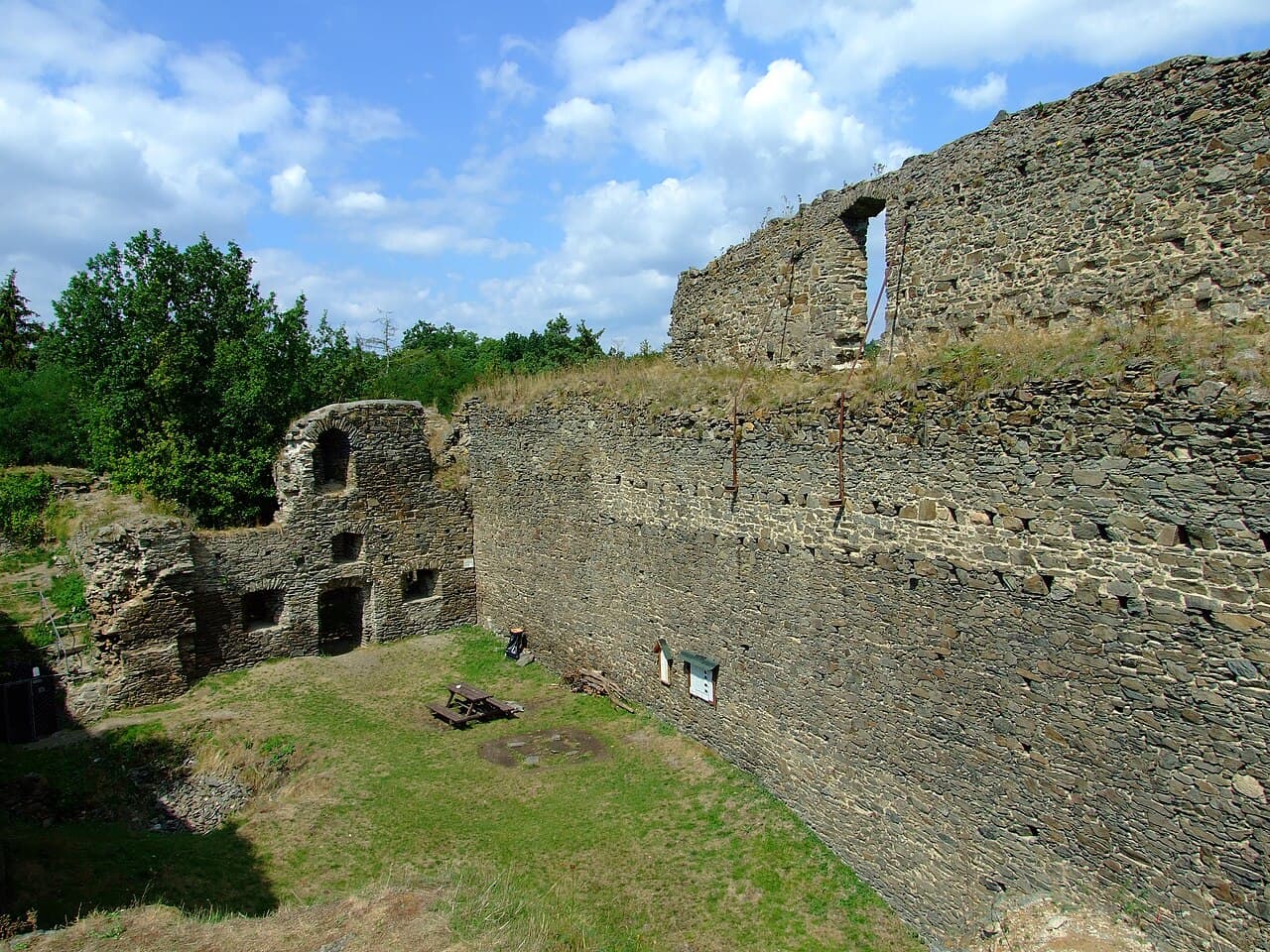
Buben Castle's architecture reflects typical late medieval defensive design adapted to its rugged terrain. The castle complex includes remnants of multiple defensive structures such as curtain walls, gates, a zwinger wall, and a bastion. The surviving sections of the first gate lie in the southeastern outer bailey, while parts of the third gate are preserved deeper within the castle. The curtain walls, which once encircled the castle, still stand in significant portions, enclosing the core area with its tower-like palace situated toward the northwest rear.
The castle courtyard contains foundations of a smaller palace building, indicating residential quarters within the fortified enclosure. The zwinger wall, a heavily fortified outer enclosure designed to trap and expose attackers, remains partially intact along the eastern side. However, this section suffered severe damage after the collapse of a bastion in 2013, a consequence of earlier inappropriate restoration using modern concrete that destabilized the structure.
Defensive features also include a neck ditch cut into the natural rock before the first gate, protecting the southeastern approach. This narrow ravine was originally spanned by a wooden bridge, controlling access from the village of Plešnice. A watchtower once stood on a solitary rock outcrop southwest of the main complex but no longer survives.
The castle was built primarily from sandstone blocks, some of which have been removed over centuries and repurposed in local buildings as window and door frames or cornerstones. Near the castle lies the Zámecký Mlýn (Castle Mill), first documented in 1448. Powered by water diverted through a weir at the river confluence, the mill and its channel remain, although the weir was destroyed during World War II, altering the water flow.
Conservation and modern history
By the 16th century, Buben Castle was no longer used as a residence, leading to gradual deterioration. Despite this, the absence of nearby settlements helped preserve much of the stonework from being quarried for other constructions. By 1912, the castle was a partial ruin, prompting the Czech Tourist Club to begin restoration efforts.
Between 1929 and 1932, the club undertook comprehensive conservation work, stabilizing the ruins and enhancing access. They also built Schwarz's lodge below the castle in 1932 to accommodate visitors. After the club's disbandment in 1948, ownership passed to a Czechoslovak physical education organization and subsequently to the state by 1953.
Unfortunately, restoration attempts in 1991 used unsuitable cement materials, which absorbed water and became too heavy for the ancient walls, causing rapid deterioration. This led to the collapse of a bastion in 2013 that blocked the main access path from the river. Until 2009, a civic association named Excalibur managed the ruins' maintenance. In 2010, ownership transferred to the municipality of Plešnice, which currently oversees the site.
Since 1958, Buben Castle has been protected as a cultural monument under Czech law, reflecting its historical and architectural significance. Visitors can reach the site via a marked forest trail from Plešnice, approximately two kilometers long. However, the destruction of a footbridge over the Mže River in 2011 due to flooding has affected direct access routes.
Visitor information and accessibility
Today, Buben Castle stands as a partially preserved ruin offering a glimpse into medieval fortification techniques and noble life in the Czech lands. The site’s remote and forested setting provides a serene environment for exploration, though visitors should be prepared for uneven terrain and limited facilities.
The castle is accessible via a hiking trail from Plešnice, with signage guiding visitors through the forested landscape. The absence of modern amenities and the fragile state of the ruins mean that visitors should exercise caution while exploring. The nearby Schwarz's lodge, originally built to support tourists, no longer functions as accommodation but remains a landmark below the castle.
While there is no formal ticketing system, visitors are encouraged to respect the protected status of the site and contribute to its preservation through responsible tourism. The castle’s historical context, architectural remnants, and scenic location make it a valuable destination for enthusiasts of medieval history and castle architecture.
Frequently asked questions (FAQ)
- How do I reach Buben Castle from Plešnice?
- Buben Castle is accessible via a marked forest trail approximately two kilometers long from the village of Plešnice. Visitors should be prepared for a hike through forested terrain, and note that the footbridge over the Mže River was destroyed in 2011, affecting direct access routes.
- What is the historical significance of Buben Castle?
- Buben Castle dates back to the 14th century and was originally owned by the knights of Buben. It played a role in regional noble lineages and endured turbulent periods such as the Hussite Wars, reflecting the medieval history of the Czech lands.
- What architectural features remain at Buben Castle?
- Surviving features include sections of the first and third gates, curtain walls, a zwinger wall, a bastion (partially collapsed), a tower-like palace, and foundations of smaller palace buildings within the courtyard.
- Is Buben Castle suitable for visitors with limited mobility?
- Due to its location on a rocky spur and the uneven forest trail access, Buben Castle is not well-suited for visitors with limited mobility. The terrain can be challenging and there are no modern accessibility facilities on site.
- When was the last major restoration of Buben Castle?
- The most comprehensive conservation work was carried out between 1929 and 1932 by the Czech Tourist Club. Later restoration attempts in 1991 used unsuitable materials, leading to deterioration and the collapse of a bastion in 2013.
Photo gallery

Information
Sources & official resources
Verify the information above using these authoritative references.
Loading map...
Visitor reviews
No reviews yet. Been here? Write the first review and help other travelers!
Write the first reviewVisited this castle? Share your experience
Your review helps other travelers and adds first-hand knowledge to our encyclopedia.