Kolossi Castle
Kolossi Castle stands as a remarkable testament to the medieval history of Cyprus, embodying the strategic and economic significance of the island during the Late Medieval period. Located in the Limassol District, approximately 14 kilometers west of the city of Limassol, this fortress was originally established by the Frankish Crusaders in the early 13th century. Its primary purpose was military defense and administration, but it also played a pivotal role in the production of sugar and the famed Commandaria sweet wine, one of the oldest named wines in continuous production worldwide.
The castle’s origins trace back to around 1210, when King Hugh I of Cyprus granted the lands of Kolossi to the Knights Hospitaller, also known as the Order of St. John of Jerusalem. This religious and military order constructed the initial fortifications to secure their holdings and oversee the surrounding agricultural estates. However, the castle’s control shifted during the turbulent Crusader era. In 1306, the Knights Templar seized Kolossi Castle amidst factional rivalries, only to return it to the Hospitallers in 1313 following the suppression of the Templar order by the papacy.
Architectural design and construction history
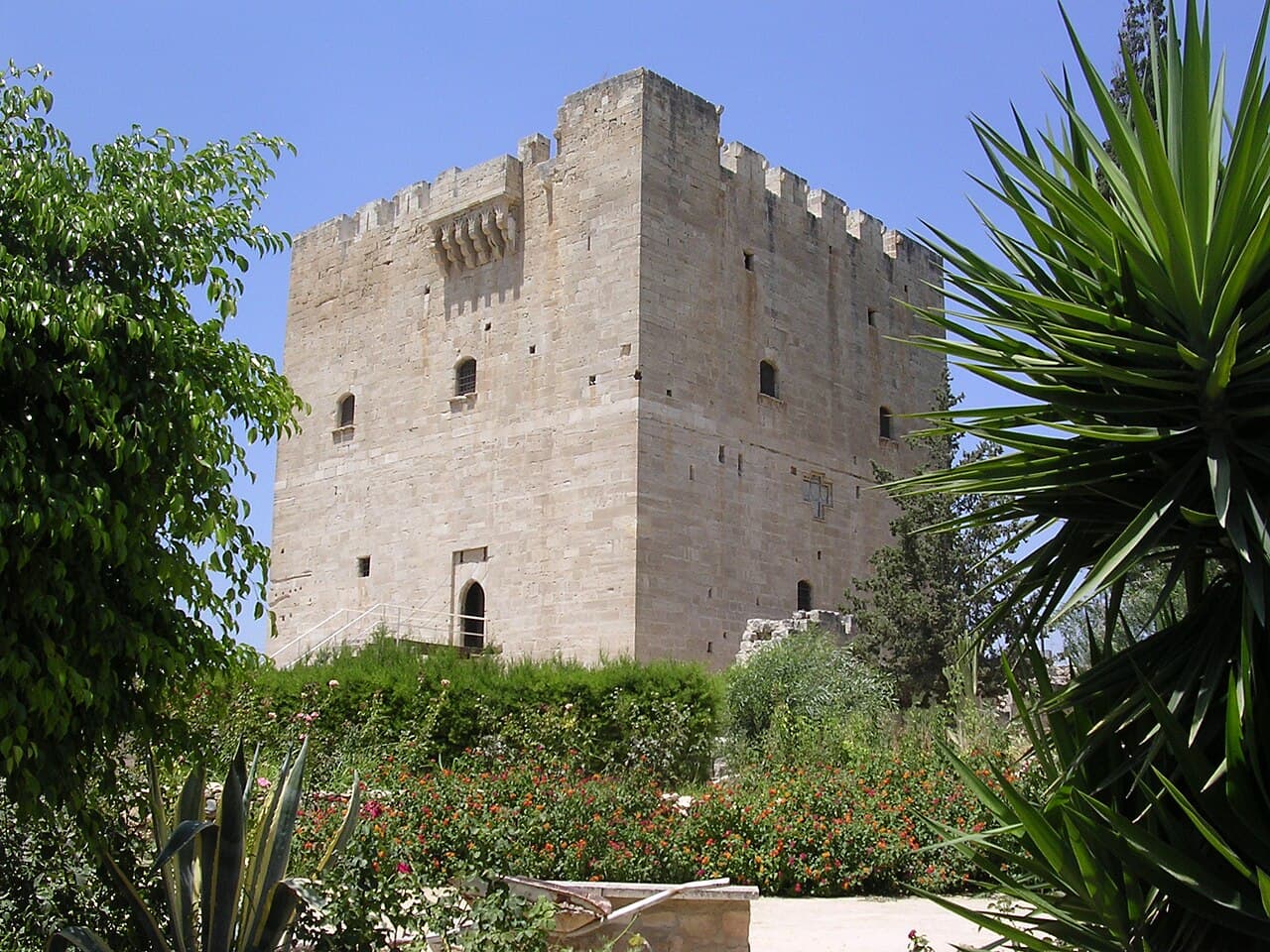
The present structure of Kolossi Castle dates from 1454, when it was rebuilt by Louis de Magnac, the commander of the Hospitallers’ commandery at Kolossi. His coat of arms is prominently carved into the castle walls, symbolizing the renewed authority and defensive strength of the fortress. The castle is a prime example of medieval military architecture designed for practical defense rather than ornamental grandeur. It consists of a single three-storey keep attached to a rectangular courtyard or bailey measuring approximately 30 by 40 meters.
The castle’s walls are constructed of thick stone, reaching up to 21 meters in height and 1.25 meters in thickness, reflecting the need for robust fortifications against both military assault and siege warfare. Defensive features include machicolations—stone projections with openings to drop projectiles onto attackers—and embrasures for archers and crossbowmen. The roof was designed as a defensive platform, providing vantage points for surveillance and protection.
Interior layout and functional spaces
The ground floor served primarily as storage, safeguarding valuable goods such as sugar produced from local sugarcane crops, a major export commodity of medieval Cyprus. This level also contains two underground cisterns that collected rainwater, ensuring a reliable water supply during sieges or droughts. These cisterns remain intact, offering insight into the castle’s self-sufficiency and water management techniques.
Access to the first floor was originally protected by a drawbridge, enhancing security. Inside, two large rooms were used for both religious and domestic purposes. One room features a wall painting of the Crucifixion of Jesus, highlighting the spiritual life of the castle’s occupants. The adjacent room, equipped with a fireplace, functioned as a dining and living area, illustrating the blend of practicality and comfort in medieval castle life.
The second floor housed the living quarters, providing private spaces for the castle’s residents. This arrangement reflects the dual military and residential nature of Kolossi Castle, accommodating both defense needs and daily life.
Historical significance and ownership
Kolossi Castle’s history is deeply intertwined with the broader political and military developments of Cyprus during the Crusades and beyond. After the fall of Acre in 1291, the Knights Hospitaller relocated their headquarters to Cyprus, using Kolossi as a regional commandery. The castle oversaw the administration and defense of the surrounding lands, including about sixty villages, and managed the production of sugar and Commandaria wine.
The castle suffered multiple attacks during the 14th and 15th centuries, including assaults by Genoese forces in 1373 and repeated invasions by Mamluk Egyptian troops in 1402, 1413, 1425, and 1426. Earthquakes also caused damage, necessitating several phases of reconstruction. The 1454 rebuilding under Louis de Magnac restored the castle’s defensive capabilities and ensured its continued strategic importance.
In 1488, political control of Cyprus shifted when Queen Catherine Cornaro ceded the island to the Republic of Venice. Kolossi Castle was granted as a hereditary fief to George Cornaro, a relative of the queen. The Cornaro family maintained ownership through the Ottoman conquest and into the late 18th century, after which the estate passed to the Motsennigo family.
Commandaria wine and economic role
One of the castle’s most enduring legacies is its association with Commandaria wine, a sweet dessert wine produced in the region for over a thousand years. The wine’s name derives from “La Grande Commanderie,” the military headquarters of the Knights Templar and Hospitallers at Kolossi. This wine was famously praised by Richard the Lionheart during his 1191 wedding celebration near Limassol, where he reportedly declared it "the wine of kings and the king of wines." Commandaria remains a celebrated Cypriot product and a symbol of the island’s rich viticultural heritage.
Architectural features and current condition
Today, Kolossi Castle is a well-preserved example of a hill castle from the Late Medieval period, showcasing the practical military architecture of the Crusader era. Visitors can explore the three-storey keep with its imposing walls, the adjoining rectangular courtyard, and remnants of the sugar mill and refinery that underscore the castle’s economic functions.
The castle’s robust construction includes defensive walls with battlements and arrow slits, while the interior spaces reveal the dual nature of the fortress as both a military stronghold and a residence. The preserved cisterns and storage areas illustrate the logistical planning necessary to sustain the castle’s occupants during sieges.
On the eastern facade, a distinctive cross-shaped niche displays four coats of arms, including those of the Kingdom of Cyprus and notable Grand Masters such as Louis de Magnac, Jean de Lastic, and Jacques de Milly. These heraldic symbols connect the castle visually to its historical leaders and the political context of the Crusader states.
Kolossi Castle remains a significant cultural and historical landmark in Cyprus, attracting visitors interested in medieval history, Crusader architecture, and the heritage of Mediterranean winemaking.
Visiting kolossi castle
Today, Kolossi Castle is accessible to the public and offers a fascinating glimpse into the military and economic history of medieval Cyprus. Visitors can explore the castle’s well-preserved keep, the courtyard, and the surrounding grounds, including the remains of the sugar production facilities.
The castle’s location near Limassol makes it a convenient destination for those interested in Crusader history and Cypriot culture. Interpretive signage and guided tours provide insights into the castle’s architecture, historical events, and its role in the production of Commandaria wine.
Kolossi Castle is an essential stop for travelers seeking to understand the complex history of Cyprus during the Crusades and to experience one of the island’s most iconic medieval monuments.
Frequently asked questions (FAQ)
- When was Kolossi Castle originally built and by whom?
- Kolossi Castle was originally built around 1210 by the Frankish Crusaders after King Hugh I granted the land to the Knights Hospitaller.
- What is the architectural style of Kolossi Castle?
- Kolossi Castle is built in the Gothic style, characterized by its practical military design with thick stone walls, machicolations, and embrasures.
- Why is Kolossi Castle historically significant?
- The castle served as a strategic military stronghold for the Knights Hospitaller and Knights Templar, and was central to the production of sugar and Commandaria wine, a famous Cypriot sweet wine.
- Can visitors explore the interior of Kolossi Castle?
- Yes, visitors can explore the three-storey keep, the courtyard, and view the remains of the sugar mill and storage facilities.
- What is Commandaria wine and how is it connected to Kolossi Castle?
- Commandaria is a sweet dessert wine produced in the region for over a thousand years, named after the Knights’ military headquarters at Kolossi Castle and famously praised by Richard the Lionheart.
- Is Kolossi Castle easily accessible from Limassol?
- Yes, Kolossi Castle is located about 14 kilometers west of Limassol and is accessible by road, making it a popular day trip destination.
Photo gallery

Photo by Vegard Ottervig•Public domain
Information
Website
Visit websiteSources & official resources
Verify the information above using these authoritative references.
Loading map...
Visitor reviews
No reviews yet. Been here? Write the first review and help other travelers!
Write the first reviewVisited this castle? Share your experience
Your review helps other travelers and adds first-hand knowledge to our encyclopedia.