Kofu Castle
Kofu Castle, also known as Maizuru Castle, is a significant historic fortress located in Kofu, the capital city of Yamanashi Prefecture in Japan. Constructed in 1583 by the powerful warlord Tokugawa Ieyasu, the castle played a crucial role in the political and military landscape of the region during the late Sengoku period and the subsequent Edo period. Positioned strategically on a hill overlooking the Kofu Basin, Kofu Castle was designed as a formidable hill castle to control the surrounding area and serve as a stronghold against rival clans.
The castle's construction followed Tokugawa Ieyasu's decisive victory over the Takeda clan, specifically after defeating Takeda Katsuyori, the heir of the famed warlord Takeda Shingen, in 1582. Although the Takeda clan had established their castle town in Kofu, their actual seat of power was the Tsutsujigasaki Yakata, a fortified residence rather than a full-scale castle. Kofu Castle was built to consolidate Tokugawa's control over the region and to replace the earlier Takeda fortifications.
Architectural features and layout
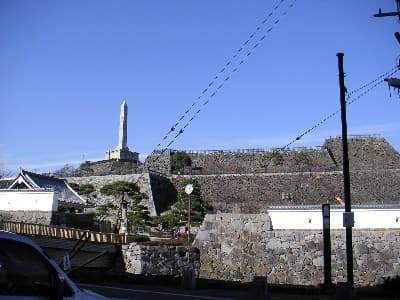
Kofu Castle is a classic example of a hill castle (yamashiro) typical of late 16th-century Japanese castle architecture. The castle complex was designed to take advantage of the natural terrain, with multiple baileys (courtyards) terraced along the hillside. The main enclosure was fortified with robust stone walls and moats, reflecting advancements in defensive architecture of the period.
The castle originally featured several yagura (turrets) and gates that controlled access to the inner areas. Notably, the Inari Yagura and the Yamanote Gomon gate have been recently restored, allowing visitors to appreciate the castle's defensive structures and architectural style. These restored elements showcase the traditional wooden construction techniques combined with stone bases typical of Japanese castles from the Sengoku and Edo periods.
Defensive design
The castle's position on a hill provided a natural vantage point for surveillance and defense. The arrangement of baileys and gates created multiple defensive layers, making it difficult for attackers to penetrate the inner sanctum. The stone walls were constructed to withstand sieges, and the moats added an additional barrier against invaders.
Historical significance and ownership
Kofu Castle was one of the strongest castles in the Kanto region, second only to Edo Castle, the Tokugawa shogunate's primary seat of power. It served as a key military and administrative center throughout the Edo period.
After its construction, the castle became the residence of lords closely affiliated with the shogun. From 1724 until the end of the Edo period, the lordship of Kofu Castle was held by a rotating series of daimyo, with approximately 200 different lords governing the domain by the period's conclusion. This rotation reflected the Tokugawa shogunate's policy of controlling regional power by frequently reassigning daimyo to prevent the establishment of local strongholds that could challenge central authority.
It is important to clarify a common misconception found in some English sources: while Kofu was historically a castle town under the Takeda clan, Kofu Castle itself was not built or ruled by the Takeda. The Takeda clan's main residence was the Tsutsujigasaki Yakata, a fortified manor rather than a full castle like Kofu Castle.
Restoration and current condition
Today, Kofu Castle is classified as partially preserved. Although much of the original structure was lost over time, recent restoration efforts have focused on key architectural elements to preserve the castle's historical legacy. The restoration of the Inari Yagura and the Yamanote Gomon gate has enhanced the site's appeal and provides visitors with tangible insights into the castle's original grandeur.
The castle grounds are accessible to the public and provide scenic views of the surrounding mountain ranges, especially on clear days. The castle's location near the train station allows easy access for visitors, although the restored gate is situated across the tracks, requiring a short walk.
Visitor experience
Visitors to Kofu Castle can explore the restored turrets and gates, stroll through the castle grounds, and enjoy panoramic vistas of the Kofu Basin and nearby mountains. The site offers a combination of historical education and natural beauty, making it a popular destination for history enthusiasts and tourists alike.
Signage and informational displays help contextualize the castle's role in Japanese history, particularly its connection to the Tokugawa shogunate and the Sengoku period's turbulent conflicts.
Legacy and cultural importance
Kofu Castle remains an important cultural landmark in Yamanashi Prefecture. It symbolizes the region's transition from the era of warring states to the relative peace and stability under Tokugawa rule. The castle's association with Tokugawa Ieyasu, one of Japan's most influential historical figures, further elevates its significance.
As a hill castle with preserved and restored features, Kofu Castle offers valuable insights into Japanese castle architecture, military strategy, and feudal governance. It continues to attract scholars, students, and tourists interested in Japan's rich heritage.
Frequently asked questions (FAQ)
- How do I get to Kofu Castle?
- Kofu Castle is located in the city of Kofu, Yamanashi Prefecture. It is easily accessible by train, with Kofu Station nearby. From the station, the castle grounds and restored gates are within walking distance, though the Yamanote Gomon gate is across the train tracks, so plan a short walk.
- What is the historical significance of Kofu Castle?
- Kofu Castle was built by Tokugawa Ieyasu in 1583 after defeating the Takeda clan's heir. It served as a major stronghold in the Kanto region and was one of the strongest castles after Edo Castle. It also housed lords closely connected to the shogun during the Edo period.
- Can I visit the restored gates and turrets?
- Yes, the Inari Yagura turret and Yamanote Gomon gate have been recently restored and are open to visitors. These structures provide insight into the castle's defensive architecture and offer scenic views of the surrounding mountains.
- When is the best time to visit Kofu Castle?
- The best time to visit Kofu Castle is during clear weather, especially in spring and autumn, when the views of the surrounding mountains are most spectacular and the weather is pleasant for walking around the grounds.
- Is Kofu Castle associated with the Takeda clan?
- While Kofu was historically a castle town under the Takeda clan, Kofu Castle itself was built by Tokugawa Ieyasu and was not ruled by the Takeda. The Takeda clan's main residence was the Tsutsujigasaki Yakata, a fortified manor different from Kofu Castle.
Photo gallery

Information
Website
Visit websiteSources & official resources
Verify the information above using these authoritative references.
Loading map...
Visitor reviews
No reviews yet. Been here? Write the first review and help other travelers!
Write the first reviewVisited this castle? Share your experience
Your review helps other travelers and adds first-hand knowledge to our encyclopedia.