Kodak Fortress
Kodak Fortress stands as a significant historical monument near the modern city of Dnipro in Ukraine. Established in 1635 by the Polish–Lithuanian Commonwealth, it served as a fortified military outpost designed to control the Zaporizhian Cossacks and restrict their access to the Black Sea. The strategic location of Kodak Fortress was chosen following the 1634 peace treaty with Muscovy, reflecting the Commonwealth's intent to assert dominance over the volatile southern frontier. The fortress was developed under the direction of Crown Hetman Stanisław Koniecpolski with the assistance of the notable French military engineer Guillaume Le Vasseur de Beauplan.
Early history and military significance
Shortly after its foundation, Kodak Fortress became a focal point of conflict. In August 1635, it was seized and partially demolished by Cossack forces led by Hetman Ivan Sulima, who also executed the fortress commander, Jean Marion. Despite this early setback, the Polish Sejm approved reconstruction efforts in 1636. The rebuilding was completed in 1639 by Friedrich Getkant, a German-Swedish engineer, who enlarged the fortress significantly to meet contemporary defensive standards inspired by the New Dutch fortification system. This system emphasized angular bastions and layered defenses optimized to resist artillery, marking Kodak as a modern military installation of its time.
The fortress's expanded design allowed it to house a larger garrison and defend against raids and attempts to escape to the nearby Zaporizhian Sich. This strategic importance earned Kodak the nickname "the key to Zaporizhzhia".
Role during the khmelnytsky uprising and later conflicts
Kodak Fortress played a central role during the Khmelnytsky Uprising. After enduring a siege lasting four months, it surrendered on October 1, 1648 to the Cossack army under Colonel Maksym Nesterenko (or possibly Prokop Shumeiko). Following its capture, Kodak was transformed into a Cossack military base and eventually came under the authority of the Zaporizhian Sich around 1656.
Throughout the late 17th and early 18th centuries, Kodak served as a logistical and strategic center during various Russo-Turkish conflicts. The fortress also provided refuge to the rebel leader Kondraty Bulavin during 1707–1708. Under the tenure of Hetman Ivan Mazepa, Kodak functioned as a lookout post monitoring the activities of the Zaporizhian Sich.
However, the fortress was ordered destroyed in 1711 according to the terms of the Treaty of the Pruth, along with several other fortifications in the southern region. Although partially rebuilt in the early 1700s, Kodak suffered further damage in the 1720s when Tatar forces captured and burned the site and the adjacent settlement, effectively ending its function as a defensive fortress.
Post-military use and decline
From 1734 to 1775, the area served as a Cossack settlement and administrative center known as the Kodak palanka. After the destruction of the New Sich in 1775, many displaced Cossacks resettled there, and the locality became known as Stari Kodaky. The historical importance of Kodak Fortress was recognized in 1910 when historian Dmytro Yavornytsky advocated for a memorial plaque commemorating the site.
The fortress ruins endured significant damage in the 20th century, especially beginning in 1938 when granite quarrying devastated much of the site. By the 1980s, approximately 90% of the original structure had been lost despite local efforts to protect it. Archaeological investigations have been carried out intermittently since Yavornytsky's initial work in the early 1900s.
Renewed excavations since 1990, including those led by archaeologists from Dnipro National University, uncovered remains such as the St. Archangel Michael Church, which had been destroyed in 1937. These efforts have provided valuable insights into the fortress's occupation and use during the Cossack period.
Architectural features and layout
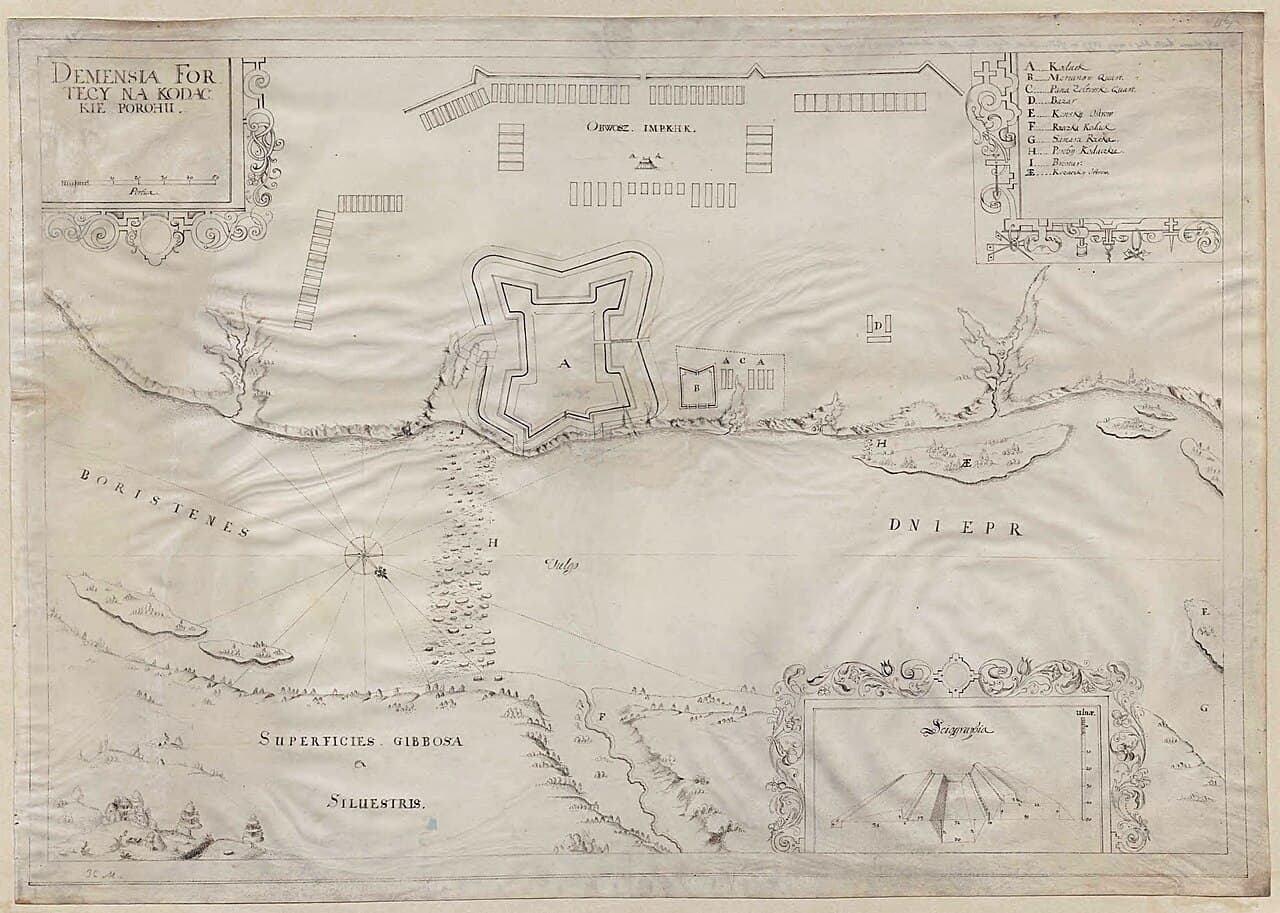
The original layout of Kodak Fortress reflected a quadrangular earthwork design established in 1635. It featured two half-bastions on the southern side, a defensive rampart surrounding the site, and a protective ditch. After reconstruction in 1639, the fortress expanded nearly threefold and was reshaped into a square measuring approximately 112.5 meters on each side. The design followed the New Dutch fortification system, emphasizing angular bastions and layered defenses suited to resist artillery attacks.
The earthen ramparts were substantial, measuring 24 meters wide at the base and rising about 7 meters in height. On top of these ramparts sat two rows of wooden palisades, serving as fencing to provide an additional barrier. Surrounding the fortress on three sides was a broad, dry moat about 11 meters deep and 16 meters wide, designed to hinder attackers. The fourth side faced the steep cliffs of the Dnieper River, offering a natural defensive advantage.
Within the fortress grounds stood religious and residential structures, including a Catholic church with an adjoining monastery and an Orthodox church. Around sixty houses formed a small settlement complete with a market near the walls. The garrison grew to around 600 mercenaries equipped with artillery, supplemented by a large watchtower located roughly three kilometers away, enhancing the site's surveillance capabilities. Some reports indicate the fortress could accommodate more than 1,000 people.
Current condition and preservation efforts
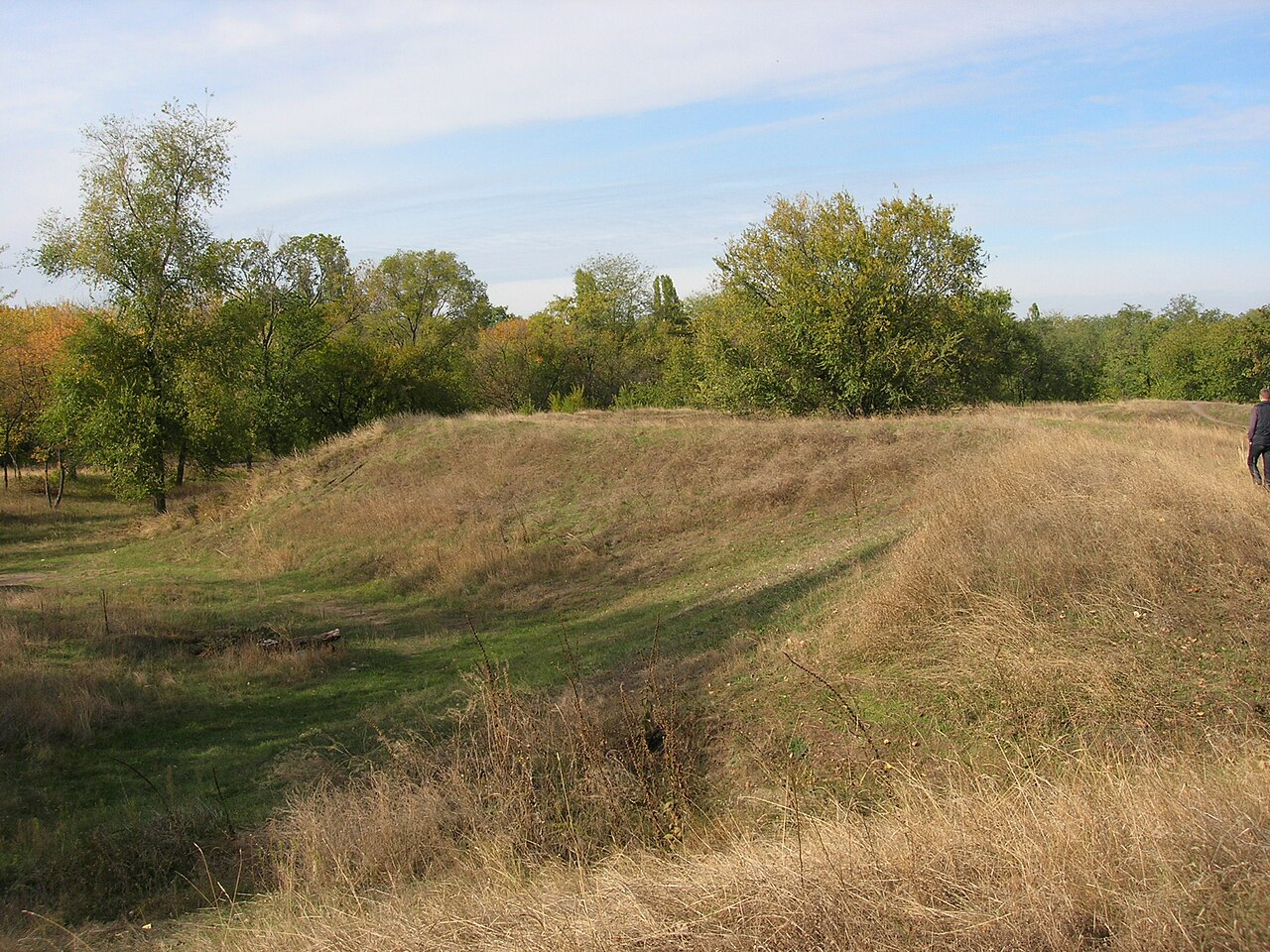
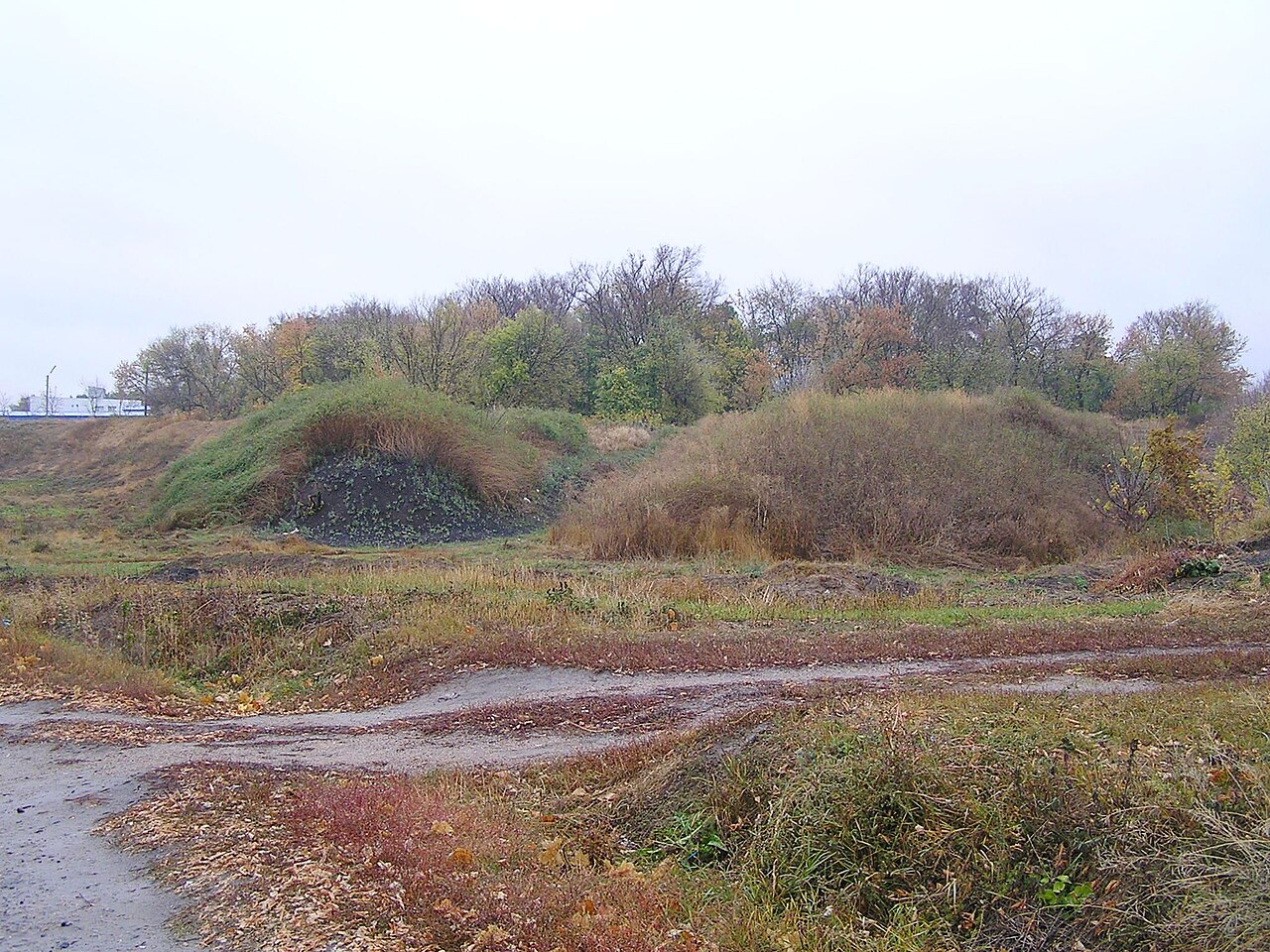
Today, only portions of the northern earth ramparts survive, with much of the fortress demolished due to extensive granite quarrying starting in the late 1930s. Archaeological efforts have identified cultural layers associated with the Cossack period, revealing insights into the fortress's occupation and use.
Excavations have unearthed remnants of the St. Archangel Michael Church, a religious building destroyed in 1937 but confirmed to have stood within the fortress precinct. Recent conservation proposals seek to restore surviving features, including the earthworks and moats.
Plans include reconstructing sections of the wooden fortifications with palisades and drawbridges along the ramparts to give a clearer sense of the original defensive system. A museum complex is being designed on stilts above the quarry lake, aligning with the reconstructed outlines of the fortress as seen from the river, thereby reviving the silhouette of this once-critical military stronghold.
Frequently asked questions (FAQ)
- How do I get to Kodak Fortress from Dnipro city center?
- Kodak Fortress is located near Dnipro and can be reached by local bus or taxi within 20-30 minutes from the city center.
- What is the historical significance of Kodak Fortress?
- Kodak Fortress was a key military outpost built in 1635 to control the Zaporizhian Cossacks and played a major role during the Khmelnytsky Uprising and later conflicts.
- Can I visit the ruins of Kodak Fortress today?
- Yes, the ruins are accessible to the public with free entry. Visitors can explore the surviving earthworks and learn about the site's history through informational displays.
- What architectural style is Kodak Fortress built in?
- Kodak Fortress features a mixed architectural style, primarily influenced by the New Dutch fortification system of the 17th century, combining earthworks, bastions, and wooden palisades.
- When is the best time to visit Kodak Fortress?
- The best time to visit is during the warmer months from late spring to early autumn when the weather is favorable for outdoor exploration of the ruins and surrounding landscape.
Photo gallery

Photo by Friedrich Getkant•Public domain
Information
Opening hours
10:00-18:00, daily
Ticket prices
Free
Current owner
Municipality
Website
Visit websiteSources & official resources
Verify the information above using these authoritative references.
Loading map...
Visitor reviews
No reviews yet. Been here? Write the first review and help other travelers!
Write the first reviewVisited this castle? Share your experience
Your review helps other travelers and adds first-hand knowledge to our encyclopedia.