Knockalla Fort
Knockalla Fort is a significant example of early 19th-century coastal military architecture located on Dunree Head in County Donegal, Ireland. Constructed between 1812 and 1813, this Napoleonic battery was part of a strategic network designed to protect the northwestern coast of Ireland from potential French invasion during the Revolutionary and Napoleonic Wars. The fort was built to secure the important maritime entrance of Lough Swilly, alongside other fortifications such as Fort Dunree on the opposite shore.
Historical context and construction
The fortification at Knockalla was erected on the site of an earlier temporary fortification dating back to 1798, reflecting the ongoing military concerns of the period. The fort's construction was part of a broader British defensive initiative responding to the threat posed by Napoleon's forces. Its completion in the early 19th century marked a critical enhancement of coastal defenses in this region.
Architectural design and layout
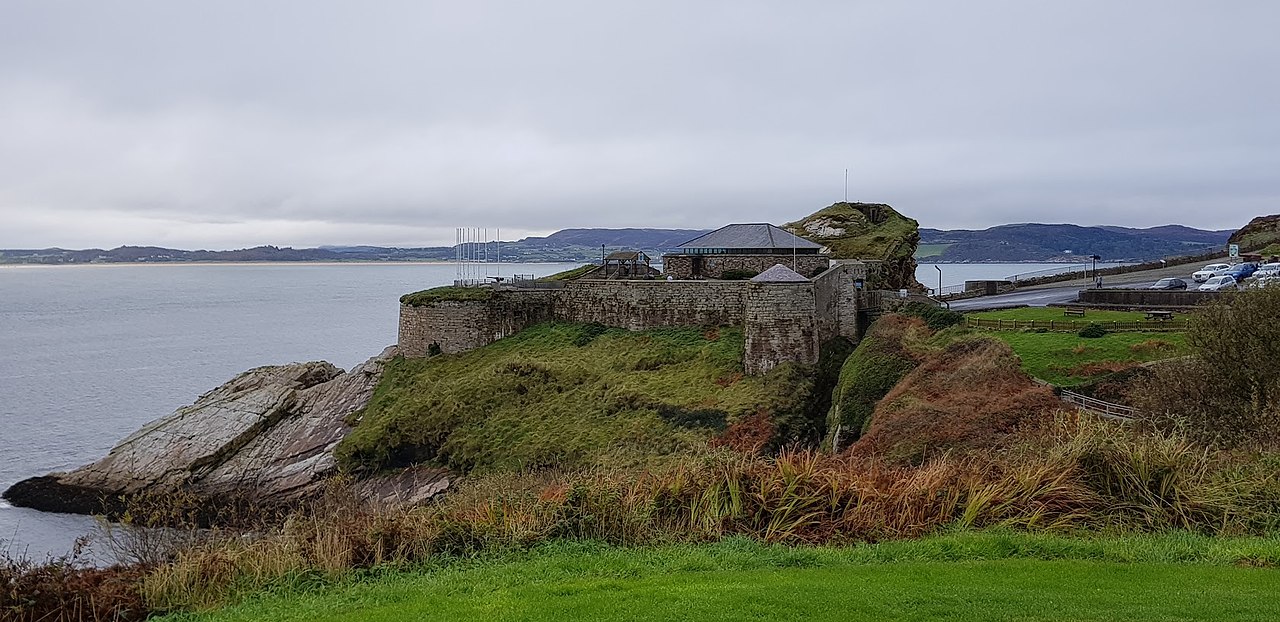
Knockalla Fort has a distinctive triangular plan with a prominent quadrant-shaped tower positioned on the landward salient angle. The tower features rounded corners and was originally armed with a 24-pounder gun and a 5.5-inch howitzer. From the tower, two defensive walls extend downwards, protected by a dry moat that is partly hewn from the natural rock, enhancing the fort's defensive capabilities.
The fort's walls lead to steep rocky cliffs overlooking the sea, where two levels of gun batteries are situated. The lower battery includes seven gun emplacements that initially mounted French 42-pounder smoothbore guns on traversing platforms, designed to cover the approaches by sea. The upper battery contains barracks, a magazine, casemates, and an entrance gateway. It also mounts two 24-pounder smoothbore guns on the northern flank, providing additional firepower.
Defensive features
The combination of the dry moat, the steep cliffs, and the layered batteries created a formidable defense system. The moat served as an obstacle to any landward assault, while the elevated batteries commanded a wide field of fire over the lough's entrance. The fort's design reflects the military engineering principles of the early 19th century, emphasizing artillery placement and natural terrain advantages.
Later history and military use
Following the end of the Napoleonic Wars, Knockalla Fort's military importance diminished. By the 1860s, the fort's armament was reduced and updated with an 18-pounder gun and a 5.5-inch howitzer in the tower, and a 24-pounder gun in the upper battery. Despite these updates, advances in military technology and changing strategic priorities rendered the fort obsolete.
Consequently, the fort was disarmed and abandoned by the military in the 1870s. Since then, it has remained largely intact, preserving its original form and structural elements.
Current status and preservation
Today, Knockalla Fort stands as a well-preserved example of a Napoleonic coastal fortification. Unlike many similar sites, it has not fallen into ruin but has been adapted for use as a private residence. The fort's substantial preservation offers valuable insights into the military architecture and coastal defense strategies of the early 19th century.
Architectural significance
The fort's triangular layout, quadrant-shaped tower, and multi-level gun batteries demonstrate the application of contemporary military engineering designed to maximize defensive capabilities. The use of natural features such as the rock-cut dry moat and steep cliffs highlights the integration of the fort into its rugged coastal environment.
Visiting and cultural heritage
Although privately owned and not generally open to the public, Knockalla Fort remains a point of interest for those studying Napoleonic military history and coastal fortifications in Ireland. Its proximity to other historical sites around Lough Swilly, including Fort Dunree, makes it part of a broader heritage landscape that illustrates the region's strategic military past.
Frequently asked questions (FAQ)
- When was Knockalla Fort built and for what purpose?
- Knockalla Fort was built between 1812 and 1813 as part of a network of coastal defenses to protect Lough Swilly from French invasion during the Napoleonic Wars.
- What is the architectural layout of Knockalla Fort?
- The fort has a triangular plan with a quadrant-shaped tower on the landward angle, two defensive walls with a dry moat, and two levels of gun batteries on steep cliffs.
- Is Knockalla Fort open to the public?
- Knockalla Fort is privately owned and not generally open to the public, but it remains an important historical site visible from the surrounding area.
- What types of artillery were mounted at Knockalla Fort?
- Originally, the fort mounted French 42-pounder smoothbore guns, 24-pounder guns, and a 5.5-inch howitzer. Later, it was armed with an 18-pounder gun and 5.5-inch howitzer before being disarmed.
- What is the current condition of Knockalla Fort?
- The fort is well preserved and has been adapted for use as a private residence, retaining much of its original structure and defensive features.
Information
Current owner
Private owner
Loading map...
Visitor reviews
No reviews yet. Been here? Write the first review and help other travelers!
Write the first reviewVisited this castle? Share your experience
Your review helps other travelers and adds first-hand knowledge to our encyclopedia.