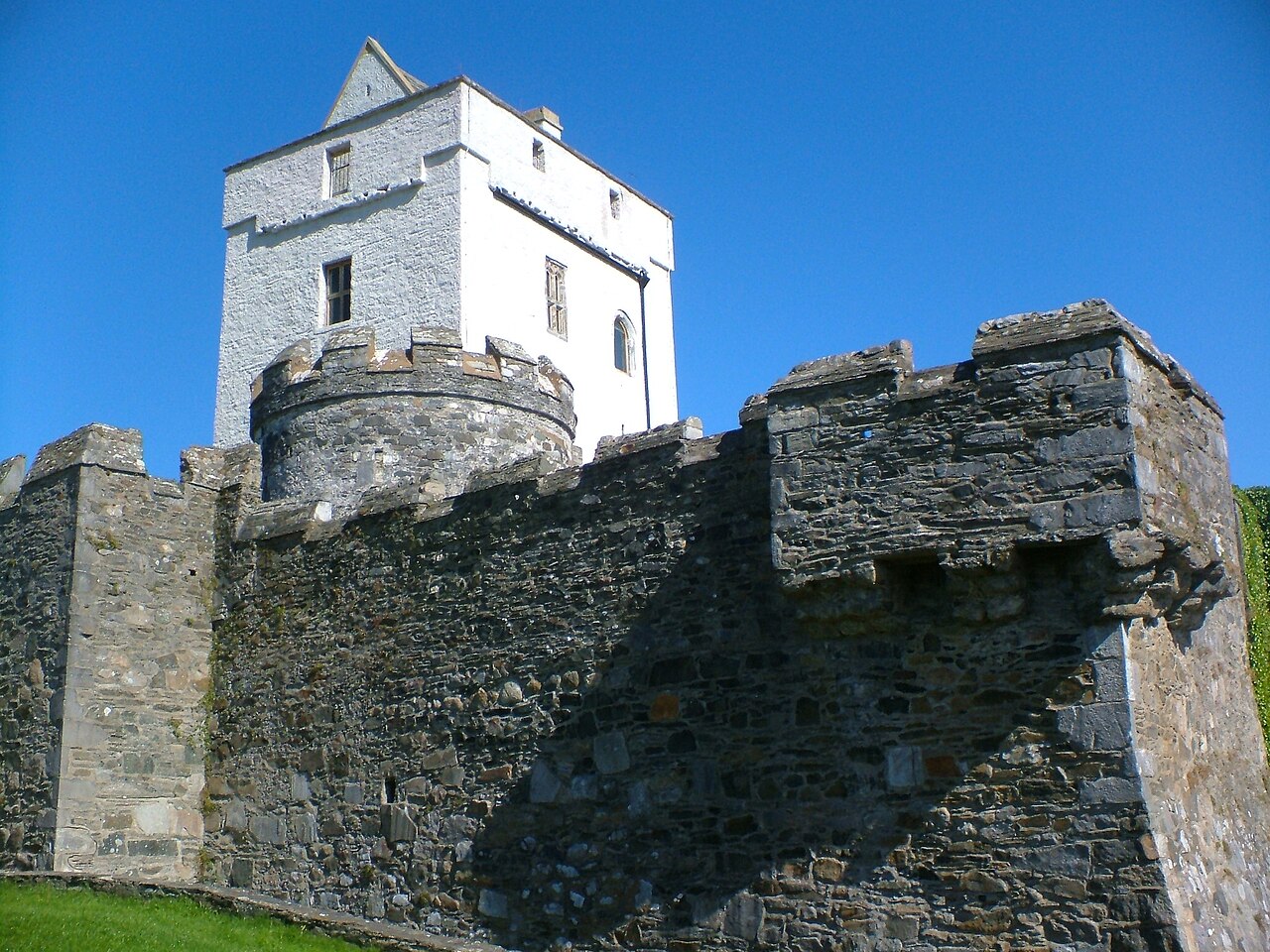
Doe Castle
Doe Castle stands as a prominent late-medieval fortress located in Ulster, in the north-west of Ireland. Constructed around 1420, this castle served as the historical stronghold of the Clan MacSweeney (also known as Clan tSuibhne), a powerful Gaelic family of gallowglass warriors with close ties to Scotland. The castle's strategic position on a small peninsula, surrounded on three sides by water and protected by a moat cut into the rock on the landward side, exemplifies typical defensive features of 15th-century Irish tower houses. Its architecture reflects influences from Scottish tower houses, underlining the cultural and martial connections between the regions during the period.
Architectural features and layout
The castle complex comprises a high outer curtain wall enclosing an interior bawn (a fortified courtyard), with a dominant four-storey tower house or keep at its core. The bawn walls are robust and were designed to protect the inhabitants and their livestock during attacks. The tower house features narrow windows, battlements, and thick stone walls typical of defensive structures of the late-medieval period. The landward moat, cut directly into the rock, enhanced the castle's defensibility by creating a formidable barrier against invaders approaching from inland.
Construction and early ownership
Doe Castle was likely constructed by the Quinn family around 1420, but by the 1440s it had passed into the hands of the MacSweeney family, specifically the branch known as Mac Suibhne na d'Tuath or MacSweeney Doe. The MacSweeneys were gallowglass mercenaries of Scottish origin who became influential landholders in the region. They ruled over territories including Rosguill, Doe (now Creeslough and Dunfanaghy), Cloughaneely (now Falcone), and Tory Island. The clan maintained possession of Doe Castle for almost two centuries, establishing it as their principal seat.
Historical significance and notable events
Throughout its history, Doe Castle played a pivotal role in the turbulent political and military struggles of Ireland. In 1608, the castle served as the headquarters for Sir Cahir O'Doherty during his rebellion and attack on Derry. The MacSweeneys regained control of the castle during the Irish Rebellion of 1641, and in 1642, the famed Irish chieftain Eoghan Rua O'Neill landed at Doe Castle upon his return from Spain, underscoring the castle's strategic importance.
By approximately 1660, a British garrison occupied the castle, reflecting the shifting control during the Cromwellian conquest and subsequent English domination. However, by 1690, the MacSweeney family had briefly reclaimed the stronghold. The castle changed hands multiple times during the 17th century, reflecting the broader conflicts between English and Irish forces. Notably, in 1650, Sir Charles Coote, Governor of Londonderry, took possession of the castle.
Ownership in the 18th and 19th centuries
In 1800, the castle was purchased by George Vaughan Hart, whose initials (GVH) remain carved above the eastern gateway as a testament to his ownership. The Hart family inhabited the castle until 1843. Despite its age, Doe Castle remained occupied until 1909, demonstrating its continued residential viability well into the modern era.
Legends and cultural heritage
The castle is steeped in local legend, most famously the tragic love story of Aileen Turlough. Aileen was the beautiful daughter of Doe Maolmhuire, and Turlough was an O'Boyle from Ballymore. Despite the longstanding enmity between the O'Boyle and MacSweeney clans, Aileen and Turlough fell deeply in love. When her father discovered their relationship, he confined Aileen to the upper room in the castle tower. Turlough was captured by the MacSweeneys while fishing on the nearby Lackagh River and brought back to the castle, where he was killed. Upon seeing his corpse prepared for burial from her tower window, Aileen tragically jumped to her death. To this day, local folklore speaks of their ghosts rowing a boat on the Lackagh River, a haunting reminder of their doomed romance.
Restoration and current status
After falling out of private ownership, Doe Castle was acquired by the Irish Land Commission in 1932 and subsequently declared a national monument in 1934, coming under the care of the Office of Public Works. The castle underwent significant restoration efforts, particularly in the 1990s, focusing on the tower house. Restoration work has included repairing the walls, renovating floors, and reconstructing new staircases faithful to the original design. A new roof was installed on the tower to protect the structure from weather damage, a critical step in preserving the castle's integrity.
Today, Doe Castle is a well-preserved example of a late-medieval Irish tower house and bawn complex. It is open to the public daily, with guided tours available during the summer months that highlight its rich history, architectural features, and cultural significance. The castle remains a symbol of Gaelic resilience and heritage in Ulster, attracting visitors interested in medieval architecture, Irish history, and folklore.
Frequently asked questions (FAQ)
- How do I visit Doe Castle and are guided tours available?
- Doe Castle is open daily to visitors, with guided tours of the tower house offered during the summer months. It is advisable to check local visitor information for seasonal hours and tour availability.
- What is the historical significance of Doe Castle?
- Doe Castle was the stronghold of the MacSweeney clan, playing key roles in 17th-century Irish conflicts including the 1608 rebellion and the 1641 uprising. Its strategic location and architecture reflect its importance in Ulster's history.
- What architectural features make Doe Castle unique?
- Doe Castle features a four-storey tower house surrounded by a high curtain wall and a rock-cut moat on the landward side. Its design shows Scottish tower house influences, with defensive battlements and a fortified bawn courtyard.
- Is Doe Castle accessible to visitors with mobility issues?
- Due to its medieval structure, some areas of Doe Castle, including the tower house, may have limited accessibility. Visitors with mobility concerns should inquire in advance about available accommodations.
- When was Doe Castle restored and who manages it today?
- Significant restoration of Doe Castle took place in the 1990s, focusing on structural repairs and roof replacement. Today, it is managed by the Office of Public Works as a national monument open to the public.
Information
Opening hours
Daily, guided tours in summer
Current owner
Office of Public Works
Loading map...
Visitor reviews
No reviews yet. Been here? Write the first review and help other travelers!
Write the first reviewVisited this castle? Share your experience
Your review helps other travelers and adds first-hand knowledge to our encyclopedia.