Fort Dunree
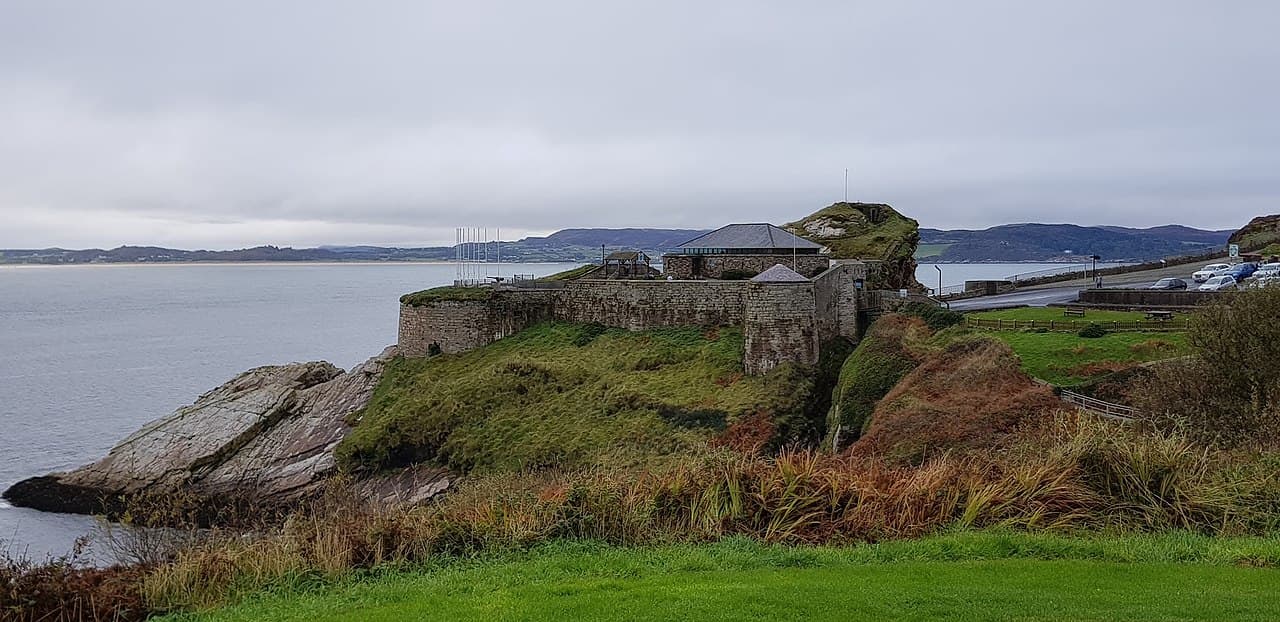
Fort Dunree (Irish: An Dún Riabhach, meaning 'Grey Fort' or Dún Fhraoigh meaning 'Fort of Heather') is a significant bastioned fortress situated on the rugged western coast of the Inishowen Peninsula in County Donegal, Ireland. Overlooking the strategic entrance to Lough Swilly, this 19th-century fortification was built to protect one of Ireland's most important natural harbors, which has served as a naval base and anchorage for centuries.
Historical background and strategic importance
The construction of Fort Dunree was part of a wider British military strategy during the 19th century to safeguard key coastal points against potential naval threats. The fort was designed to defend Lough Swilly, a deep-water inlet that provided a natural harbor for naval fleets. Its location on a steep cliff gave it a commanding view over the surrounding sea approaches, making it an ideal site for coastal defense.
The fort's military significance extended through both World Wars, serving as a coastal artillery battery to protect against naval incursions. Its position allowed it to monitor and control access to the lough, which was used by the British Royal Navy and later by Irish forces.
Architectural features and design
Fort Dunree is an example of a bastioned fortress, a style characterized by angular bastions projecting from the main walls to provide overlapping fields of fire. This design was intended to eliminate blind spots and enhance defensive capabilities against enemy ships and landing parties.
The fort's walls are constructed from robust local stone, integrating with the natural rocky landscape. The bastions are equipped with artillery emplacements designed to house heavy coastal guns. The layout includes gun platforms, magazines, barracks, and observation posts, all arranged to maximize defensive efficiency.
Access to the fort was carefully controlled through fortified gates and a network of defensive earthworks. The steep cliffs surrounding the site also acted as natural barriers, making direct assault difficult.
Military use and armament
Throughout its operational history, Fort Dunree was armed with a range of coastal artillery pieces, including large-caliber guns capable of engaging enemy vessels at considerable distances. These weapons were mounted on rotating platforms to allow wide firing arcs.
During the 20th century, the fort was updated to accommodate modern artillery and observation equipment. It played a defensive role during both World War I and World War II, although it never saw direct combat.
After Irish independence, the fort was maintained by the Irish Defence Forces for coastal defense purposes before eventually being decommissioned.
Current status and visitor experience
Today, Fort Dunree is a well-preserved historic site open to the public as a military museum and heritage center. Visitors can explore the extensive fortifications, including the bastions, gun emplacements, and barracks. The site offers panoramic views over Lough Swilly and the Atlantic Ocean.
The museum exhibits a collection of military artifacts, weapons, and historical displays that illustrate the fort's role in coastal defense. Walking trails around the site provide access to natural features and wildlife habitats, enhancing the visitor experience.
The fort's preservation allows insight into coastal military architecture of the 19th and 20th centuries, making it an important cultural and historical attraction in County Donegal.
Geographical setting and natural environment
Located on a steep promontory, Fort Dunree commands a strategic position overlooking the narrow entrance to Lough Swilly. The surrounding landscape is characterized by rugged cliffs, heathland, and coastal flora, reflecting the fort's Irish name referencing heather.
The natural environment around the fort supports diverse birdlife and marine species, contributing to its appeal as a destination for both history enthusiasts and nature lovers.
Frequently asked questions (FAQ)
- How do I get to Fort Dunree?
- Fort Dunree is located on the Inishowen Peninsula in County Donegal, Ireland. It is accessible by car via local roads from nearby towns such as Buncrana and Carndonagh. Signage directs visitors to the site.
- What are the opening hours of Fort Dunree?
- The fort is generally open to visitors daily during the warmer months, typically from 10:00 to 17:00. It is advisable to check the official website or local tourist information for seasonal variations.
- Is there an admission fee to visit Fort Dunree?
- Yes, there is a modest admission fee to enter the museum and explore the fortifications. Prices vary but are generally affordable, with discounts for children and groups.
- What can I see at Fort Dunree?
- Visitors can explore the extensive bastioned walls, gun emplacements, barracks, and observation posts. The museum houses military artifacts and exhibits detailing the fort's history and coastal defense role.
- Is Fort Dunree suitable for families and children?
- Yes, the site is family-friendly with accessible walking paths and educational displays. Children can learn about military history in an engaging outdoor setting.
- When was Fort Dunree built?
- Fort Dunree was constructed in the 19th century as part of British coastal defenses to protect Lough Swilly.
Photo gallery

Information
Loading map...
Visitor reviews
No reviews yet. Been here? Write the first review and help other travelers!
Write the first reviewVisited this castle? Share your experience
Your review helps other travelers and adds first-hand knowledge to our encyclopedia.