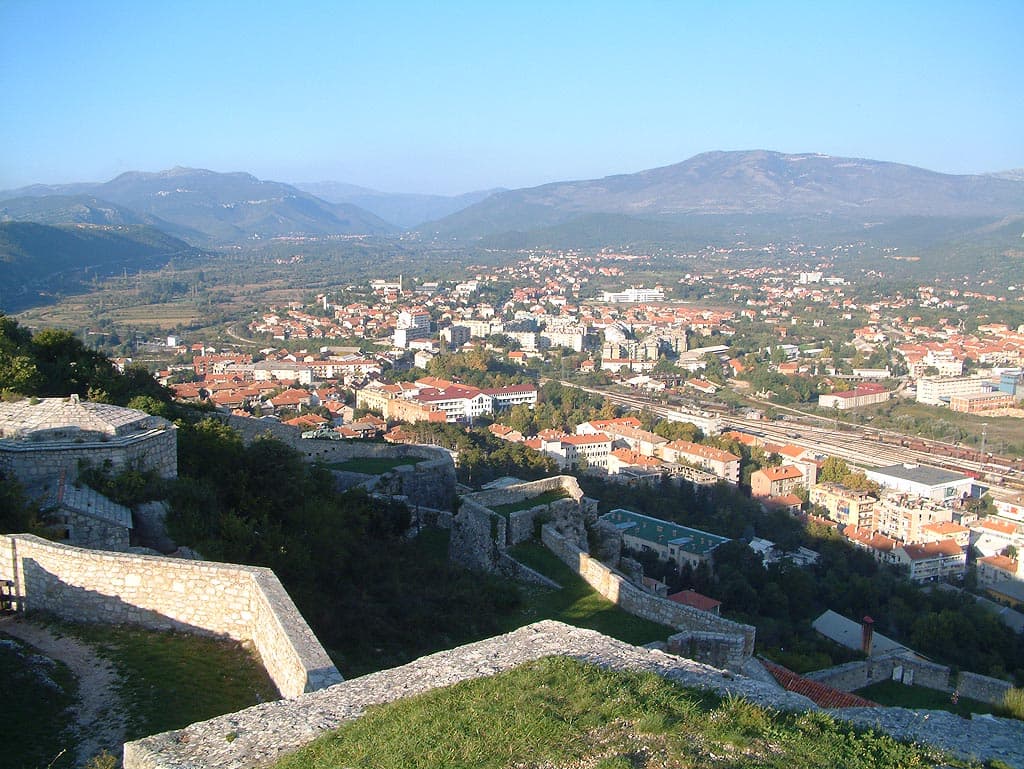
Knin Fortress
Knin Fortress is a monumental bastioned fortress located in Knin, Croatia, strategically positioned near the tallest mountain in Croatia, Dinara, and close to the source of the river Krka. It stands as the second largest fortress in Croatia and is considered one of the most significant defensive strongholds in the Dalmatian Hinterland. The fortress occupies a commanding position on the main transport corridor linking Dalmatia to continental Croatia and Bosnia, underscoring its historical importance as a military and administrative center.
The origins of Knin Fortress date back to the 8th century AD, with archaeological evidence indicating that the area had been populated since the 6th century. The fortress was constructed by the Croats shortly after they settled in the region, near the ruins of a devastated Roman settlement. It became a vital residence for Croatian monarchs, notably reaching its zenith during the reign of King Demetrius Zvonimir (r. 1075–1089), when Knin served as a political and military center of the Croatian Kingdom. Its location made it a safer seat of power from which to govern the lands of Liburnia and Dalmatia, and to facilitate the Christianization of the pagan Croats in the regions of Gacka, Lika, and Krbava.
Historical development and significance
The fortress evolved significantly over the centuries. In the 14th century, Knin Fortress was divided into a small town and a big town. The small town was primarily a defensive stronghold, while the big town contained residential quarters for the town's governors, bishops, and župans (local officials). Surrounding suburbs developed just outside the fortress walls, reflecting the growth of the settlement.
The oldest section of the fortress is the upper town located on the northern side. The middle and lower towns were additions from the Late Middle Ages. During the 15th century, as the threat from the advancing Ottoman Empire increased, an additional defensive wall was constructed, which included the main entrance to the fortress as it stands today. This outer wall, together with the original fortifications, formed a unified defensive complex comprising multiple citadels.
In May 1522, the fortress endured a significant siege by the Ottoman forces, culminating in its capture on 29 May 1522. Later, in the late 17th century, the fortress was conquered by the Venetians and remained under their control until the fall of the Republic of Venice in 1797. This period saw further architectural enhancements, particularly in the fortifications, adapting the fortress to contemporary military needs.
Architectural features and layout
The fortress is divided into three main sections: northern, middle, and southern. Each section is fortified with loopholes and gun holes designed for defense and is interconnected by city gates and drawbridges. The northern section, the oldest part, was developed from the mid-8th century through to the end of the 11th century, reflecting early medieval military architecture.
The main entrance to the fortress features baroque stone gates with robust oakwood doors reinforced by iron nails. These gates were likely constructed by Ignacije Macanović, a builder from Trogir, and bear the emblem of the Venetian Republic above them, symbolizing Venetian authority during their occupation. The entrance leads into the fortress complex where several important buildings stand.
Adjacent to the northern entrance is the former governor of arms' building, which now serves as the old city hall. Nearby are the former barracks, which have been repurposed as the gallery of the Museum of Knin. A memorial to fra Lujo Marun (1857–1939), a friar and pioneering archaeologist who initiated excavations in the area and uncovered key remnants of Croatian heritage, is also located here.
Within the fortress is the church of St. Barbara, which houses a bell gifted by Pope John Paul II during his visit in 1994, emphasizing the fortress's continued cultural and religious significance.
Venetian period and later modifications
The current state of the fortress largely reflects the work of Venetian military engineer Alberghetti, who completed significant construction work by 1711. The Venetians enhanced the fortress's defensive capabilities, adapting it to the requirements of early modern warfare, including the use of bastions and artillery positions. The fortress's robust stone walls and bastioned design exemplify the military architectural trends of the period.
Knin Fortress is protected today as a historical urban complex and is listed in the register of the Cultural Heritage of Croatia as a monument of top importance. Its preservation allows visitors to explore a site that reflects centuries of military, political, and cultural history in the region.
Visiting Knin Fortress
Visitors to Knin Fortress can explore its extensive fortifications, historical buildings, and museum exhibits. The fortress offers panoramic views of the surrounding Dalmatian hinterland and the nearby Dinara mountain range. Its layered architecture provides insight into the evolution of defensive structures from the early medieval period through the Venetian era.
The fortress's location near Knin town makes it accessible for tourists interested in Croatian history and medieval architecture. The site is an important cultural landmark that illustrates the strategic role Knin played in the defense and administration of the Croatian Kingdom and later Venetian territories.
Frequently asked questions (FAQ)
- What is Knin Fortress known for?
- Knin Fortress is renowned for its impressive historical significance as a military stronghold that dates back to the Roman period. It played a crucial role in the defense of the region and offers stunning views of the surrounding landscape, making it a popular site for both history enthusiasts and tourists.
- When was Knin Fortress built?
- Knin Fortress was originally constructed in the 9th century, with various modifications and expansions occurring over the centuries. Its strategic location and robust architecture have allowed it to withstand numerous sieges, reflecting its importance throughout Croatian history.
- Is it possible to visit Knin Fortress year-round?
- Yes, Knin Fortress is open to visitors year-round. However, the best time to visit is during the spring and early fall, when the weather is mild and the landscape is particularly beautiful.
- Can I access the fortress with limited mobility?
- The fortress has some areas that may be challenging for individuals with limited mobility due to its historical architecture and uneven terrain. It is advisable to check with local guides for the best routes and accessibility options before your visit.
- What are the opening hours for Knin Fortress?
- Knin Fortress typically opens at 9 AM and closes at 7 PM during the summer months, while winter hours may vary. It's recommended to check the official website for the most current information before planning your visit.
- What are the ticket prices for visiting Knin Fortress?
- Entrance to Knin Fortress is generally free, allowing visitors to explore its majestic walls and historical features without any cost. However, guided tours or special exhibitions may have associated fees, so it's best to inquire upon arrival.
- What nearby attractions can I visit while in Knin?
- While in Knin, visitors can explore the stunning Krka National Park, famous for its waterfalls and hiking trails. Additionally, the town of Knin itself is rich in history, with several museums and cultural sites to enjoy.
Photo gallery

Photo by No machine-readable author provided. Kork~commonswiki assumed (based on copyright claims).•Public domain
Information
Loading map...
Visitor reviews
No reviews yet. Been here? Write the first review and help other travelers!
Write the first reviewVisited this castle? Share your experience
Your review helps other travelers and adds first-hand knowledge to our encyclopedia.



