Kilmartin Castle
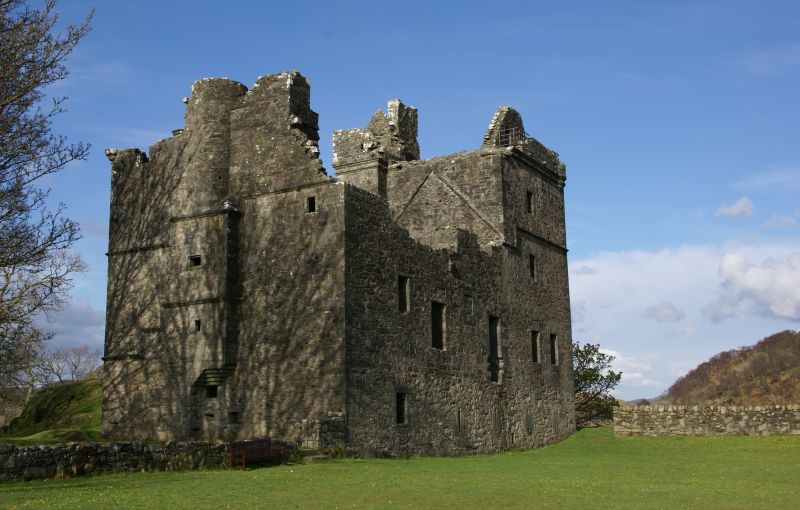
Kilmartin Castle is a notable example of a Renaissance-era tower house located in Argyll and Bute, Scotland. Built around 1580, this small castle stands prominently above the village of Kilmartin, embodying the architectural and historical characteristics of Scottish tower houses of the late 16th century. It was historically associated with the powerful Campbell family, whose members are interred in the nearby churchyard, highlighting the castle's significance within local noble lineage.
Architectural features and layout
The castle's structure consists of an oblong, three-storey main block which is complemented by two round towers positioned at the north-east and south-west corners. This design was typical for Scottish tower houses of the period, combining residential space with defensive elements. Additionally, a small stair tower is located on the west front, providing access between floors while maintaining the castle's compact footprint.
Defensive features are evident throughout the building, including shot holes strategically placed for musket fire and iron yetts (grilles) over the windows, which were intended to protect against forced entry while allowing light and air into the interior. These elements reflect the turbulent times in late 16th-century Scotland, when smaller noble residences needed to balance comfort with security.
Historical context and occupants
Kilmartin Castle was once the residence of John Carswell, the Rector of Kilmartin who later became the titular Bishop of the Isles. His occupancy connects the castle to the ecclesiastical history of the region. Carswell eventually moved to Carnasserie Castle, another notable estate in Argyll, which further underscores the interconnected nature of local noble and clerical families during this period.
The castle's ownership by the Campbells situates it within the broader narrative of one of Scotland's most influential clans. The Campbells' presence in Kilmartin and their burial in the adjacent churchyard demonstrate the castle's role not only as a defensive residence but also as a familial and social hub.
Restoration and current condition
Although Kilmartin Castle fell into ruin in earlier centuries, it has been restored as a private residence in recent years. The restoration carefully preserved key historical features such as the shot holes and iron yetts, maintaining the castle's authentic appearance and defensive character. The castle's current well-preserved state allows visitors and historians alike to appreciate the architectural style and historical significance of a Scottish Renaissance tower house.
Significance within Scottish castle architecture
Kilmartin Castle exemplifies the Renaissance architectural style adapted to the Scottish context, where tower houses served as fortified homes for the nobility. Its compact design, defensive features, and integration into the landscape reflect the practical needs and social status of its inhabitants. The castle's preservation contributes valuable insight into the evolution of Scottish domestic fortifications during the late 16th century.
Frequently asked questions (FAQ)
- How do I get to Kilmartin Castle?
- Kilmartin Castle is located in Argyll and Bute, Scotland, easily accessible by car or public transport. If driving, you can follow the A816 road towards Kilmartin, where you'll find signage directing you to the castle. Public transport options include local buses that connect to nearby towns.
- What is the historical significance of Kilmartin Castle?
- Kilmartin Castle dates back to the 12th century and is rich in history, serving as a stronghold for the local clan. It played a significant role in the region's feudal system and has been a witness to many historical events over the centuries. The castle is also surrounded by ancient burial sites and stone circles, making it a key site for understanding the area's past.
- When was Kilmartin Castle built?
- Kilmartin Castle was constructed in the 12th century, making it one of the oldest surviving castles in Scotland. Its original architecture reflects the medieval design, and over the years, it has undergone several renovations. The castle's enduring structure offers a glimpse into the architectural styles of the period.
- Can I visit Kilmartin Castle?
- Yes, Kilmartin Castle is open to visitors, allowing you to explore its historical grounds and learn about its significance. Guided tours may be available, providing insights into the castle's past and architecture. Check the castle's official website for current visiting hours and any special events.
- Why is Kilmartin Castle a popular tourist destination?
- Kilmartin Castle attracts visitors due to its rich history, stunning architecture, and picturesque setting in the Scottish countryside. The surrounding area is also filled with prehistoric sites, making it a fascinating destination for history enthusiasts. Additionally, it offers a tranquil experience away from bustling tourist spots.
- Is it possible to access Kilmartin Castle with a wheelchair?
- Yes, Kilmartin Castle is committed to providing accessibility for all visitors. While some areas may have limited access due to the castle's historical structure, staff are available to assist with wheelchair access and provide alternatives where necessary. It's advisable to contact the castle in advance for specific accessibility inquiries.
- What are the opening hours for Kilmartin Castle?
- Kilmartin Castle typically opens daily from 10 AM to 5 PM, but hours may vary seasonally. It's important to check the official website or contact the castle directly for up-to-date information before your visit. Special events may also affect regular opening hours.
- What are the ticket prices for visiting Kilmartin Castle?
- Ticket prices for Kilmartin Castle are usually affordable, with discounts available for children, seniors, and families. Children under a certain age may enter free of charge. For the latest pricing and any special offers, please refer to the castle's official website before planning your visit.
- What nearby attractions can I visit after Kilmartin Castle?
- After visiting Kilmartin Castle, you can explore the nearby Kilmartin Glen, home to numerous ancient monuments, including standing stones and burial cairns. The village of Kilmartin also offers charming shops and cafes. Additionally, the coastal town of Oban is a short drive away, featuring beautiful scenery and local seafood.
Information
Loading map...
Visitor reviews
No reviews yet. Been here? Write the first review and help other travelers!
Write the first reviewVisited this castle? Share your experience
Your review helps other travelers and adds first-hand knowledge to our encyclopedia.