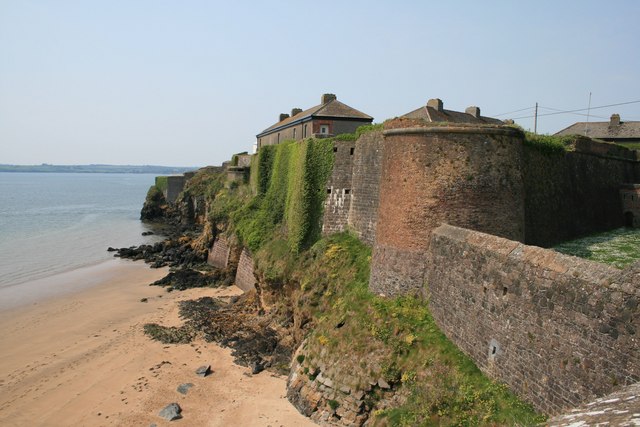
Kilcloggan Castle
Kilcloggan Castle is a notable example of a 14th-century late medieval tower house located in the townland of Kilcloggan in County Wexford, Ireland. This slender, square castle rises to approximately 17 meters in height and reflects the architectural and historical legacy of the Knights Hospitallers of St John, who are believed to have constructed it as the center of their manor on the Hook Peninsula.
The knights hospitallers and their manorial influence
The Knights Hospitallers were a military and religious order active during the medieval period, known for their role in the Crusades and for establishing fortified sites across Europe. Kilcloggan Castle served as a strategic stronghold and administrative center for the order's holdings in the region. Alongside Kilcloggan, the Knights Hospitallers controlled other significant castles on the Hook Peninsula, including Ballyhack Castle and Slade Castle. Their presence in this part of Ireland was part of a broader network of fortifications that helped secure their territorial and economic interests.
Architectural features and layout
Kilcloggan Castle is characterized by its slender, square plan typical of many late medieval tower houses in Ireland. Standing approximately 17 meters tall, the castle would originally have been surrounded by a bawn—a defensive walled courtyard—though this feature has not survived to the present day. The tower house likely contained multiple floors with narrow windows and thick stone walls designed for defense as well as habitation. Its vertical emphasis and compact footprint reflect the need for both protection and efficient use of space during the turbulent medieval period.
Historical ownership and changes
The castle's history is closely tied to the fate of the Knights Hospitallers, who were suppressed in Ireland in 1541 during the Tudor reformation of monastic and military orders. Following this suppression, Kilcloggan Castle changed hands several times. By 1587, it was held by Henry Radcliffe, a figure associated with the English administration in Ireland. Shortly thereafter, in 1591, ownership passed to Sir Dudley Loftus, whose family retained possession of the castle until the late 19th century. This continuity of ownership through the Loftus family reflects the castle's role as a landed estate rather than a purely military fortress in later centuries.
Current status and accessibility
Today, Kilcloggan Castle stands within the garden of a private residence, limiting public access to the site. Despite its restricted accessibility, the castle remains an important architectural and historical monument within County Wexford. Its preservation as a well-preserved late medieval tower house offers valuable insight into the defensive structures and manorial estates of the period.
Significance in Irish medieval architecture
Kilcloggan Castle exemplifies the typical Irish tower house form that proliferated during the late medieval period. These structures combined residential and defensive functions, often serving as the homes of local lords or military orders. The castle's association with the Knights Hospitallers adds an additional layer of historical interest, highlighting the role of religious military orders in shaping the medieval landscape of Ireland. While many tower houses have fallen into ruin, Kilcloggan's relatively intact state provides a valuable case study for scholars and enthusiasts of medieval architecture.
Architectural details and defensive features
The castle's square tower design includes thick stone walls that would have provided substantial protection against attackers. Narrow slit windows allowed defenders to observe and repel assaults while minimizing vulnerability. The original bawn would have added an outer layer of defense, enclosing the courtyard and ancillary buildings such as stables or workshops. Internally, the tower likely featured vaulted chambers and a spiral staircase, common elements in tower houses designed to maximize defense and efficient movement within limited space.
Context within the Hook Peninsula
The Hook Peninsula, where Kilcloggan Castle is situated, was a strategic location during the medieval period due to its coastal position and access to maritime routes. The presence of multiple castles, including Ballyhack and Slade, underscores the peninsula's importance as a defensive and administrative region. Kilcloggan Castle's role as the center of the Knights Hospitallers' manor highlights its significance within this network of fortifications.
Frequently asked questions (FAQ)
- Can I visit Kilcloggan Castle?
- Kilcloggan Castle is located within a private residence's garden and is not open to the public for visits.
- When was Kilcloggan Castle built and by whom?
- Kilcloggan Castle was built in the 14th century by the Knights Hospitallers of St John as their manorial center on the Hook Peninsula.
- What architectural style characterizes Kilcloggan Castle?
- Kilcloggan Castle is a late medieval tower house featuring a slender, square plan typical of defensive residences from the 14th century in Ireland.
- What happened to the Knights Hospitallers' ownership of the castle?
- The Knights Hospitallers were suppressed in 1541, after which Kilcloggan Castle passed to various owners, including Henry Radcliffe and later Sir Dudley Loftus.
- Is Kilcloggan Castle part of a larger network of castles?
- Yes, Kilcloggan Castle was part of the Knights Hospitallers' holdings on the Hook Peninsula, alongside Ballyhack Castle and Slade Castle.
Information
Current owner
Private owner
Address
East of L4045 Broomhill Point, Hook Peninsula, County Wexford, Ireland
Loading map...
Visitor reviews
No reviews yet. Been here? Write the first review and help other travelers!
Write the first reviewVisited this castle? Share your experience
Your review helps other travelers and adds first-hand knowledge to our encyclopedia.