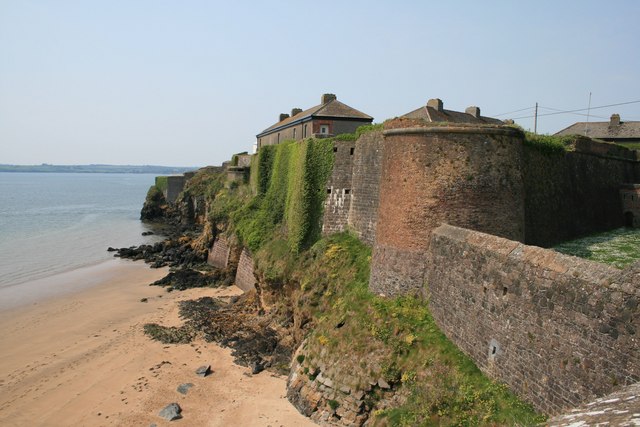
Duncannon Fort
Duncannon Fort is a prominent 17th-century bastioned fort located on a rocky promontory at the waterfront village of Duncannon in County Wexford, Ireland. Its strategic position overlooking the estuary of the River Barrow and River Suir made it a key defensive site for controlling access to the important port city of Waterford. The fort's location on a natural headland allowed it to command the surrounding waterways and protect against naval threats.
Early history and initial fortifications
The site of Duncannon Fort was originally occupied by a tower house with a bawn, held by John Etchingham in 1508. This early medieval structure served as a fortified residence typical of the period, providing a defensible position on the rocky promontory. However, the increasing military threats of the late 16th century, particularly the fear of Spanish invasion during the Anglo-Spanish conflicts, necessitated a more robust fortification.
Construction of the bastioned fort
Between the 1580s and 1590s, the original tower house was replaced by a comprehensive bastioned fort designed by the British to defend the southeastern coast of Ireland. This fortification exemplified the Renaissance military architecture style, which incorporated angled bastions to provide overlapping fields of fire and eliminate blind spots. The fort's design included thick stone walls, bastions at the corners, a dry moat, and gun embrasures for artillery placement. These features reflected advances in fortification technology adapted to withstand cannon fire and sieges.
Role in the Irish Confederate Wars
Duncannon Fort played a significant role during the turbulent Irish Confederate Wars in the mid-17th century. In 1642, the fort successfully withstood a siege by the Irish Catholic Confederation, showcasing its strong defensive capabilities. However, during a subsequent siege in 1645, the Confederation forces succeeded in capturing the fort. The fort's strategic importance continued as Oliver Cromwell attempted to retake it in 1649 but failed. Eventually, after a prolonged blockade, the fort surrendered in 1650 to Cromwellian forces.
Visits by English monarchs
In 1690, Duncannon Fort was visited by two English kings amidst the Williamite War in Ireland. James II and later William III both inspected the fort, emphasizing its ongoing military significance during this period of conflict between Jacobite and Williamite forces.
Later military use and decline
The fort remained under British control with a garrison stationed there until 1857, serving as a coastal defense point. Following Irish independence movements, the fort was handed over to the Irish National Army in 1921. However, during the Irish Civil War in 1922, the fort was deliberately burned down by the Irish Republican Army (IRA), causing significant damage to its structures.
Restoration and modern era
Despite the damage, Duncannon Fort was restored for military use during World War II, when it served as a defensive position for the Irish army. The fort was eventually decommissioned in 1993 and transferred to the Wexford County Council. Since then, it has been developed into a museum and heritage site, open to visitors interested in its rich military history and architectural features.
Architectural features and visitor experience
The fort's layout includes prominent bastions designed for artillery defense, thick curtain walls, and a central courtyard. Visitors can explore the ramparts, gun platforms, and remaining defensive works that illustrate the evolution of military architecture from the late medieval period through the Renaissance. The museum housed within the fort offers exhibits on its historical sieges, military significance, and role in Irish history.
Visiting hours vary seasonally, and there is an admission fee to access the site. The fort's waterfront setting provides scenic views of the estuary and surrounding countryside, enhancing the visitor experience.
Frequently asked questions (FAQ)
- How do I get to Duncannon Fort?
- Duncannon Fort is located in the village of Duncannon, easily accessible by car and public transport. If you're traveling by car, you can find parking nearby. There are also local bus services that connect to the fort from surrounding areas.
- What is the historical significance of Duncannon Fort?
- Duncannon Fort was built in the 16th century as a defensive structure to protect the entrance of Waterford Harbour. It played a crucial role during various conflicts, including the Williamite War and the Napoleonic Wars, and is an important part of the military history of Ireland.
- When was Duncannon Fort constructed?
- Construction of Duncannon Fort began in 1588, with significant modifications and expansions made in the 17th and 19th centuries. This long history has contributed to its architectural richness and historical value. Today, visitors can explore the fort's various structures and learn about its evolution over the centuries.
- Can I visit Duncannon Fort year-round?
- Yes, Duncannon Fort is open to visitors throughout the year, although opening hours may vary by season. It is advisable to check the official website for the most current information regarding hours and any seasonal events. This ensures you can plan your visit accordingly.
- Why is Duncannon Fort popular among tourists?
- Duncannon Fort attracts tourists for its stunning coastal views, rich history, and impressive architecture. Visitors enjoy exploring the fort's walls and bastions, as well as engaging in guided tours that provide in-depth insights into its past. Its picturesque setting also makes it a great spot for photography.
- Is it possible to access all areas of Duncannon Fort?
- While many areas of Duncannon Fort are accessible to visitors, some sections may have restricted access due to preservation efforts or safety concerns. However, the main attractions and exhibition spaces are open to the public, allowing for a comprehensive experience of the fort's history and architecture.
- What are the ticket prices for Duncannon Fort?
- Ticket prices for Duncannon Fort are typically very affordable, with discounts available for children, seniors, and families. It's recommended to check the official website for the most accurate and up-to-date pricing information before your visit. This ensures you can budget appropriately for your trip.
- What are the opening hours of Duncannon Fort?
- Duncannon Fort generally opens daily, with specific hours that may vary depending on the season. During peak tourist months, the fort may have extended hours to accommodate visitors. Always check the official site for current hours to avoid any disappointment.
- What nearby attractions can I visit while in Duncannon?
- While visiting Duncannon Fort, you can also explore the charming village of Duncannon, known for its beautiful beach and scenic walking trails. Other nearby attractions include the historic town of New Ross and the scenic landscapes of the Hook Peninsula, making for a full day of exploration.
Information
Loading map...
Visitor reviews
No reviews yet. Been here? Write the first review and help other travelers!
Write the first reviewVisited this castle? Share your experience
Your review helps other travelers and adds first-hand knowledge to our encyclopedia.