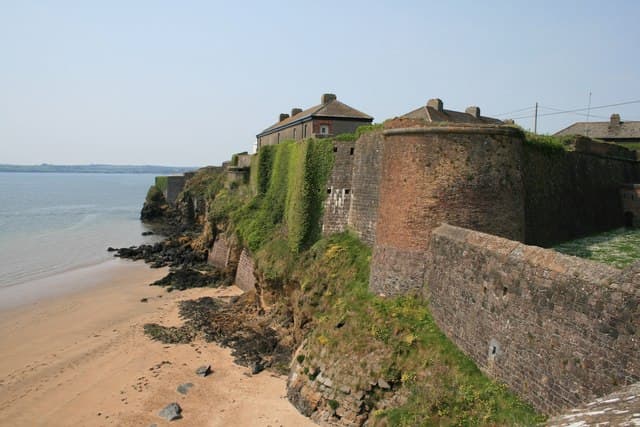
Duncannon Fort
Duncannon Fort is a prominent star-shaped bastioned fortress located in County Wexford, Ireland. Constructed in the 16th century during the Renaissance period, it was strategically positioned to guard the entrance to the Waterford Harbour and control access along the southeastern coast of Ireland. This National Monument exemplifies the military architectural advancements of its time, designed to withstand artillery sieges and naval attacks.
Strategic location and historical significance
The fort occupies a commanding position on a rocky promontory overlooking the Barrow estuary, a vital waterway that leads into the interior of Ireland. Its location was chosen to protect the important maritime trade routes and to serve as a defensive stronghold against potential invasions, particularly from English and later British forces. Throughout its history, Duncannon Fort played a key role in various military conflicts, including the Irish Confederate Wars in the 17th century and the Williamite War in Ireland.
Architectural features of duncannon fort
The fort is a classic example of a bastioned fortress, characterized by its angular bastions projecting outward from the main walls. This design allowed defenders to cover all approaches with overlapping fields of fire, eliminating blind spots and enhancing the fort's defensive capabilities. The star fort layout, influenced by Renaissance military engineering principles, was intended to resist cannon fire and provide a strong defensive perimeter.
The walls of Duncannon Fort are constructed of thick stone masonry, with ramparts and curtain walls surrounding a central courtyard. The fort includes multiple bastions, each equipped with gun emplacements designed to mount cannons. Inside, there are magazines for storing gunpowder and ammunition, as well as barracks and other service buildings to accommodate the garrison.
Defensive structures and layout
The fort's moat and ditch further enhanced its defenses, making direct assaults difficult. The entrance was protected by a gatehouse with defensive features such as murder holes and portcullises. The design reflects the evolution of fortification architecture from medieval castles to early modern military engineering.
Historical events and military use
Duncannon Fort's robust defenses enabled it to withstand several sieges, most notably during the Siege of Duncannon in 1645, when it was held by English Parliamentarian forces against Irish Confederate troops. Later, during the Williamite War, the fort was a significant stronghold for the Jacobite forces loyal to King James II. Its capture by Williamite forces was a strategic victory that helped secure control over southeastern Ireland.
In subsequent centuries, the fort was modernized to adapt to changing military technologies but gradually lost its strategic importance. It was eventually decommissioned as a military installation and preserved as a historical site.
Preservation and public access
Today, Duncannon Fort is a well-preserved example of Renaissance military architecture and is protected as a National Monument. Visitors can explore the extensive ramparts, bastions, and interior buildings, gaining insight into the fort's defensive features and historical role. The site offers panoramic views of the surrounding coastline and estuary, enhancing its appeal as a cultural and heritage attraction.
Interpretive signage and guided tours provide educational context about the fort's construction, military history, and architectural significance. The fort's accessibility and historical importance make it a valuable destination for those interested in Ireland's military past and Renaissance fortification design.
Frequently asked questions (FAQ)
- How do I get to Duncannon Fort in County Wexford?
- Duncannon Fort is located in County Wexford, Ireland, accessible by car via local roads connecting to the N25. Public transportation options include regional buses that serve the nearby town of Duncannon, followed by a short walk to the fort.
- What is the historical significance of Duncannon Fort?
- Duncannon Fort played a crucial role in protecting Waterford Harbour and the southeastern coast of Ireland during the 16th century and subsequent conflicts such as the Irish Confederate Wars and the Williamite War. Its bastioned design reflects Renaissance military engineering advancements.
- Can visitors explore inside Duncannon Fort?
- Yes, the fort is well-preserved and open to the public, allowing visitors to explore its bastions, ramparts, and interior buildings. Guided tours and informational signage enhance the visitor experience by explaining the fort's history and architecture.
- When was Duncannon Fort built?
- Duncannon Fort was constructed in the 16th century, during the Renaissance period, incorporating star fort design principles to defend against artillery attacks.
- Is Duncannon Fort wheelchair accessible?
- While the fort offers extensive outdoor areas and ramparts to explore, some parts may be challenging for wheelchair users due to uneven terrain and historic stone surfaces. Visitors are advised to check accessibility details in advance.
Photo gallery

Information
Loading map...
Visitor reviews
No reviews yet. Been here? Write the first review and help other travelers!
Write the first reviewVisited this castle? Share your experience
Your review helps other travelers and adds first-hand knowledge to our encyclopedia.



