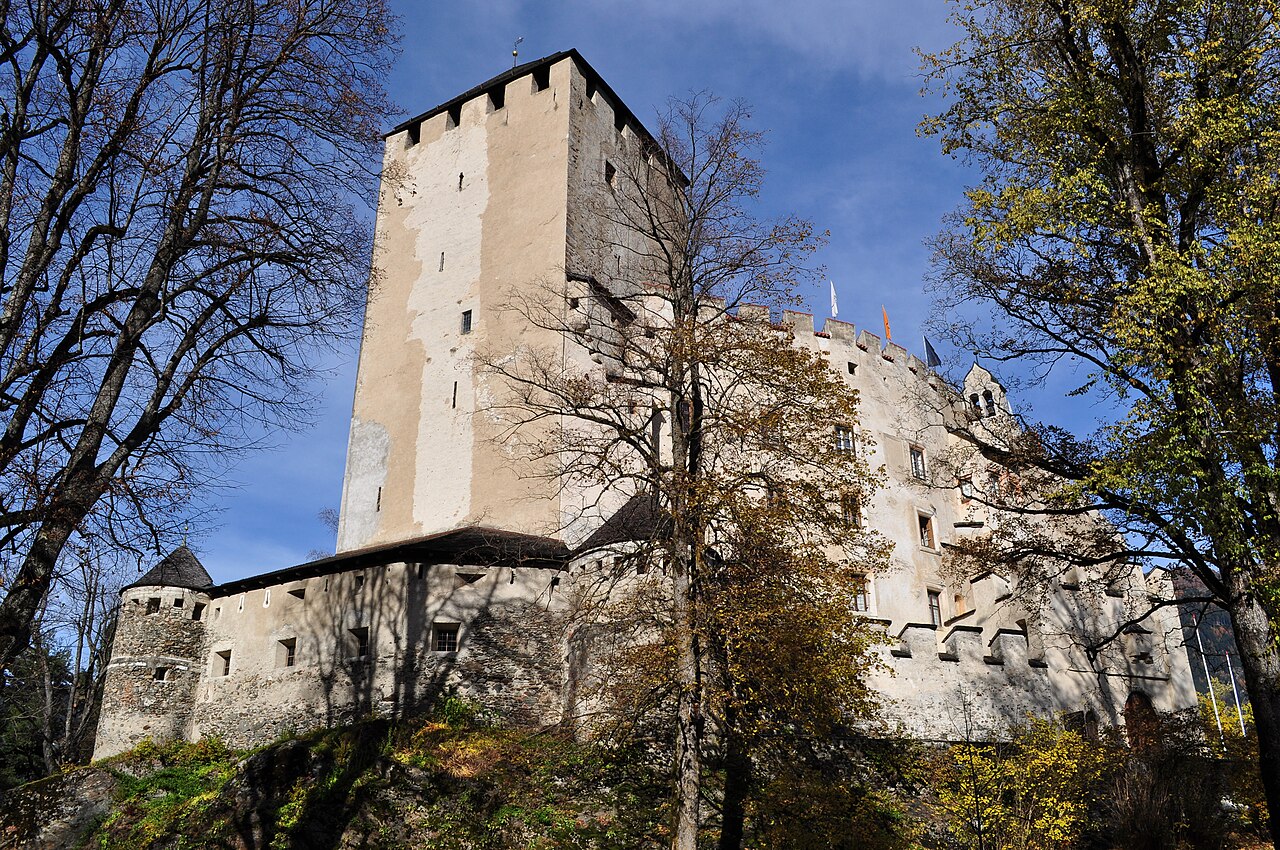
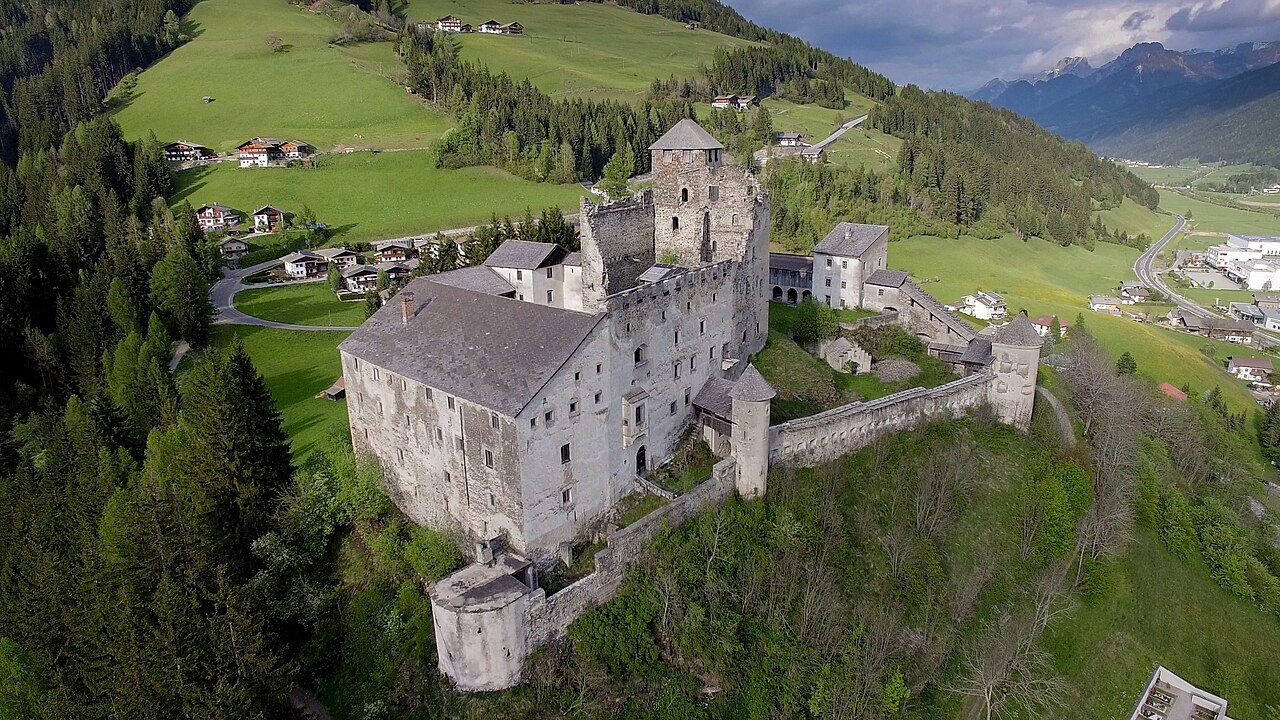
Kienburg Castle, a medieval hill castle ruin, is situated between Huben and Sankt Johann im Walde in the municipality of Matrei, Austria. Its name likely derives from the old German word "kühn," meaning bold, or from Archbishop Erich Kuenburg, one of its notable owners. The castle first appears in historical records around the year 1000 AD, marking it as an important medieval stronghold in the region. Positioned on a rocky hill above the Iseltal valley, it commanded key trade routes connecting the Iseltal, Defereggental, and Kalsertal valleys, underscoring its strategic significance during the High Medieval period.
Historical significance and ownership
The castle was originally constructed by the European nobility and initially held by the Counts of Lechsgemünd. In 1212, ownership transferred to the Archbishopric of Salzburg, reflecting the castle's integration into ecclesiastical and political power structures. During the mid-13th century, Burg Kienburg became a focal point in the conflicts between Archbishop Philipp von Spanheim of Salzburg and Emperor Frederick II. These clashes brought battles and destruction to the castle's vicinity, highlighting its defensive importance.
Throughout the following centuries, the castle frequently changed hands amid regional power struggles. It was inhabited by various noble families, including the Earls of Lechsgemünde and later the Bishopric of Salzburg. The last known resident was Knight Earl Christoph von Kienburg, who lived there until the castle was devastated by a fire in 1579. After the fire, the castle was abandoned as a residence.
In the modern era, the castle ruins became part of private estates. The Wanner family acquired the property in 1825, followed by the Stocker family in 1936. In 1945, an American aerial bomb severely damaged the remaining walls and destroyed the main tower, further reducing the castle to a ruin. Presently, the site is privately owned and is undergoing careful renovation to preserve its remains.
Architectural features and layout
The remnants of Kienburg Castle reveal a fortress constructed around a central courtyard. The southern side is enclosed by a substantial ring wall designed for defense. Extending northward from this wall was a residential wing that housed the castle's living quarters. The ring wall exhibits construction techniques typical of the 12th century, including sections of laid rubble stone and distinctive opus spicatum masonry, also known as "herringbone" pattern. This masonry style involves arranging stones diagonally in a zigzag pattern, a hallmark of medieval building craftsmanship.
The castle's elevated position on a rocky hill provided natural defense and panoramic views of the surrounding valleys and trade routes. The surviving ruins include fragments of the main tower, which once stood prominently within the complex but was largely destroyed during the 1945 bombing. These remains offer valuable insight into the castle's original scale and defensive capabilities.
Current status and preservation efforts
Today, Kienburg Castle exists as a ruin within a private estate covering approximately 103 hectares. The estate includes five additional buildings and a natural pond, integrating the historic site into a contemporary setting. One of these buildings, known as the "Heubad," functions as a wellness facility managed by the current owners.
The castle site is a restricted archaeological area to protect its historical fabric. Renovation and stabilization efforts are ongoing to prevent further deterioration of the remaining walls and structures. The preservation work aims to maintain the castle's historical significance while allowing limited access under controlled conditions.
Location and accessibility
Kienburg Castle is located roughly halfway between the towns of Lienz and Matrei in East Tyrol, Austria. It sits on a hilltop between the villages of Huben and Sankt Johann im Walde, overlooking the Iseltal valley. The castle's position not only provided defense but also control over important medieval trade routes through the adjacent valleys.
Access to the site is limited due to its status as a private property and archaeological zone. Visitors interested in viewing the ruins should seek permission from the owners or explore nearby public viewpoints that offer scenic vistas of the castle hill and surrounding landscape.
Frequently asked questions (FAQ)
- When was Kienburg Castle first mentioned in historical records?
- Kienburg Castle was first mentioned around the year 1000 AD, marking its origins in the High Medieval period.
- What architectural features are notable at Kienburg Castle?
- The castle features a 12th-century ring wall with opus spicatum masonry, a central courtyard, and remnants of a main tower.
- Who were some of the notable owners of Kienburg Castle?
- Notable owners included the Counts of Lechsgemünd, the Archbishopric of Salzburg, and Knight Earl Christoph von Kienburg.
- Is Kienburg Castle open to the public?
- Kienburg Castle is on private property and located within a restricted archaeological area, so public access is limited and requires permission.
- What caused the destruction of Kienburg Castle?
- The castle was severely damaged by a fire in 1579 and later further destroyed by an American aerial bomb in 1945.
- Where is Kienburg Castle located?
- Kienburg Castle is located on a hilltop between Huben and Sankt Johann im Walde, near Matrei in Tyrol, Austria.
Information
Loading map...
Visitor reviews
No reviews yet. Been here? Write the first review and help other travelers!
Write the first reviewVisited this castle? Share your experience
Your review helps other travelers and adds first-hand knowledge to our encyclopedia.