Kellie Castle
Kellie Castle stands as a remarkable example of Scots Baronial architecture nestled in the village of Carnbee, near Pittenweem in Scotland. Its origins trace back to the mid-12th century, with the earliest records dating to 1150 when it was mentioned in a charter by King David I. The castle’s history intertwines with notable Scottish families and monarchs, reflecting centuries of architectural evolution and social change.
The estate was initially owned by Robert of London, an illegitimate son of King William the Lion. Though none of the original early structures have survived, the castle’s core was established under the ownership of the Oliphant family from 1360 onwards. Walter Oliphant, a relative by marriage to the Bruce dynasty, acquired Kellie, marking the start of a long Oliphant tenure lasting until 1613. The castle later passed to Sir Thomas Erskine, who was honored with the title Earl of Kellie by King James VI following Erskine’s role in saving the king during the Gowrie Conspiracy.
Architectural development and layout
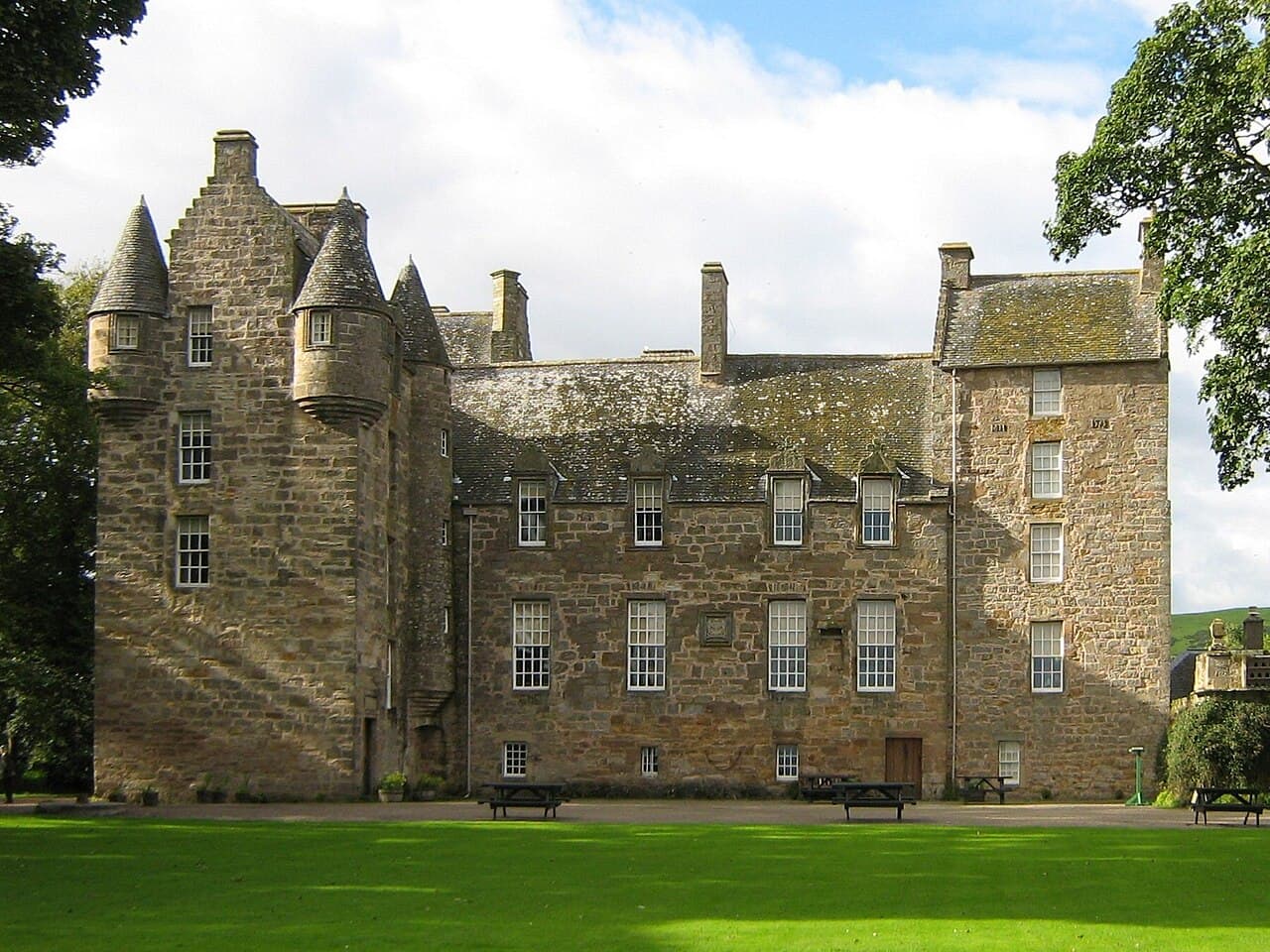
The oldest surviving part of Kellie Castle is the lower section of the northwest tower, dating to around 1360. This tower was originally a simple medieval tower house, built primarily for defense and residence. Local tradition holds that this part of the castle is haunted, adding to its historic mystique.
In 1573, the 4th Lord Oliphant constructed a new east tower adjacent to the original structure, likely serving as a jointure house for his wife Margaret. This expansion marked a significant phase in the castle’s development, reflecting the transition from purely defensive architecture to more comfortable domestic living spaces.
Between 1573 and 1606, the castle was further extended by linking the two towers with a new range, culminating in the addition of a southwest tower. This created the distinctive T-plan layout seen today. The castle’s exterior showcases hallmark features of the Scots Baronial style, including stepped gables, corbelled turrets, and ornate chimneys, which combine defensive elements with elegant domestic architecture.
Interior features and artistic heritage
The east tower houses a remarkable plaster-decorated ceiling dated 1617, bearing the monogram "T V F" for Thomas Viscount Fenton. This ceiling exemplifies an early adoption of London-style decorative plasterwork in Scotland and may have been commissioned in anticipation of King James VI’s visit in 1617.
Inside the castle, visitors can admire a painted panel above the drawing room fireplace, created in 1897 by Phoebe Anna Traquair. Inspired by Botticelli’s Primavera, this artwork was concealed during the 1940s and later restored in 1996, representing the castle’s rich artistic legacy.
The dining room features a composite Flemish tapestry centered on a 1580 panel depicting the mythological scene of Europa and the Bull. The tapestry includes later-added borders with a Latin inscription, adding layers of historical and cultural significance.
The Great Hall, completed around 1606, is the castle’s largest room. It contains two unique eagle-crested mirrors designed by architect Sir Robert Lorimer and crafted by Edinburgh firm Whytock and Reid. These mirrors create an optical illusion preserving the viewer’s image size as they move, showcasing innovative design.
Gardens and later history
The castle’s walled garden dates from the 17th century, with late Victorian additions. Restoration efforts led by Robert Lorimer and his sister Caroline-Louise revitalized the gardens, which now feature a collection of old-fashioned roses, fruit trees, and herbaceous plants. The garden reflects the traditional Scottish gentry estate style and complements the historic castle setting.
Following the death of Methven Erskine, the 10th Earl of Kellie, circa 1830, the castle was abandoned for decades until the Lorimer family’s involvement began in 1878. Robert Lorimer, a prominent architect, undertook significant restoration work, preserving the castle’s heritage. The Lorimers maintained a connection to Kellie Castle until 1936, with Hew Lorimer later purchasing it in 1948. Hew Lorimer’s ownership lasted until 1970, when the property was sold to the National Trust for Scotland.
The castle’s stables were converted into the studio of Hew Lorimer until 1990 and now house a permanent exhibition of his artwork, linking the site’s historic and artistic heritage.
Historical significance and cultural impact
Kellie Castle is a significant monument in Scottish history, reflecting the evolution of castle architecture from medieval tower houses to the more elaborate Scots Baronial style. Its association with prominent historical figures, including King James VI and Sir Thomas Erskine, underscores its political and cultural importance.
The castle’s architectural features, such as the T-plan layout, corbelled turrets, and decorative plaster ceilings, provide valuable insight into late medieval and early modern Scottish domestic architecture. The artistic treasures within, including the Traquair panel and Flemish tapestry, enhance its cultural heritage value.
Today, Kellie Castle is preserved as a well-preserved historic site managed by the National Trust for Scotland, attracting visitors interested in Scottish history, architecture, and art. The castle and gardens offer a rich experience that combines medieval heritage with Victorian restoration and artistic legacy.
Frequently asked questions (FAQ)
- When was Kellie Castle originally built?
- Kellie Castle's earliest surviving structures date from around the 14th century, with the oldest part being the lower section of the northwest tower built circa 1360.
- What architectural style is Kellie Castle known for?
- Kellie Castle is a fine example of Scots Baronial domestic architecture, featuring stepped gables, corbelled turrets, and ornate chimneys typical of the style.
- Who were some notable historical figures associated with Kellie Castle?
- Notable figures include Sir Thomas Erskine, who saved King James VI during the Gowrie Conspiracy, and King James VI himself, who visited the castle in 1617.
- Can visitors see original artwork inside Kellie Castle?
- Yes, visitors can view a painted panel by Phoebe Anna Traquair inspired by Botticelli's Primavera and a Flemish tapestry depicting Europa and the Bull.
- What is unique about the Great Hall in Kellie Castle?
- The Great Hall features two eagle-crested mirrors designed by Sir Robert Lorimer that create a unique optical illusion preserving the viewer’s image size as they move.
- Are the gardens at Kellie Castle historically significant?
- Yes, the walled garden dates from the 17th century with Victorian additions and contains traditional plantings like old-fashioned roses and fruit trees.
- Who manages Kellie Castle today?
- Kellie Castle is managed by the National Trust for Scotland and is open to the public for visits.
Photo gallery

Information
Sources & official resources
Verify the information above using these authoritative references.
Loading map...
Visitor reviews
No reviews yet. Been here? Write the first review and help other travelers!
Write the first reviewVisited this castle? Share your experience
Your review helps other travelers and adds first-hand knowledge to our encyclopedia.