George Wishart Memorial Stones
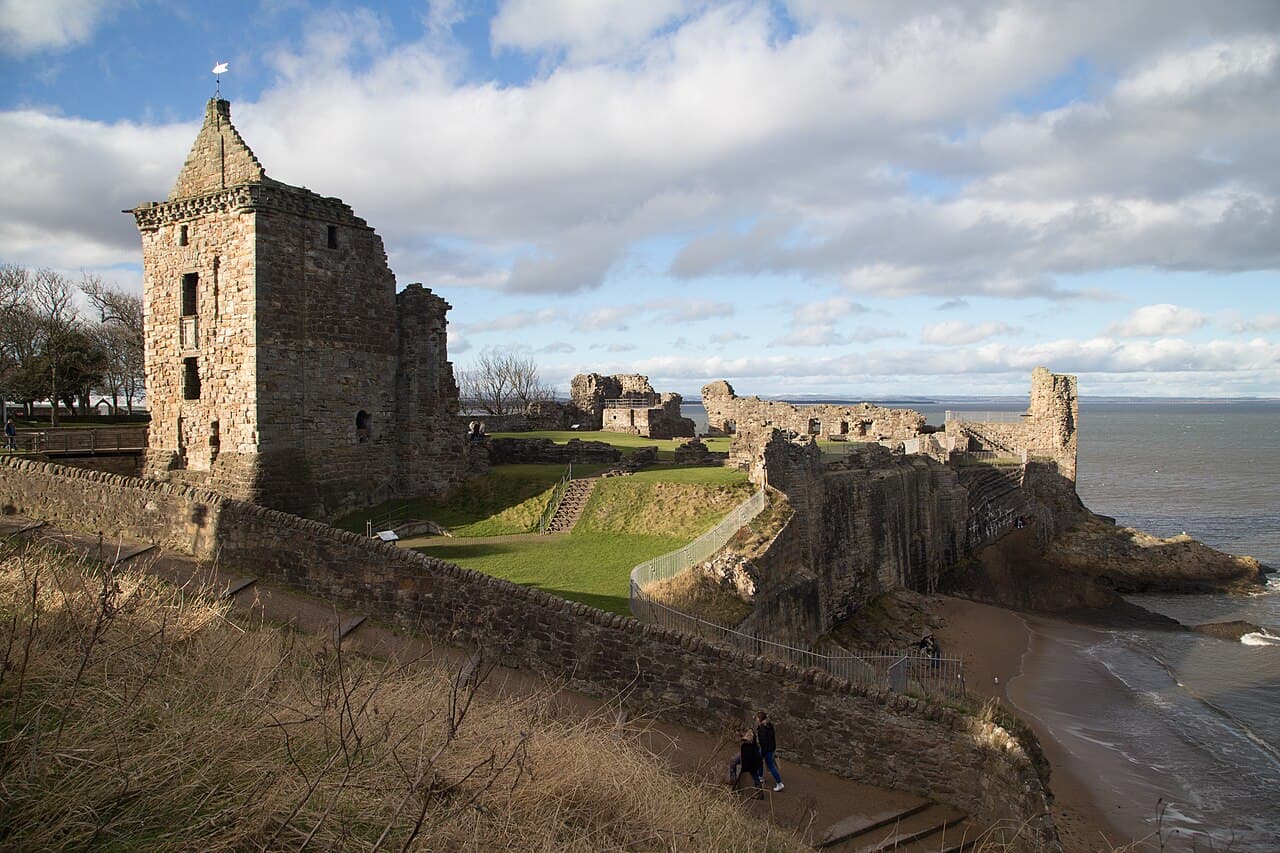
St Andrews Castle stands prominently on a rocky promontory overlooking the North Sea and Castle Sands beach in the historic town of St Andrews, Scotland. This late medieval hill castle was originally constructed as the fortified residence of the bishops who led Scotland's primary ecclesiastical center before the Scottish Reformation. Its long history intertwines religious authority, political intrigue, and military conflict, making it a significant monument in Scottish heritage.
The origins and medieval significance of St Andrews Castle
The castle's origins date back to the episcopate of Bishop Roger (1189–1202), son of the Earl of Leicester. Initially, it served as a fortified home for the bishops of St Andrews, the ecclesiastical capital of Scotland. Throughout the Wars of Scottish Independence in the late 13th and early 14th centuries, the castle was a strategic military asset. It changed hands multiple times between Scottish and English forces. In 1336–1337, the Scots deliberately destroyed the fortress to prevent English occupation, leaving the site in ruins for several decades.
Bishop Walter Trail rebuilt the castle around 1400, completing a stronghold that forms the basis of the remains visible today. He died within its walls in 1401. During the 15th century, the castle was not only a residence but also a prison, holding high-profile captives such as David Stuart, Duke of Rothesay, and Murdoch Stewart, Duke of Albany. The castle also played a role in the education of James I of Scotland, who studied under Bishop Henry Wardlaw, the founder of the University of St Andrews.
Architectural features and defensive structures
The castle's layout reflects its evolution through various phases of medieval and early modern fortification. Key surviving elements include a section of the south wall enclosing a square sea tower, the kitchen tower, and the infamous bottle dungeon. The bottle dungeon is an underground prison cut directly from solid rock beneath the northwest tower, historically used to confine both common criminals and prominent prisoners.
In response to advances in artillery technology during the early 16th century, the castle underwent significant defensive upgrades. A robust artillery blockhouse was added to withstand cannon fire, demonstrating the castle's continued military importance during the turbulent religious conflicts of the era.
One of the castle's most remarkable features is the network of mine and counter-mine tunnels blasted through solid rock beneath the fortress during the 1546–1547 siege. These tunnels, rediscovered in the late 19th century, vividly illustrate the intense mining warfare between the besieging forces and the castle's defenders. They remain accessible to visitors today, offering a tangible connection to this dramatic episode in the castle's history.
The castle's role in the Scottish Reformation and religious conflict
During the 16th century, St Andrews Castle was at the heart of Scotland's religious upheaval. Archbishop James Beaton reinforced the castle against artillery attacks as tensions escalated. His nephew, Cardinal David Beaton, used the castle as his residence while opposing the proposed union of Mary, Queen of Scots, and Prince Edward of England.
In 1546, the castle became infamous as the site where Protestant preacher George Wishart was imprisoned and executed on the orders of Cardinal Beaton. Shortly after, a group of Wishart's supporters assassinated the cardinal within the castle grounds, marking a pivotal moment in the Scottish Reformation.
The assassins and other Protestant nobles then occupied the castle, forming what is considered Scotland's first Protestant congregation. The castle endured a prolonged siege led by Regent James Hamilton, involving extensive mining operations beneath the fortress. Despite plans for English intervention, no support arrived, and during a truce, the reformer John Knox preached within the castle walls.
The siege ended when a French-led artillery assault, commanded by engineer Leone Strozzi, overwhelmed the defenses. After six hours of bombardment, the castle was surrendered, and the Protestant garrison was captured and sent to France as galley slaves.
Post-Reformation decline and preservation
Following the siege, Archbishop John Hamilton undertook substantial rebuilding efforts. However, the castle's importance waned over the 17th century. In 1606, it was separated from the archbishopric and granted to the Earl of Dunbar, briefly returning to church ownership in 1612. The abolition of the bishopric in 1689 marked the end of its ecclesiastical function.
By the mid-17th century, the castle had fallen into disrepair. Its stones were repurposed by the burgh council to repair the town pier, accelerating its decline. Today, the ruins include the south wall, sea tower, kitchen tower, bottle dungeon, and the mine tunnels, all maintained as a scheduled monument by Historic Environment Scotland.
The castle grounds feature a visitor center displaying carved stone fragments from various construction phases, illustrating the castle's architectural detail. The center also provides historical exhibits, a shop, and access to the tunnels, enriching the visitor experience.
Life within the castle and cultural significance
Historical records reveal domestic aspects of castle life, including gardens where onions and lettuce were cultivated and facilities for brewing beer. These details highlight the castle's role as a self-sustaining residence for the bishops and their retinue.
The castle's artillery was operated by a combination of French and local engineers, such as Christopher Grymmerschere and Master Wolf. Coal for heating and metalwork was brought from West Wemyss, underscoring the logistical efforts supporting the castle's defense.
A brick inscription bearing George Wishart's initials marks the site outside the castle where he was executed, serving as a solemn reminder of the castle's turbulent religious history and its role in Scotland's Reformation.
Frequently asked questions (FAQ)
- What is the George Wishart Memorial Stones?
- The George Wishart Memorial Stones are a historical landmark located in Saint Andrews, dedicated to the memory of George Wishart, a prominent Scottish Reformer and Protestant martyr. These stones mark the site where he was executed in 1546 and serve as a significant reminder of Scotland's religious history and the Reformation period.
- When was the George Wishart Memorial Stones established?
- The memorial stones were erected in 1888 to commemorate George Wishart's life and contributions to the Protestant Reformation in Scotland. They highlight the historical significance of his martyrdom and the impact it had on the religious landscape of the country.
- Can I visit the George Wishart Memorial Stones?
- Yes, the George Wishart Memorial Stones are open to the public and can be visited year-round. Visitors can explore the area and learn about its historical significance at their own pace, making it a great spot for history enthusiasts.
- What are the opening hours for the George Wishart Memorial Stones?
- The memorial stones are accessible at all times, allowing visitors to come and go as they please. However, it is recommended to visit during daylight hours for a safer and more enjoyable experience.
- Is it possible to reach the George Wishart Memorial Stones using public transportation?
- Yes, the memorial is easily accessible via local public transportation in Saint Andrews. Buses and taxis frequently service the area, providing convenient options for visitors traveling to the site.
- What is the best time to visit the George Wishart Memorial Stones?
- The best time to visit is during the spring and summer months when the weather is pleasant and conducive to outdoor exploration. This allows visitors to enjoy the surroundings and participate in local events that may be taking place in Saint Andrews.
- Are there any nearby attractions to the George Wishart Memorial Stones?
- Yes, the George Wishart Memorial Stones are located near several other historical sites, including St. Andrews Cathedral and the Old Course. Visitors can easily combine their trip to the memorial with a tour of these nearby attractions for a comprehensive experience of Saint Andrews' rich history.
- Is there an entrance fee to visit the George Wishart Memorial Stones?
- No, there is no entrance fee to visit the George Wishart Memorial Stones. Visitors can enjoy this historical site free of charge, making it an accessible option for everyone interested in Scotland's history.
- What is the historical significance of the George Wishart Memorial Stones?
- The memorial stones commemorate George Wishart's role in the Scottish Reformation and his martyrdom, which played a crucial part in shaping religious thought in Scotland. The site symbolizes the struggle for religious freedom and the impact of reformers on the nation's history.
Photo gallery

Information
Website
Visit websiteSources & official resources
Verify the information above using these authoritative references.
Loading map...
Visitor reviews
No reviews yet. Been here? Write the first review and help other travelers!
Write the first reviewVisited this castle? Share your experience
Your review helps other travelers and adds first-hand knowledge to our encyclopedia.



