Ackergill Tower
Ackergill Tower stands as a remarkable example of a 16th-century Scottish stone tower house, located near the coastal village of Wick in northern Scotland. This imposing structure embodies the turbulent history of the Scottish clan system and the architectural evolution of defensive residences in the region. Built in the early 1500s, Ackergill Tower has witnessed centuries of conflict, ownership changes, and adaptations, making it a significant cultural and historical monument.
The lands on which Ackergill Tower stands were first brought under the control of Clan Keith in 1354, when John Keith of Inverugie inherited them from the Cheynes family. It is believed that the tower itself was constructed by his son, with the first documented mention of the tower dating to 1538. The tower's strategic position on a cliff overlooking Sinclair's Bay provided both defensive advantages and commanding views of the surrounding landscape, crucial for monitoring the coast and local rival clans.
Clan conflicts and ownership struggles
The 16th century was marked by intense rivalry between the Keiths and the Sinclairs, two powerful clans vying for dominance in the region. Ackergill Tower became a focal point of this conflict, changing hands multiple times. The Sinclairs seized the tower in 1547 and again in 1556, but political intervention by Mary of Guise, the Regent of Scotland, resulted in pardons that restored the tower to the Keith family. During this period, Laurence Oliphant was appointed as the tower's keeper in 1549, reflecting its importance as a stronghold.
Further skirmishes occurred in the late 16th century. In 1593, Robert Keith took the tower by force but was branded a rebel, leading to the property's return to the Earl Marischal, head of the Keith clan. A daring nocturnal attack by John Keith of Subster in 1597 successfully recaptured the tower. Ownership shifted in 1612 when the Sinclairs officially acquired Ackergill Tower from the Earl Marischal, illustrating the ongoing power struggles between clans.
The tower was besieged in 1623 during a clan feud by Sir Robert Gordon, but it surrendered without a fight, indicating the complex political dynamics of the time. In 1651, it is believed that Oliver Cromwell's forces stationed soldiers at Ackergill Tower during their military campaigns against nearby Dunnottar Castle, searching for the Honours of Scotland (the Scottish crown jewels).
Later ownership and architectural modifications
In 1676, the tower passed into the hands of John Campbell, 2nd Earl of Breadalbane and Holland, as repayment of debts owed by the Sinclairs. This transition marked a new chapter in the tower's history, followed by its sale in 1699 to Sir William Dunbar of Hempriggs. The Dunbar family maintained and enhanced Ackergill Tower over the next centuries, reflecting changing tastes and functional needs.
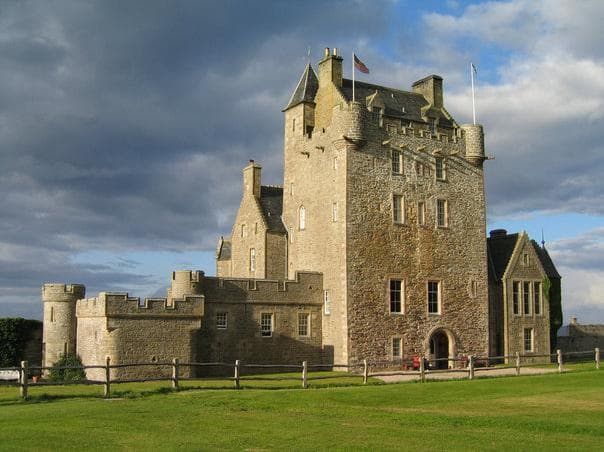
The 18th century saw the addition of a four-storey lean-to extension at the rear of the main tower, expanding the living quarters and adapting the structure for more comfortable domestic use. In the mid-19th century, the renowned architect David Bryce undertook significant remodeling for George Sutherland Dunbar, 7th Lord Duffus. Bryce's work included the addition of a distinctive cap-house atop the tower, enhancing its silhouette and providing additional functional space.
Architectural features and preservation
Ackergill Tower is a well-preserved example of a five-storey stone tower house with an oblong, rectangular footprint typical of early 16th-century Scottish defensive residences. The tower's sturdy stone walls were designed for both defense and domestic comfort, featuring narrow windows and battlements that reflect its martial origins.
The attached four-storey lean-to extension, added in the early 18th century, marks the first major alteration beyond the original construction, illustrating the evolution from purely defensive architecture to more residential use. David Bryce's mid-19th-century renovations further modernized the structure while respecting its historic character.
Situated on a cliff overlooking Sinclair's Bay, approximately four kilometers north of Wick, the tower's location provided strategic advantages for surveillance and defense against seaborne threats. Its stone construction and enduring form have earned it Category A listed status, recognizing it as a nationally important historic monument in Scotland.
Local legends and cultural significance
The tower is also steeped in local folklore, most notably the legend of Helen Gunn, a young woman said to have been abducted by John Keith. According to the tale, she escaped captivity by leaping from the top of the tower. Her spirit is believed to haunt Ackergill Tower, adding an element of mystery and cultural heritage to the site.
Today, Ackergill Tower serves as a prominent landmark that embodies the rich history of Scottish clan rivalries, architectural evolution, and coastal defense. Its transformation into a hotel and event venue since the late 20th century has allowed visitors to experience its historic ambiance while preserving its architectural integrity.
Visiting Ackergill Tower
Visitors to Ackergill Tower can appreciate its dramatic coastal setting and explore the architectural features that reflect centuries of Scottish history. The tower's preservation allows for an immersive experience into the life of a Scottish clan stronghold. While interior details are limited in public records, the exterior and surrounding landscape offer insights into the strategic importance and residential adaptations of the tower.
The tower's historical significance, combined with its scenic location overlooking Sinclair's Bay, makes it a valuable destination for those interested in Scottish history, architecture, and folklore.
Frequently asked questions (FAQ)
- How do I get to Ackergill Tower?
- Ackergill Tower is located about four kilometers north of Wick in the Highland region of Scotland. Visitors can reach it by car via local roads from Wick, with parking available nearby. Public transport options are limited, so driving is recommended.
- What is the best time to visit Ackergill Tower?
- The best time to visit Ackergill Tower is during the late spring to early autumn months when the weather is milder and the coastal views are at their most spectacular. Summer offers longer daylight hours, ideal for exploring the grounds and surroundings.
- Is Ackergill Tower accessible to visitors with mobility issues?
- Due to its historic structure and age, Ackergill Tower has limited accessibility for visitors with mobility impairments. The tower's multiple floors and narrow staircases may present challenges. Visitors are advised to check accessibility options in advance.
- Can I stay overnight at Ackergill Tower?
- Yes, Ackergill Tower has been restored and repurposed as a hotel and event venue. Guests can experience staying in a historic Scottish tower house with modern amenities while enjoying the coastal scenery.
- What architectural styles are represented at Ackergill Tower?
- Ackergill Tower features a blend of architectural styles, primarily reflecting its original <strong>late medieval defensive tower house design</strong> with later additions and remodeling in the 18th and 19th centuries, including elements introduced by architect David Bryce.
Photo gallery

Photo by LeeNapier at English Wikipedia•Public domain
Information
Current owner
Private owner
Loading map...
Visitor reviews
No reviews yet. Been here? Write the first review and help other travelers!
Write the first reviewVisited this castle? Share your experience
Your review helps other travelers and adds first-hand knowledge to our encyclopedia.