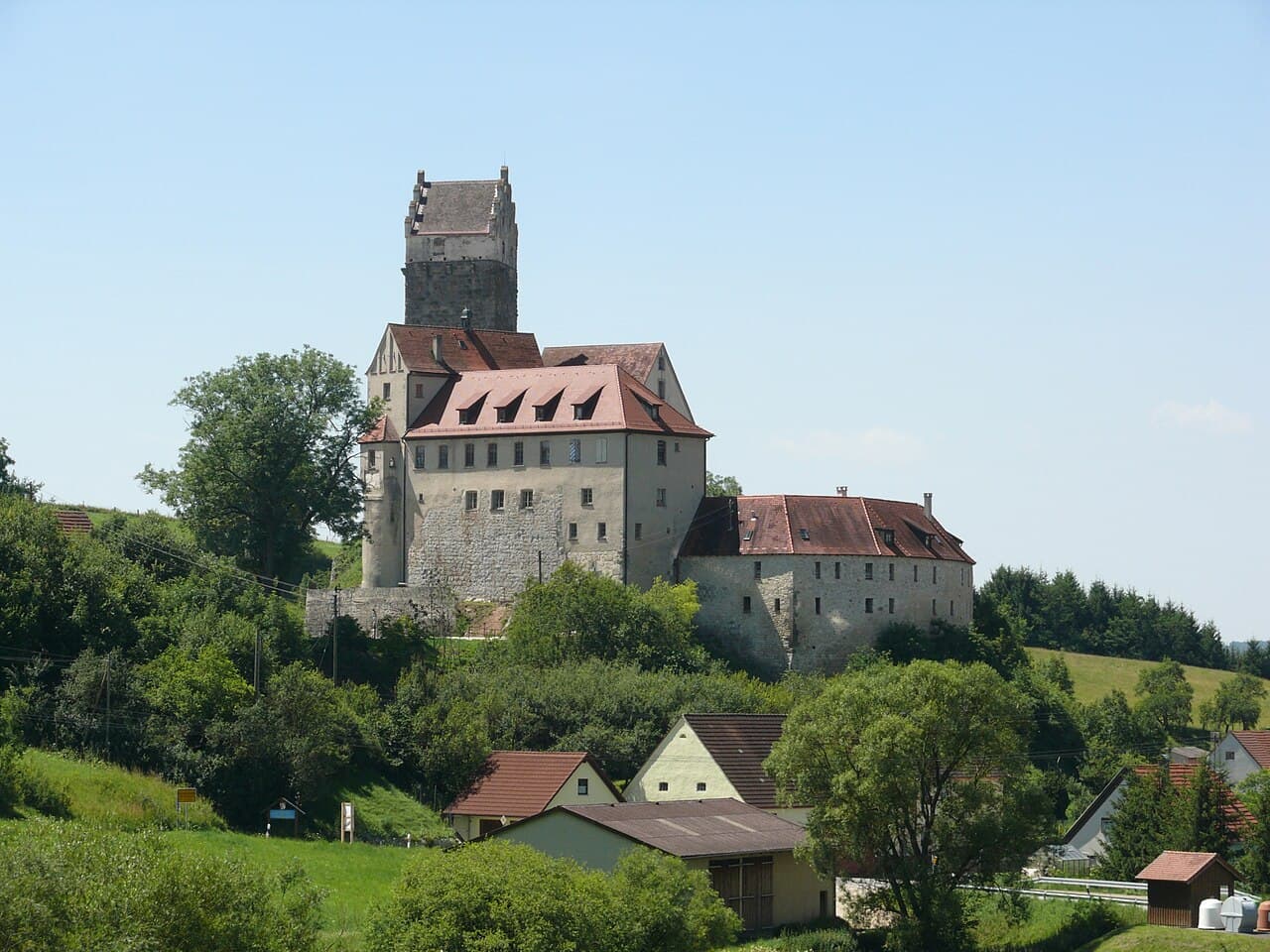
Katzenstein Castle
Katzenstein Castle is a remarkable example of a high medieval hill castle in Germany, notable for its continuous historical significance and well-preserved architectural features. Located in a side valley of the river Egua near the ancient Roman road connecting Faimingen and Oberdorf bei Bopfingen, this fortress stands on a rocky hill at an elevation of 538 meters above sea level. It is one of the oldest surviving Hohenstaufen castles, with origins dating back to the 11th century. The castle's strategic position allowed it to control important medieval trade and military routes in the region.
The earliest recorded mention of the castle dates to 1099, linked to the Lords von Cassenstein, a ministerial family serving the Counts of Dillingen. These ministeriales were unfree knights who held administrative and military roles in the feudal system. The von Katzenstein family, first reliably attested in the 12th century, took their name from the castle and played a significant role in the region's medieval nobility. While some earlier references mention a knight named Odalrich de Cazzenstein in 1099, this individual is likely connected to a different Katzenstein castle near Langenburg.
Medieval ownership and noble lineage
Throughout the 12th and 13th centuries, Katzenstein Castle was closely tied to the noble families of the region. The von Katzenstein family line ended in 1288 with Conrad von Katzenstein. From 1262, the von Hürnheim family became the castle's main residents, adopting the combined name von Hürnheim-Katzenstein. This reflects the common medieval practice of noble families merging names to signify inheritance or alliance.
In 1354, the castle changed hands when Hermann von Hürnheim-Katzenstein sold it to the Counts of Oettingen. Shortly thereafter, it was pawned to the Counts of Helfenstein, who then granted it to Berthold von Westerstetten in 1382 through marriage ties. The Westerstetten-Katzenstein line ended in 1572, after which ownership reverted to the Counts of Oettingen. This complex sequence of ownership highlights the castle's importance as a noble residence and its role in regional power dynamics.
Destruction and reconstruction in the early modern period
The castle suffered significant damage during the Thirty Years' War, a devastating conflict that engulfed much of Central Europe from 1618 to 1648. In 1648, French troops burned Katzenstein Castle to the ground, leaving it in ruins. This destruction marked the end of its medieval military function.
Reconstruction began in 1669 under Count Notger Wilhelm von Oettingen-Baldern, who restored Katzenstein as a noble residence. The rebuilding incorporated 17th-century architectural elements, including the addition of a New Palace (Neues Schloss). This period of restoration reflects the transition from medieval fortress to a more comfortable aristocratic dwelling, blending defensive features with residential needs.
Architectural features and layout
Katzenstein Castle is a classic example of a hill castle built on a high rocky outcrop, enclosed by a robust ring wall surrounding a small courtyard. The main entrance, located on the eastern side, was originally protected by a forecourt with a gatehouse and a moat. Although the moat has since been filled in, a stone causeway now crosses this area, preserving the castle's defensive layout.
The most prominent feature is the bergfried, or main tower, dating from the 11th century. This imposing tower stands approximately 30 meters tall and is constructed from large, rough-hewn ashlar blocks. Its original entrance was positioned about seven meters above ground level, a strategic design to deter attackers and enhance defense.
On the eastern side of the courtyard stands the four-story palas, a residential building from the late Romanesque period. This structure served as the main living quarters for the castle's noble inhabitants and exemplifies medieval residential architecture with its robust stone walls and narrow windows designed for defense.
The 17th-century additions include the New Palace (Neues Schloss), partially reconstructed today, which features the Grafensaal or count’s hall. This hall was renovated after a fire in 1995, preserving its historical and architectural significance.
Castle chapel and frescoes
The castle chapel, dedicated to Saint Laurentius, dates back to around the year 1000, making it one of the oldest parts of the complex. Inside, visitors can find rare frescoes from the transitional period between late Romanesque and early Gothic art, created circa 1250 to 1280. These frescoes are significant for their depiction of religious themes and artistic style, illustrating the evolution of medieval art. Later Baroque paintings partially cover these medieval frescoes, discovered during restoration work in 1973 when the chapel was cleaned and reopened.
Defensive walls and additional structures
The castle's lower defensive wall, known as the wehrgang, currently houses a tavern called “Zum Marstall,” blending historical architecture with modern use. The upper defensive wall contains guest rooms, demonstrating the castle’s adaptation to contemporary hospitality needs while maintaining its historical integrity.
Modern ownership and cultural significance
After the death of the last Count of Oettingen-Baldern in 1798, Katzenstein Castle passed to the princely line of Oettingen-Wallerstein. In 1810, it became part of the Württemberg district of Neresheim. Since 1939, the castle has been privately owned but remains open to the public as a hotel and restaurant, allowing visitors to experience its historical ambiance firsthand.
In 1997, Katzenstein Castle was recognized as part of the Staufer tourist route, a cultural trail highlighting sites connected to the Hohenstaufen dynasty. Since 2007, it has served as an information point within the UNESCO Swabian Alb Geopark, emphasizing its geological and cultural importance in the region.
Today, Katzenstein Castle stands as a well-preserved monument to medieval architecture and noble history, offering insights into the evolution of castle construction, feudal society, and artistic heritage in southern Germany.
Frequently asked questions (FAQ)
- When was Katzenstein Castle originally built?
- Katzenstein Castle dates back to the 11th century, making it one of the oldest surviving castles from the high medieval period in Germany.
- What architectural features make Katzenstein Castle unique?
- The castle features a prominent 11th-century bergfried tower with a high entrance, a late Romanesque palas, and a chapel with rare frescoes from the 13th century showing the transition from Romanesque to Gothic art.
- Is Katzenstein Castle open to visitors today?
- Yes, Katzenstein Castle is privately owned but open to the public. It houses a hotel and restaurant, allowing visitors to explore its historic architecture and enjoy its cultural ambiance.
- What happened to Katzenstein Castle during the Thirty Years' War?
- The castle was burned down by French troops in 1648 during the final year of the Thirty Years' War but was rebuilt starting in 1669 as a noble residence.
- Are there any notable artworks inside Katzenstein Castle?
- Yes, the castle chapel contains rare medieval frescoes dating from around 1250 to 1280, illustrating the transition from Romanesque to early Gothic art, partially covered by later Baroque paintings.
Photo gallery

Information
Sources & official resources
Verify the information above using these authoritative references.
Loading map...
Visitor reviews
No reviews yet. Been here? Write the first review and help other travelers!
Write the first reviewVisited this castle? Share your experience
Your review helps other travelers and adds first-hand knowledge to our encyclopedia.



