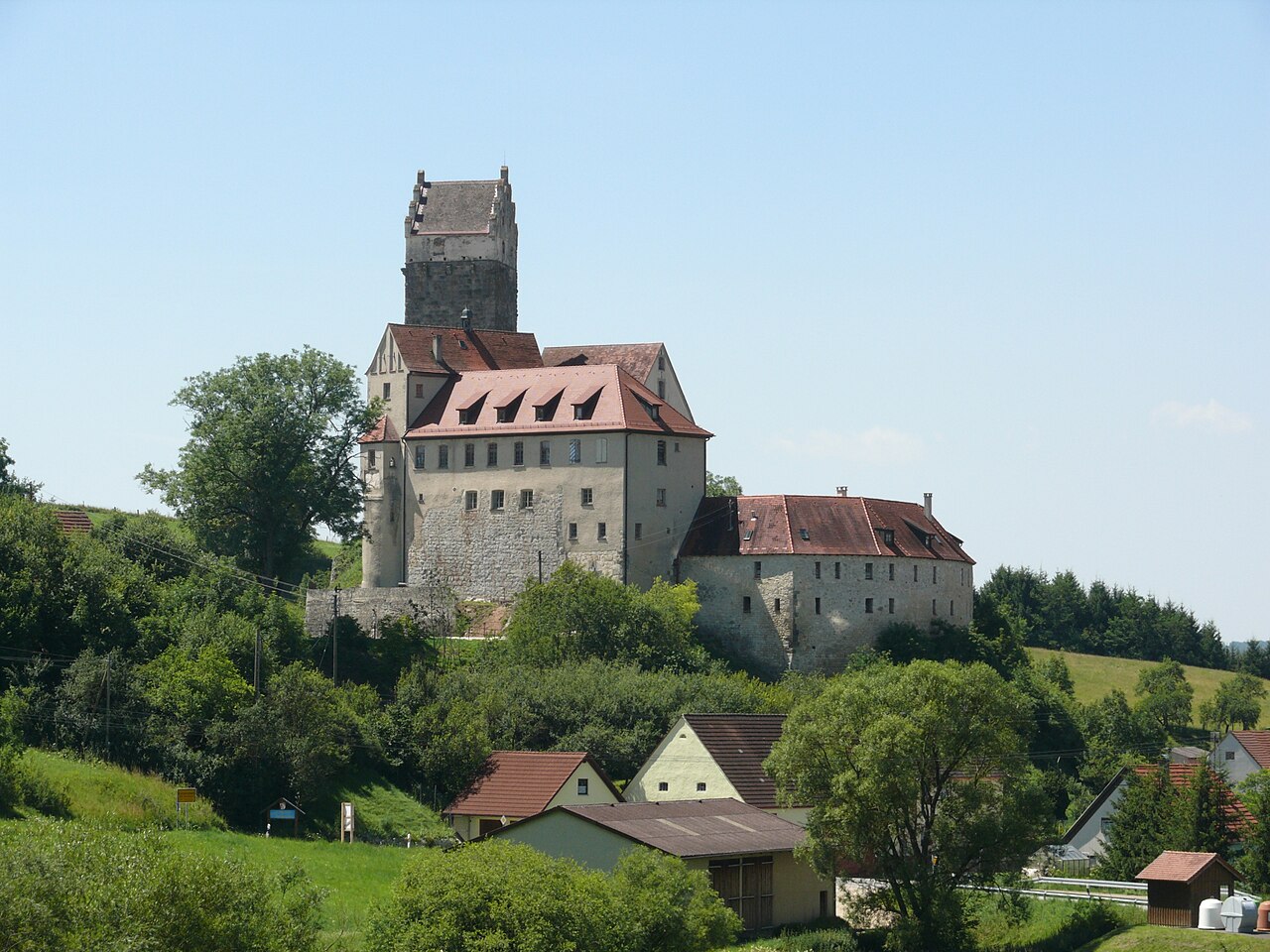
Burg Hochhaus
Burg Hochhaus stands as a remarkable example of a medieval hill castle that evolved through centuries into a baroque palace before falling into ruin. Located near the municipality of Ederheim in Germany, this castle's history begins around the early 13th century, founded by a branch of the noble von Hürnheim family. The family adopted the name von Hochhaus, derived from the Latin phrase de alta domo, meaning "from the High House," underscoring the castle's elevated and commanding position on its hilltop.
Early history and noble lineage
The earliest documentary evidence of Burg Hochhaus dates to 1236, when Rudolf I von Hochhaus appeared as a witness in a legal document. This confirms the castle's existence and importance during the high medieval period. The castle remained the seat of the von Hochhaus family until the mid-14th century, serving as a noble residence and administrative center. In 1347, the castle was sold by Konrad II von Hochhaus to the Counts of Oettingen-Oettingen for 3,000 pounds. Following the death of the last von Hochhaus lord without heirs in 1353, the Oettingen family officially assumed ownership.
Fortifications and architectural evolution
Under the Counts of Oettingen, Burg Hochhaus gained prominence as an administrative hub and underwent significant architectural enhancements. Throughout the 15th and 16th centuries, the castle was modernized and fortified to improve its defensive capabilities in response to evolving military technologies and regional conflicts. The extensive system of ramparts, ditches, and walls surrounding the castle reflects these efforts, including a notable neck ditch that separates the castle plateau from the surrounding terrain.
Medieval defensive structures
The castle's defensive complex includes a wall ditch approximately 200 meters in length, marking the boundary between the plateau and the hinterland. Excavations reveal the probable site of an outer bailey, a fortified courtyard that no longer stands but was integral to the castle's defense. The main castle itself forms an irregular quadrilateral enclosed by walls measuring roughly 60 by 70 meters. The counter-escarpment wall of the neck ditch features masonry construction in some sections, highlighting the castle's robust defensive design.
Baroque transformation and decline
In 1719, the medieval fortress underwent a significant transformation when it was expanded and remodeled into a baroque palace. This renovation retained the original fortifications and the main residential building known as the palas, while adding new architectural elements characteristic of the baroque style. Unfortunately, in 1749, a devastating fire destroyed the newly constructed palace, and it was left unrepaired, marking the beginning of the castle's decline.
Later history and cultural significance
Between 1787 and 1792, Burg Hochhaus served as a detention site for Wilhelm Ludwig Wekhrlin, an Enlightenment-era journalist and political thinker. During his confinement, Wekhrlin wrote articles advocating progressive political ideas, adding a layer of intellectual history to the castle's legacy. The old palas continued to be used for administrative purposes until 1807, after which the site was deliberately neglected to enhance its romantic ruin aesthetic, popular in the 19th century.
Records indicate that the castle was inhabited until at least 1839, when the last resident was permitted to relocate to the nearby town of Nördlingen. In the 1960s, limited conservation efforts focused on stabilizing the counter-escarpment wall of the neck ditch, which had partially collapsed. Since then, no major preservation activities have been documented, and the castle remains a ruin accessible only for external viewing.
Architectural remains and features
The ruins of Burg Hochhaus occupy a hilltop fortified by substantial defensive works from various periods. The main castle's irregular quadrilateral layout is enclosed by walls approximately 60 by 70 meters in perimeter. Notable surviving structures include the remains of a four-winged baroque palace, largely decayed but still discernible, and the three-story palas, the original main residential building characterized by broad window openings and currently vulnerable to collapse.
Defensive courtyards and towers
South of the palas lies the gate zwinger, a fortified outer courtyard designed to trap attackers between defensive walls. Portions of a flanking tower remain here, although the primary gate structure has been lost. One of the best-preserved features is a slender corner tower on the southwest side, accompanied by a low, elongated artillery tower constructed in front of it.
Visual documentation and artistic representation
Two oil paintings dated around 1750 to 1760, housed at Burg Harburg, provide valuable visual insights into the castle's appearance before its deterioration. These artworks depict the main palace with a timber-framed upper floor topped by a small turret made of stone or plaster. The lower wings of the building featured gently curved gables, while the slender corner tower extended upward to the roof ridge of the main structure, illustrating the blend of medieval and baroque architectural elements.
Visiting burg hochhaus today
Today, Burg Hochhaus is accessible only for external viewing due to the unstable condition of some structures, which present safety hazards. Photographic records highlight key features such as the southwest section combining the palas and gate building, the zwinger with its semicircular tower, southern casemates adjacent to the zwinger, the neck ditch partially filled with masonry, and the southeast tower alongside fragments of the northern wall. These remnants collectively narrate the castle's evolution from a medieval fortress to a baroque residence and ultimately to a picturesque ruin cherished for its romantic appeal.
Visitors interested in medieval and baroque architecture, as well as the history of noble families in Germany, will find Burg Hochhaus a compelling site that embodies centuries of architectural innovation and historical transformation.
Frequently asked questions (FAQ)
- How do I get to Burg Hochhaus?
- Burg Hochhaus is located in the picturesque region of Germany, easily accessible by car or public transport. There are designated parking areas nearby, and local bus services connect the castle to surrounding towns.
- What is the historical significance of Burg Hochhaus?
- Burg Hochhaus dates back to the medieval period and has served as a strategic military outpost throughout its history. Its well-preserved architecture reflects the feudal system and the defensive needs of the time, making it an important site for understanding Germany's past.
- When was Burg Hochhaus built?
- Construction of Burg Hochhaus began in the early 12th century, with several renovations and expansions occurring over the centuries. The castle stands as a testament to the architectural styles and historical events that have shaped the region.
- Can I take guided tours of Burg Hochhaus?
- Yes, guided tours of Burg Hochhaus are available and highly recommended for a deeper understanding of its history and architecture. Tours typically run throughout the day and provide insights into the castle's past, as well as access to areas not open to the general public.
- Why is Burg Hochhaus a popular tourist destination?
- Burg Hochhaus attracts visitors for its stunning views, rich history, and well-preserved architecture. The castle offers a unique glimpse into medieval life and is surrounded by beautiful landscapes, making it a perfect spot for both history enthusiasts and nature lovers.
- Is it possible to host events at Burg Hochhaus?
- Yes, Burg Hochhaus offers facilities for private events, including weddings and corporate gatherings. The enchanting atmosphere of the castle, combined with its historical significance, makes it a memorable venue for special occasions.
- What are the opening hours for Burg Hochhaus?
- Burg Hochhaus is open to visitors from 9 AM to 6 PM during the peak season, with slightly reduced hours in the off-season. It is advisable to check the official website for any seasonal changes or special events that may affect opening times.
- What are the ticket prices for visiting Burg Hochhaus?
- Ticket prices for Burg Hochhaus vary depending on age and group size, with discounts available for students and seniors. Family tickets are also offered, making it an affordable option for groups looking to explore this historical site.
- What is the best time to visit Burg Hochhaus?
- The best time to visit Burg Hochhaus is during the spring and early autumn months when the weather is mild and the surrounding scenery is particularly beautiful. Visiting during weekdays can also help you avoid larger crowds and enhance your experience.
- Are there any nearby attractions to Burg Hochhaus?
- Yes, there are several nearby attractions including charming villages, hiking trails, and other historical sites. Visitors can explore the local culture and enjoy nature walks in the surrounding area, making it a perfect day trip destination.
Information
Loading map...
Visitor reviews
No reviews yet. Been here? Write the first review and help other travelers!
Write the first reviewVisited this castle? Share your experience
Your review helps other travelers and adds first-hand knowledge to our encyclopedia.