Kattenturm
The Kattenturm is a significant medieval hill castle ruin located in the municipality of Essen, in the Ruhr region of Germany. Constructed in the 13th century by local knights, it served as a residential tower within the larger castle complex known as Burg Luttelnau. This castle complex was strategically situated on a long and narrow island in the Ruhr River, leveraging the natural water barrier for defense.
Early history and ownership
The earliest documented reference to the castle's lords, the Lords of Luttelnau, dates back to 1296. They held the castle as a fief under the authority of the Abbey of Werden. Contrary to earlier beliefs that the castle was destroyed following the 1288 Battle of Worringen, archaeological evidence and historical records show that the castle continued to be inhabited and underwent significant construction and reinforcement during the 14th and 15th centuries.
Architectural evolution and fortifications
Originally, the castle's defenses included a wooden palisade, which was destroyed by fire in the 14th century. This was replaced by a stone ring wall on the northern side, enhancing the fortification against attacks. The castle's main feature, the Kattenturm, is a square tower built primarily from unplastered sandstone sourced locally from the Ruhr area. The tower stands on an artificial mound, or motte, approximately 2 meters high and 25 meters in diameter, providing a commanding vantage point over the surrounding landscape.
The tower's base measures nearly 8 meters on each side, with walls up to 1.8 meters thick on the ground floor, enclosing a vaulted chamber approximately 4 by 5.5 meters in size. This chamber included a fireplace for heating, a medieval latrine for sanitation, and narrow slit windows designed for defense and limited natural light. The tower originally rose to nearly 16 meters with three floors, although part of the northeastern section has since collapsed.
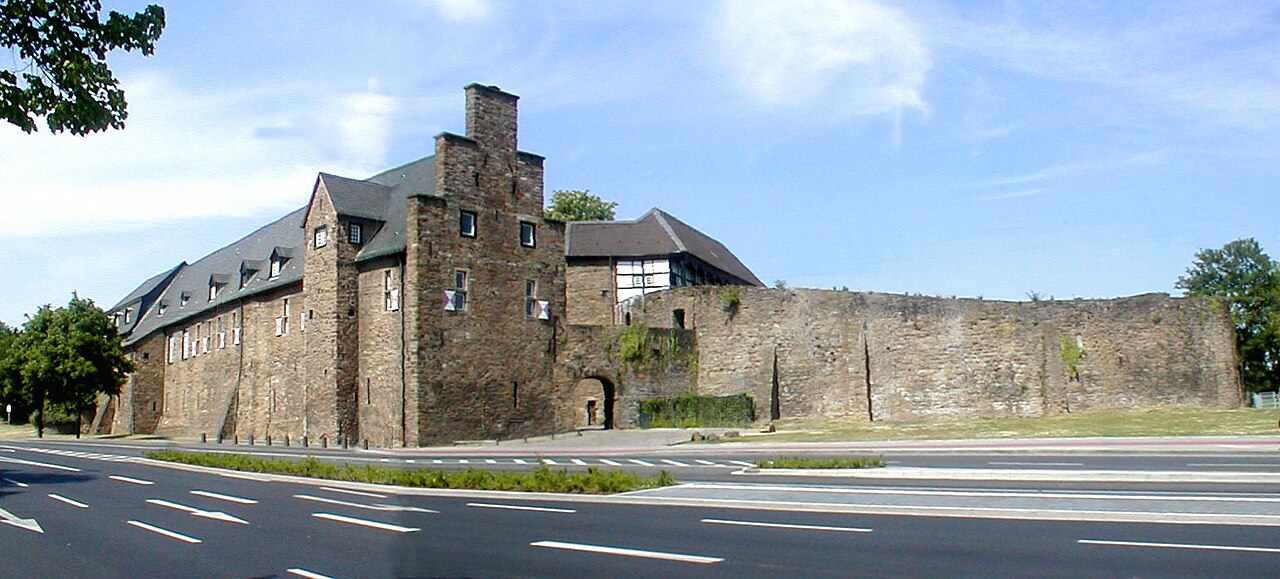
In the 14th century, the castle was expanded with an eastern tower annex added by the Lords of Luttelnau. Later, a round annex was constructed on the tower's western corner, likely serving as a stair turret or defensive lookout. Remnants of a rubble stone ring wall survive, curving around the western side to protect the landward approach.
Historical transitions and decline
Following the extinction of the Luttelnau family line in 1417, the castle passed as a fief to Heinrich von Oefte in 1424 and became part of the larger Schloss Oefte estate. Over the next decades, the importance of the castle diminished, and by 1454 it was recorded as deserted. By 1573, the castle remained abandoned, though it briefly served as a prison for the Oefte lords in the late 16th century.
Modern preservation and archaeological efforts
In the late 20th century, the city of Essen, which succeeded the former community of Kettwig, initiated preservation and conservation efforts for the ruins. Excavations began in 1969, uncovering important structural remains and providing insight into the castle's construction phases. The site was declared a municipal monument in 1985 and officially protected as an archaeological site in 1992.
Architectural features and layout
The surviving Kattenturm tower stands approximately 13 meters tall atop its artificial motte. The tower's northeastern section has partially collapsed, but the original three-floor layout remains discernible. The ground floor's thick walls and vaulted chamber reflect typical knightly residential architecture of the medieval period. The first floor, about 5 meters high, has thinner walls and likely served as living or working quarters.
The western corner's round annex, with walls 60 centimeters thick and a diameter just over 3 meters, is a notable later addition. The eastern annex's remnants survive, although its original form is not fully clear. To the north of the tower, a three-meter-wide depression marks the site of a former moat, enhancing the castle's defensive position on the island.
Further upstream, the outer bailey was situated on a flood-safe elevation. While its exact location is known, no physical remains of buildings or fortifications have been found there. These features illustrate the castle's layered development and strategic design through centuries of occupation.
Frequently asked questions (FAQ)
- When was the kattenturm built and by whom?
- The Kattenturm was built in the 13th century by local knights as part of the Burg Luttelnau castle complex.
- What remains can visitors see at the kattenturm site?
- Visitors can see the square tower ruin standing on an artificial motte, remnants of the stone ring wall, the round annex, and traces of the moat.
- Is the kattenturm accessible to the public?
- The Kattenturm site is preserved as an archaeological monument managed by the City of Essen, and while it is accessible, facilities and visiting hours may vary.
- Why was the castle abandoned?
- The castle lost its strategic importance after the Luttelnau family line ended in 1417 and was recorded as deserted by 1454, later serving briefly as a prison before falling into ruin.
Information
Current owner
City of Essen
Loading map...
Visitor reviews
No reviews yet. Been here? Write the first review and help other travelers!
Write the first reviewVisited this castle? Share your experience
Your review helps other travelers and adds first-hand knowledge to our encyclopedia.