Broich Castle
Broich Castle stands as a remarkable testament to over a millennium of history in Mülheim an der Ruhr, Germany. Originally established in the late 9th century as a military fortification against Norman Viking raids, it is among the oldest known Carolingian fortifications still preserved in the German-speaking world. Its strategic location atop an 11-meter-high natural spur overlooking a ford on the Ruhr River allowed it to control the vital Hellweg trade route, a major artery in early medieval Europe.
The castle's earliest phase was a temporary military camp constructed during the winter of 883/884 by Duke Heinrich of the East Franks, responding swiftly to the Viking threat after their occupation of Duisburg. This initial fortification consisted of an oval-shaped ring wall enclosing multi-room buildings, some rising to two stories, but lacking permanent domestic features such as kitchens or wells, indicating its transient military purpose. After successfully expelling the Vikings in 884, the site was largely abandoned but retained some fortified presence into the early 10th century.
Medieval expansion and architectural evolution
By the late 11th century, the noble family of Broich undertook extensive restoration and expansion, marking the transition from a temporary military camp to a permanent fortress. The castle's first documented mention dates to 1093, establishing the Broich lords’ long-standing influence. The late 12th century saw significant fortification enhancements: the ring wall was thickened to approximately 1.5 meters and raised to around 9 meters, a northern zwinger (outer ward) was created, and a towering bergfried nearly 18 meters tall was constructed as a formidable defensive stronghold and symbol of power.
The castle’s resilience was tested during the siege of 1240 by Archbishop Konrad of Cologne amid regional power struggles involving the Counts of Jülich and Dukes of Limburg. The fortress successfully withstood the assault, demonstrating its robust medieval military architecture.
Gothic palas and late medieval conflicts
Between 1380 and 1400, a prominent two-story Gothic palas with distinctive stepped gables was added along the southern castle wall, enhancing residential comfort while maintaining defensive features. However, the 15th century brought intense warfare; notably, between 1437 and 1439, the castle endured sieges during feuds involving Count Heinrich of Limburg-Broich and Archbishop Dietrich II of Cologne. The most devastating attack occurred in 1443 when a large allied force of up to 22,000 soldiers captured the castle, burning the bergfried and a corner tower, and severely damaging the defensive walls and living quarters. This marked the first successful conquest of Schloss Broich, leading to significant reconstruction efforts, including the deliberate demolition of the bergfried and unrealized plans for a stone bridge over the Ruhr.
Early modern transformations and ownership changes
In the early 16th century, ownership transitioned through marriage alliances to the Daun-Falkenstein family, who undertook extensive renovations focusing on residential improvements. These included sealing the northwest gate, creating a larger western entrance, and adding several two-story buildings and timber-framed houses within the castle compound. Defensive upgrades were minimal during this period, reflecting a shift from military fortress to noble residence.
The castle’s strategic importance persisted during the Cologne War and the Eighty Years’ War in the late 16th century. In 1598, a Spanish force led by Admiral Francisco de Mendoza besieged the castle with 5,000 soldiers, breaching the northwest walls and forcing surrender. The siege inflicted severe damage, and the subsequent death of Count Wirich VI marked a turning point in the castle’s turbulent history.
17th-century restoration and baroque influences
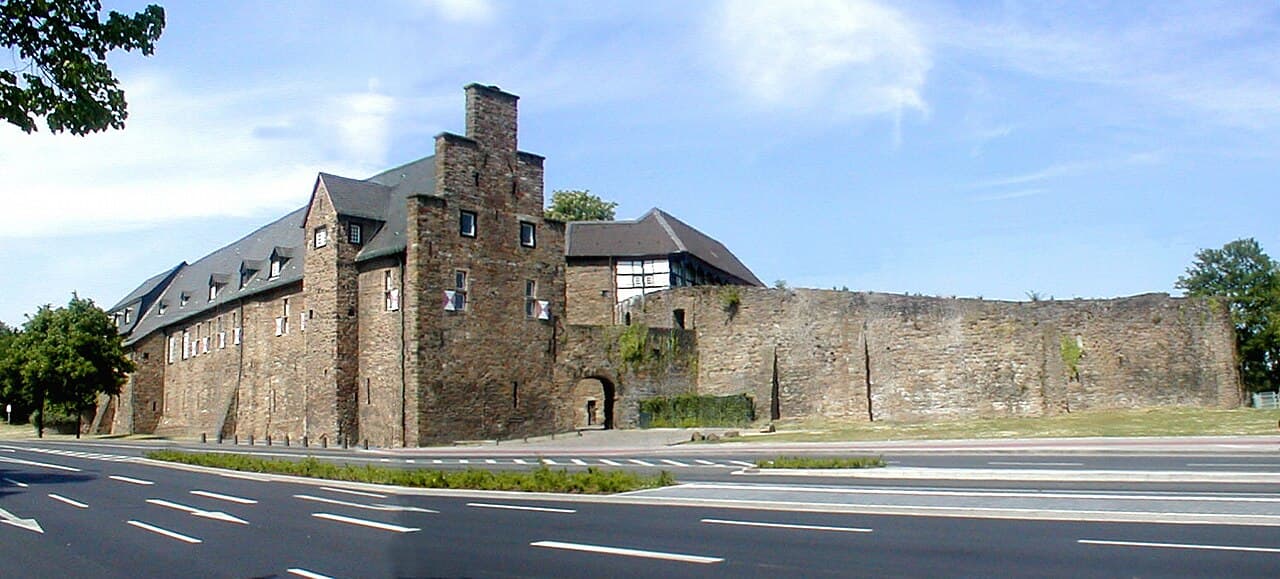
Between 1644 and 1648, Count Wilhelm Wirich von Daun-Falkenstein led a comprehensive restoration and expansion. The residential buildings were rebuilt with a timber-framed upper story and a wooden gallery above the main gatehouse, now known as the Hochschloss. His coat of arms and titles remain inscribed above the gate, commemorating this significant work. A two-story palace wing with an octagonal stair tower was constructed in the courtyard, linking the Gothic palas and earlier residences into a cohesive complex. The castle grounds were enhanced with a southern garden and an outer bailey with a moat to the northwest, although the moat was later removed in the 19th century.
Following Count Wilhelm Wirich’s death in 1682, the castle passed to the Leiningen-Dagsburg family through marriage. As military threats diminished, Schloss Broich gradually lost its defensive function and served primarily as an administrative center.
18th and 19th-century adaptations and decline
In 1789, under Maria Luise Albertine’s patronage, parts of the west wing were rebuilt in an early classical style by architect Nicolas de Pigage. This renovation included rebuilding the stair tower and demolishing the northern wing, reflecting contemporary architectural tastes. The lordship was dissolved during the Napoleonic era, and the region was annexed by Prussia in 1815.
After the last private owner died in 1830, the castle entered a period of neglect. In 1857, banker Eduard Stöcker purchased the estate, removed the timber-framed buildings, and constructed a neoclassical two-story villa adjoining the Hochschloss, reflecting 19th-century architectural preferences. The castle suffered further damage due to expanding railway and road projects during the 19th and 20th centuries.
20th-century preservation and archaeological discoveries
Ownership transferred to the municipality in 1938, but wartime and postwar conditions led to continued deterioration. Initial preservation efforts began in 1952 with the roofing of the hall building. From 1967 to 1974, archaeological excavations led by Professor Günther Binding uncovered foundational remains of the original Carolingian fortification and subsequent medieval expansions, providing valuable insights into the castle’s layered history.
The castle officially reopened in 1975, and by 2009, the ring wall's structural condition had become critical. A comprehensive restoration project commenced in 2010, funded entirely by donations and costing approximately 4.6 million euros. This decade-long effort repaired dangerous falling stones and reinforced the castle’s historic fabric, ensuring its preservation for future generations.
Architectural features and surviving structures
The surviving elements of Schloss Broich vividly illustrate its complex architectural evolution. The original late 9th-century oval ring wall enclosed multi-room buildings constructed for temporary military defense. The late 12th-century reconstruction introduced a thickened and raised ring wall, a northern zwinger, and a massive bergfried tower as key defensive features.
The Gothic palas added between 1380 and 1400 provided fortified residential space with characteristic stepped gables. Although the bergfried was destroyed in the 1443 siege and not rebuilt, the castle’s defensive walls and residential buildings were repaired and expanded in subsequent centuries.
The Hochschloss, with its timber-framed upper story and wooden gallery, remains a prominent feature, bearing the coat of arms of Count Wilhelm Wirich von Daun-Falkenstein. The two-story palace wing with its octagonal stair tower integrates the Gothic palas with later residential additions, forming a unified courtyard complex. While the outer bailey and moat constructed in the 17th century were removed in the 19th century, the castle’s core retains its historical integrity.
Today, Schloss Broich serves multiple functions: it houses a local history museum within the Hochschloss, offers event spaces such as the knights’ hall and coat-of-arms room, and hosts weddings, music festivals, and cultural events. Its preservation reflects a rich heritage spanning from the Carolingian era through medieval and early modern periods to contemporary times.
Cultural significance and visitor experience
Broich Castle is not only a monument of military and architectural history but also a cultural hub in Mülheim an der Ruhr. Its long history of noble residence, military defense, and administrative use provides a unique window into the region’s past. Visitors can explore the castle’s layered architecture, learn about its role in regional conflicts, and appreciate its transformation over centuries.
The local history museum offers exhibitions that illuminate the castle’s significance and its impact on the city’s development. The castle’s picturesque setting by the Ruhr River and its well-maintained grounds make it a popular venue for weddings, concerts, and festivals, blending historical ambiance with contemporary cultural life.
Overall, Schloss Broich stands as a rare example of a hill castle with origins in the high medieval period and earlier, showcasing architectural styles from Carolingian fortifications through Gothic and early classical renovations to 19th-century neoclassical additions. Its restoration and ongoing use highlight the importance of preserving historic sites as living parts of community heritage.
Frequently asked questions (FAQ)
- How do I get to Broich Castle?
- Broich Castle is located in Mülheim an der Ruhr, Germany, and is easily accessible by public transport. You can take the U-Bahn or bus to the nearest station, followed by a short walk to the castle. Additionally, there is parking available for those who prefer to drive.
- What is the historical significance of Broich Castle?
- Broich Castle dates back to the 13th century and is one of the oldest castles in the Ruhr area. It has played an important role in the region's history, serving as a residence for noble families and a strategic military site. Today, it stands as a symbol of the area's rich heritage.
- When was Broich Castle last renovated?
- The most recent major renovation of Broich Castle took place in the late 20th century, restoring its original medieval architecture and enhancing its historical features. Ongoing maintenance ensures that the castle remains a beautiful and safe destination for visitors. The renovations have helped preserve the castle's structure while accommodating modern amenities.
- Can I visit Broich Castle year-round?
- Yes, Broich Castle is open to visitors year-round, but hours may vary depending on the season. It is advisable to check the official website for current opening hours and any special events that may affect access. Guided tours are available, allowing guests to explore the castle's history and architecture.
- Why is Broich Castle a popular tourist attraction?
- Broich Castle attracts visitors due to its stunning architecture, rich history, and picturesque surroundings. The castle hosts various cultural events and exhibitions throughout the year, enhancing its appeal. Its beautiful gardens and scenic views make it a perfect spot for photography and leisurely walks.
- Is it possible to book a guided tour of Broich Castle?
- Yes, guided tours of Broich Castle can be booked in advance, providing a deeper insight into its history and architecture. These tours are led by knowledgeable guides who share fascinating stories about the castle's past. It is recommended to reserve your spot early, especially during peak tourist seasons.
- What are the ticket prices for visiting Broich Castle?
- Ticket prices for Broich Castle are generally affordable, with discounts available for students and seniors. Children under a certain age may enter for free, making it a family-friendly destination. Check the official website for the latest pricing information and any special events that might have different rates.
- What is the best time to visit Broich Castle?
- The best time to visit Broich Castle is during the spring and early autumn when the weather is mild and the gardens are in full bloom. These seasons also feature fewer crowds, allowing for a more enjoyable experience. Special events and festivals often take place during these months, adding to the charm of your visit.
- Are there any nearby attractions to explore after visiting Broich Castle?
- Yes, there are several attractions near Broich Castle, including beautiful parks, museums, and the scenic Ruhr River. The nearby Mülheim city center offers shopping, dining, and cultural experiences for visitors. Additionally, the region's rich industrial heritage can be explored at various museums and historical sites close to the castle.
Photo gallery

Photo by Docfeelgood•Public domain
Information
Website
Visit websiteSources & official resources
Verify the information above using these authoritative references.
Loading map...
Visitor reviews
No reviews yet. Been here? Write the first review and help other travelers!
Write the first reviewVisited this castle? Share your experience
Your review helps other travelers and adds first-hand knowledge to our encyclopedia.