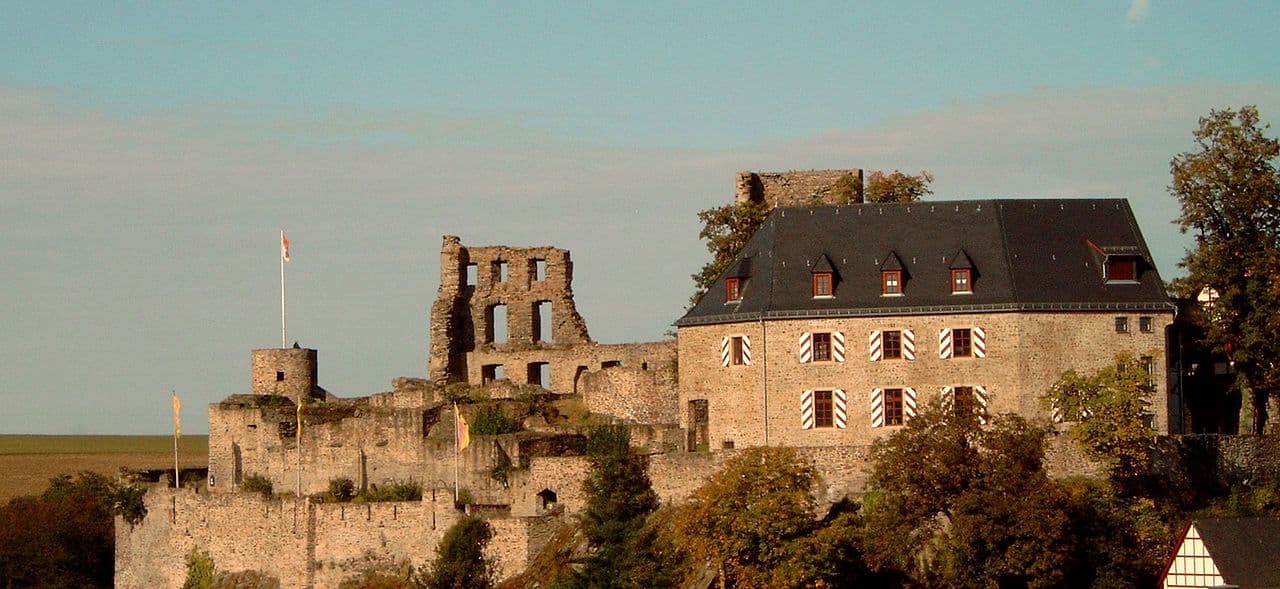
Kastellaun Castle
Kastellaun Castle stands prominently as a medieval hilltop fortress overlooking the town of Kastellaun in Germany. Constructed in the 13th century, this castle was a significant stronghold for the Counts of Sponheim, a noble family influential in the region during the High Medieval period. Its strategic location atop a castle hill allowed control over the surrounding lands and connection to the former town wall, marking it as a key defensive and administrative center in the Hunsrück region.
The castle is first documented in 1226 under the name "Kestilun," associated with the Counts of Sponheim. By 1301, it served as the residence of Simon II, Count of Sponheim-Kreuznach, underscoring its importance as a noble seat. The castle's history is marked by conflict, notably the 1321 siege led by Archbishop Baldwin of Trier, who sought to curb Sponheim influence. To counterbalance Kastellaun's power, Baldwin constructed the nearby Burg Balduinseck in 1325, highlighting the castle's regional strategic significance.
Historical ownership and political significance
After Walram of Sponheim-Kreuznach abandoned Kastellaun in 1340, the castle transitioned from a noble residence to an administrative center managed by bailiffs and burgmänner. The extinction of the Sponheim line led to joint ownership by Bernhard II, Margrave of Baden and Count Friedrich of Veldenz, who ruled the castle as a condominium, reflecting the complex feudal arrangements of the period.
In 1444, the Veldenz share passed to Stephen, Count Palatine of Simmern-Zweibrücken, integrating Kastellaun into the Palatine sphere of influence. This shift embroiled the castle in regional conflicts linked to the Palatinate, including its involvement in the Thirty Years' War (1618–1648), during which it was occupied by various armies, including Spanish, Swedish, and French forces.
From 1594, Edward Fortunatus, the last Margrave of Baden-Baden, used Kastellaun Castle as a refuge after losing his margravate. His residence there until his death in 1600 marked the castle's brief return to noble habitation before its decline.
Destruction and restoration efforts
The castle suffered its ultimate destruction in 1689 during the War of the Palatine Succession, when French troops demolished much of the fortress. An incomplete explosion spared the powder tower, which remains partially intact as a testament to the castle's turbulent past. Following centuries of neglect, the ruins entered private ownership in 1820 before being purchased by the municipality of Kastellaun in 1884. Early stabilization efforts began then, with more extensive restoration and archaeological excavations conducted between 1990 and 1993.
Architectural features and layout
Kastellaun Castle comprises an inner bailey and an outer bailey, typical of medieval hill castles. The inner ward contains the remains of the defensive bergfried, a tall tower central to the castle's defense, alongside a robust enceinte or ring wall. Two residential buildings survive in part: the eastern structure dates back to the 14th century, with excavations revealing its cellar, while the western ruins include the eastern end of the palas—the great hall used for official functions—and an adjacent rectangular powder tower likely constructed in the 16th century.
Facing the town, a zwinger—a secondary defensive wall—served as an additional barrier to attackers. The original entrance was secured by a gate tower at the northern corner of the inner bailey, though today's visitors enter through a modern gate. The outer bailey hosts two modern buildings erected on historic foundations, reflecting the site's layered history.
The palas and current uses
The former palas now functions as an open-air stage for theatrical performances, integrating cultural activities with the castle's historic ambiance. The castle cellars and restored lower bailey accommodate a restaurant offering medieval-themed cuisine, creating a unique visitor experience that blends history with modern hospitality.
Archaeological finds and museum exhibits
The documentation center established in the lower bailey presents a rich collection of artifacts spanning the region's history from prehistoric times through Roman and medieval periods to modernity. Exhibits include Celtic pottery, fibulae (ancient brooches), jewelry, and a reconstruction of a wagon burial discovered in 1938. A detailed model of a Roman legionary helmet illustrates the military and cultural influences that shaped the area long before the castle's construction.
Legacy and cultural significance
Kastellaun Castle remains a symbol of the region's medieval heritage and feudal history. Its ruins, preserved and stabilized through careful restoration, offer insight into the architectural evolution of hill castles in the High Medieval period. The castle's layered history of noble residence, military stronghold, and administrative center reflects the complex political dynamics of the Rhineland-Palatinate region.
Today, Kastellaun Castle serves not only as a historical monument but also as a vibrant cultural venue, hosting events that connect contemporary audiences with the medieval past. Its archaeological collections and preserved structures provide valuable resources for understanding regional history and medieval castle architecture.
Frequently asked questions (FAQ)
- When was Kastellaun Castle built and who were its original owners?
- Kastellaun Castle was built in the 13th century by the Counts of Sponheim, a noble family influential in the region during the High Medieval period.
- What significant historical events affected Kastellaun Castle?
- The castle was besieged in 1321 by Archbishop Baldwin of Trier, occupied during the Thirty Years' War, and ultimately destroyed by French troops in 1689 during the War of the Palatine Succession.
- What remains of Kastellaun Castle can visitors see today?
- Visitors can see the ruins of the defensive bergfried, the palas, the powder tower, and parts of the enceinte and zwinger walls, along with restored sections of the lower bailey.
- Can I attend cultural events at Kastellaun Castle?
- Yes, the former palas is used as an open-air stage for theatrical performances, and the castle hosts various cultural events throughout the year.
- Is there a museum or exhibition at Kastellaun Castle?
- Yes, the lower bailey houses a documentation center with archaeological exhibits including Celtic pottery, fibulae, jewelry, and Roman artifacts.
Photo gallery

Information
Sources & official resources
Verify the information above using these authoritative references.
Loading map...
Visitor reviews
No reviews yet. Been here? Write the first review and help other travelers!
Write the first reviewVisited this castle? Share your experience
Your review helps other travelers and adds first-hand knowledge to our encyclopedia.


