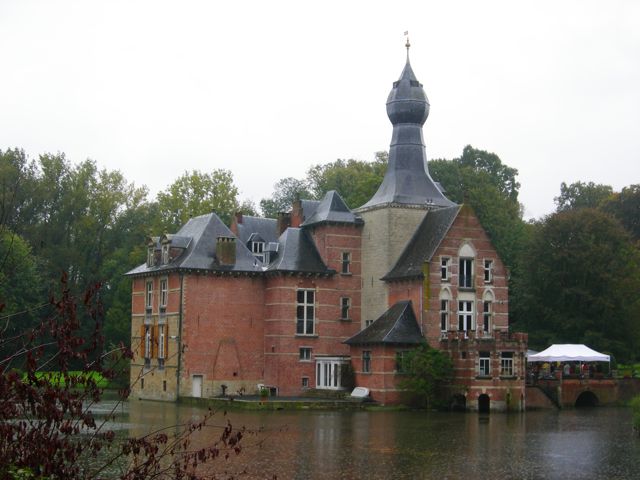
Karreveld Castle
Karreveld Castle is a remarkable historic estate located in the municipality of Molenbeek-Saint-Jean within Brussels, Belgium. With origins tracing back to the medieval Duchy of Brabant, this castle embodies a rich blend of noble residence and agricultural estate, illustrating centuries of architectural evolution and cultural significance. The castle's history, architecture, and unique contribution to Belgian cinema make it a notable landmark in the region.
Medieval origins and early history
The earliest documentation of the estate, originally called "Carnevelt" or "Karreveld," dates to 1253, when Duke John I of Brabant granted the land to his wife Marguerite, daughter of King Saint Louis of France. Although the original medieval structures have not survived intact, this grant firmly situates the estate within the feudal landscape of the High Middle Ages. The estate was part of the extensive holdings of the Duchy of Brabant, a key political entity in the Low Countries.
Transition to a manorial estate
The present castle structure was primarily built during the 16th or 17th century, reflecting its transformation into a manor house that combined agricultural functions with noble residential use. This period saw the adaptation of many medieval estates into more comfortable and representative homes for the local gentry, often incorporating Renaissance stylistic elements and practical farm buildings.
Ownership and municipal changes
Over the centuries, Karreveld Castle passed through several notable owners. In 1656, the widow of Jérôme Van Ghindertaelen sold the property to Don Garcia Osario y Borgia. Later, in 1780, the estate was acquired by the Villegas family, who also owned the nearby Rivieren Castle. The castle's municipal affiliation shifted in 1812, moving from Anderlecht to Molenbeek-Saint-Jean, reflecting broader administrative reorganizations during the Napoleonic era.
20th-century challenges and restoration
By the early 1900s, parts of the castle had fallen into disrepair amid growing urbanization pressures. The construction plans for the nearby Brussels ring road (Boulevards de Grande Ceinture) threatened the estate's integrity. In response, the municipality of Molenbeek-Saint-Jean purchased the 16-hectare property in 1930 to preserve the castle and its park as public green space while allowing controlled urban development.
Restoration efforts
Between 1952 and 1958, the castle underwent extensive restoration led by municipal architect Pierre De Bruyne. This work stabilized the structure, reinstated historical architectural features, and adapted the building for new civic and cultural uses. The restoration culminated in the castle's designation as a protected monument in 1955 and its inauguration during the Brussels World’s Fair in 1958.
Architectural features and estate layout
Karreveld Castle is a manor that harmoniously blends elements typical of a farming estate with those of a noble residence. Situated on marshy terrain, the castle required reinforced foundations installed during the mid-20th-century restoration to ensure stability.
Exterior and structural elements
The main façade faces a pond and is characterized by a pointed gable that defines its historic silhouette. Beneath layers of whitewash removed before 1930, the façade reveals exposed Spanish brickwork, highlighting authentic construction materials and craftsmanship. The castle complex includes a gatehouse and a dovecote equipped with a traditional weather vane, reflecting the estate's functional and defensive features.
Inner courtyard and outbuildings
On the east side of the inner courtyard stands a barn rebuilt during restoration, featuring a monumental fireplace relocated from Havré Castle. The barn's visible wooden roof structure preserves traditional building techniques. Adjacent to it is a tavern with an Elizabethan-style balustraded gallery, adding a decorative and social dimension to the estate.
Interior spaces and decoration
The castle's interiors showcase a range of historical influences. A salon displays Renaissance stylistic elements, while two upstairs rooms reflect later French design tastes. The attic houses a meeting room styled as a monastic hall with exposed wooden beams, creating a rustic yet solemn atmosphere. An oratory, or small chapel, was recreated in the left wing of the former hostelry beneath a turret topped by a campanile, lending a spiritual character to the space.
Gardens and parkland
The castle is surrounded by a three-hectare park redesigned to respect its historical layout. The original defensive moat was transformed into a pond bordered by a semicircular sandstone ravelin, adorned with flowerbeds and seating alcoves for visitors' enjoyment. Behind the castle lies a formal French garden with flower basins and geometrically trimmed yew hedges, leading into a wooded area that buffers the garden from the busy adjacent boulevard.
Botanical diversity
The park is notable for its diverse collection of conifer species, including Himalayan cedar, Lebanese cedar, Japanese cedar, Douglas fir, black pine, Weymouth pine, European yew, and Japanese larch. These trees enhance the estate's botanical richness and provide a varied visual experience throughout the seasons.
Pioneering role in Belgian cinema
Between 1912 and 1923, Karreveld Castle played a pioneering role in the development of Belgian cinema. Film producer Charles Pathé appointed filmmaker Alfred Machin to establish Belgium's first film studio on the castle grounds. This complex included specialized glass studios and workshops, as well as a small zoological garden housing exotic animals such as bears, camels, and panthers used as actors in early films.
Notable productions such as "La Fille de Delft" and "Maudite soit la guerre" were filmed here, marking significant milestones in Belgium's cinematic history. Although the film studios and zoo no longer exist on the site, their legacy remains an important chapter in the castle's multifaceted heritage.
Current use and cultural significance
Today, Karreveld Castle and its park serve as vibrant cultural and civic venues. The estate hosts municipal meetings, cultural festivals, and community events that continue to enliven this historic site. Its preservation as a protected monument and public green space ensures that Karreveld remains a cherished landmark reflecting Brussels' rich historical tapestry and architectural heritage.
Frequently asked questions (FAQ)
- When was Karreveld Castle originally built?
- The earliest mention of Karreveld Castle dates to 1253, but the current structure was mainly built in the 16th or 17th century as a manor house.
- What architectural styles are visible in Karreveld Castle?
- The castle features Renaissance stylistic elements in its interiors and traditional Spanish brickwork on its façade, blending noble residence and farming estate characteristics.
- What role did Karreveld Castle play in Belgian cinema?
- From 1912 to 1923, Karreveld Castle hosted Belgium's first film studio established by Alfred Machin, including exotic animals used in early films.
- Is Karreveld Castle open to the public?
- The castle and its park serve cultural and civic functions, hosting events and municipal meetings, but specific visiting hours may vary.
- What can visitors see in the castle grounds?
- Visitors can explore the castle's historic architecture, the three-hectare park with diverse conifers, a pond with a sandstone ravelin, and formal French gardens.
Information
Sources & official resources
Verify the information above using these authoritative references.
Loading map...
Visitor reviews
No reviews yet. Been here? Write the first review and help other travelers!
Write the first reviewVisited this castle? Share your experience
Your review helps other travelers and adds first-hand knowledge to our encyclopedia.