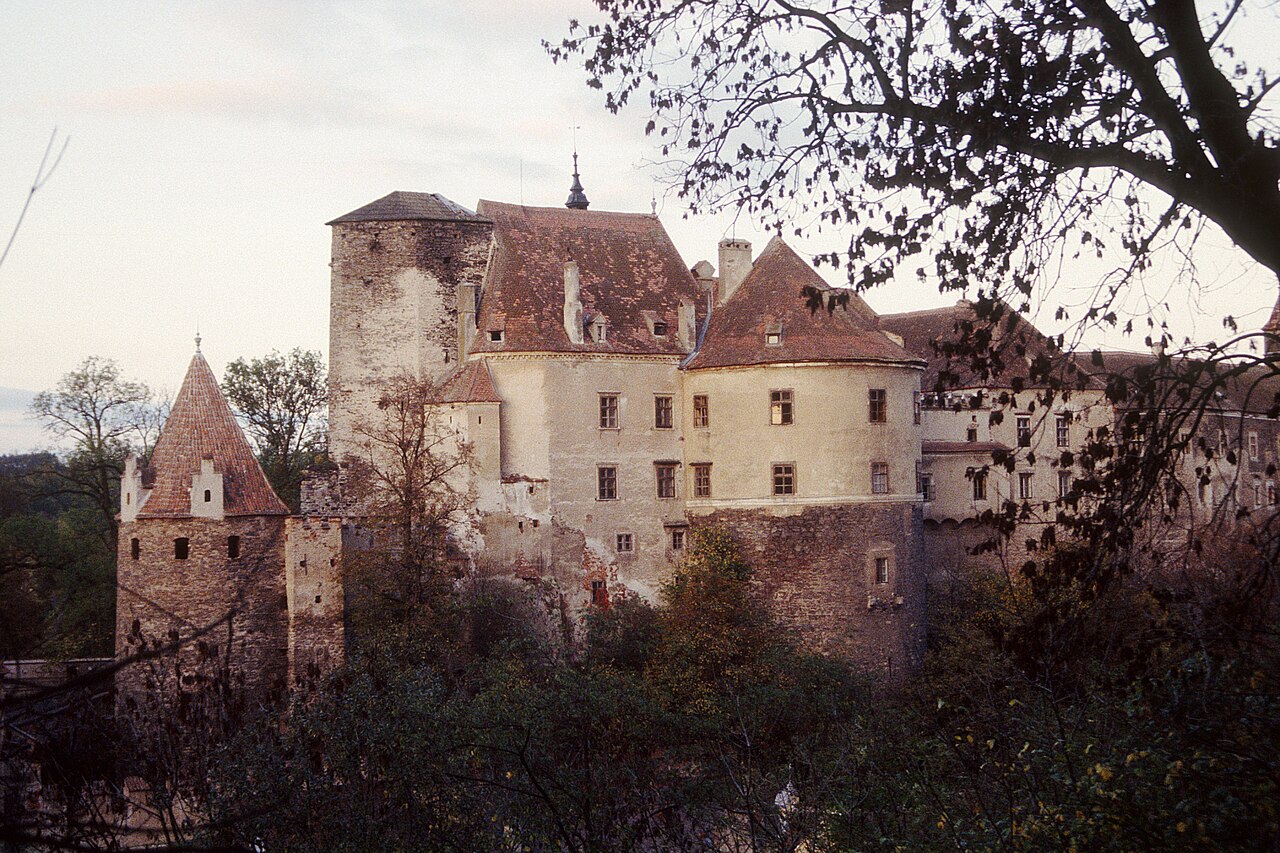
Karlstein Castle
Karlstein Castle, locally known as Burg Karlstein, is a notable medieval fortress situated in the village of Karlstein an der Thaya in the province of Lower Austria, Austria. Perched on a high cliff above the Thaya river, the castle commands a strategic vantage point that has shaped its historical significance. The earliest mention of Karlstein Castle dates back to the 12th century, establishing it as a high medieval stronghold with a rich and turbulent past.
Historical background and ownership
The castle's initial construction in the 12th century laid the foundation for a fortress that would witness centuries of political and military conflict. From 1390 to 1470, Karlstein Castle was under the ownership of the Truchessen von Grueb family, a period during which the castle likely saw significant fortifications and adaptations to meet the demands of medieval warfare. Subsequent owners included the Hauser family, followed by the Puchheim and Van der Straaten families, each contributing to the castle's evolving structure and role.
Strategic importance and conflicts
Located near the border between Bohemia and Austria, Karlstein Castle played a pivotal role in regional power struggles. It was frequently involved in conflicts with the Bohemian King Ottokar, the Hussites, and the Hungarian King Matthias Corvinus. This borderland position made the castle a focal point in the shifting alliances and hostilities that characterized Central European politics in the late medieval period.
The 30 Years' War and other sieges
During the 30 Years' War, a devastating conflict that engulfed much of Europe in the 17th century, Karlstein Castle was besieged in 1645 by Swedish troops. Despite the intensity of the siege, the castle's fortifications held firm, and it was not captured. This resilience underscores the strength of its defensive architecture and strategic location.
The Farmer Rebellion and imprisonment
In 1597, following the suppression of a farmer rebellion, the rebel leader Andreas Schrembser was likely imprisoned within Karlstein Castle before his execution in Waidhofen an der Thaya. This episode highlights the castle's use not only as a military fortress but also as a place of incarceration and judicial authority.
Architectural evolution and features
Karlstein Castle's architecture reflects its long history of construction, reconstruction, and adaptation. Although originally built in the high medieval period, the castle underwent significant rebuilding phases, with much of its present appearance dating from the 16th century. The castle's position on a rocky outcrop above the river provided natural defenses, complemented by man-made fortifications such as thick stone walls, battlements, and defensive towers.
The castle complex likely included a keep or donjon, residential quarters, a courtyard, and various outbuildings necessary for sustaining a garrison. Defensive features would have included arrow slits, gatehouses, and possibly a moat or ditch, although specific details on water defenses are not well documented.
Later uses and decline
In the 18th century, Karlstein Castle experienced a shift from military to industrial use when a watchmaking firm was established within its walls. This change reflects broader social and economic transformations in the region, moving away from feudal warfare toward commercial enterprise.
By 1832, the castle was abandoned and gradually fell into decay, a fate common to many medieval fortresses rendered obsolete by advances in military technology and changing political landscapes.
20th century history and present status
During World War I, from 1914 to 1918, the dilapidated Karlstein Castle was repurposed as an internment camp for citizens from countries hostile to Austria-Hungary. Notably, the Hungarian revolutionary Béla Kun was among those interned here after the war, adding a layer of 20th-century political history to the site.
Today, Karlstein Castle serves as a venue for cultural activities, preserving its historical legacy within a peaceful village setting. Despite its partial ruinous state, it remains a significant monument reflecting centuries of regional history, architecture, and conflict.
Architectural classification and heritage
Karlstein Castle is classified as a hill castle due to its elevated position on a cliff overlooking the Thaya river. Its construction period firmly places it within the high medieval era, although its architectural style is a blend, with significant elements from the 16th century renovations. The castle's current condition is best described as partially preserved, with some structures surviving intact while others have deteriorated.
The castle's enduring presence and historical importance make it a valuable cultural heritage site in Lower Austria, attracting visitors interested in medieval architecture, regional history, and the stories embedded in its walls.
Frequently asked questions (FAQ)
- When was Karlstein Castle originally built?
- Karlstein Castle was originally built in the 12th century, establishing it as a high medieval fortress.
- What is the architectural style of Karlstein Castle?
- Karlstein Castle primarily reflects high medieval architecture with significant renovations dating to the 16th century.
- Can visitors tour Karlstein Castle today?
- Yes, Karlstein Castle is currently used for cultural activities and is accessible to visitors interested in its history and architecture.
- What historical conflicts involved Karlstein Castle?
- Karlstein Castle was involved in conflicts with the Bohemian King Ottokar, the Hussites, and Hungarian King Matthias Corvinus, as well as a siege during the 30 Years' War by Swedish troops.
- What was the castle's role during World War I?
- During World War I, Karlstein Castle served as an internment camp for citizens from hostile countries of Austria-Hungary, including the Hungarian revolutionary Béla Kun.
Information
Address
Schlossweg, Karlstein an der Thaya, Lower Austria, Austria
Loading map...
Visitor reviews
No reviews yet. Been here? Write the first review and help other travelers!
Write the first reviewVisited this castle? Share your experience
Your review helps other travelers and adds first-hand knowledge to our encyclopedia.