Kangra Fort
Kangra Fort, also known as Nagarkot and Kot Kangra, is a monumental bastioned fortress located in the Kangra district of Himachal Pradesh, India. Perched on a hillock between the Manjhi and Banganga rivers, it lies amidst the foothills of the Dhauladhar mountain range. This fort holds the distinction of being the largest fort in the Indian Himalayas and is recognized as the oldest fort in the Himalayan region, with a history that spans nearly 4,000 years.
Historical significance and ancient origins
The Kangra Fort is steeped in history and mythology, with references dating back to ancient Indian texts and legends. It is believed to have been originally constructed during the early medieval period, although the site itself has been significant since antiquity. The fort has witnessed numerous dynasties, invasions, and battles, reflecting the turbulent history of the region.
Throughout its long existence, the fort has been ruled by various powers including the Kangra rulers, the Mughals, and later the Sikhs. Its strategic location made it a coveted stronghold due to control over the surrounding valleys and trade routes through the Himalayas.
Architectural features and fortifications
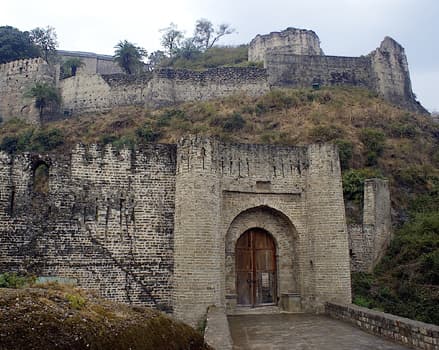
The fort's architecture is a prime example of a bastioned fortress designed to withstand prolonged sieges and attacks. The fortifications include massive stone walls reinforced with bastions and turrets that provide vantage points for defense. The walls are built using robust granite stone masonry, blending with the natural rocky terrain.
The fort complex covers a vast area, incorporating multiple gates, courtyards, and temples within its enclosure. Notable gates include the Amiri Darwaza and the Nagarkot Darwaza, which are fortified with heavy wooden doors and iron spikes to deter invaders.
Inside the fort, there are remnants of ancient palatial structures, granaries, and water tanks that highlight the self-sustaining nature of the fortress during sieges. The fort also houses several Hindu temples, including the famous Mahadev Temple, which adds religious significance to the site.
Geographical setting and strategic importance
Situated at an elevation on a hillock, the Kangra Fort commands a panoramic view of the surrounding valleys and mountain ranges. Its position between the Manjhi and Banganga rivers not only provided natural defense barriers but also ensured a steady water supply.
The fort's location in the Dhauladhar foothills made it a critical military and administrative center controlling the trade routes traversing the Himalayas. Its natural fortifications combined with man-made defenses made it one of the most impregnable forts of its time.
Historical events and sieges
The Kangra Fort has been the site of many significant historical events. It faced numerous sieges, most notably by the Mughal emperor Akbar in the 16th century. Despite fierce resistance, the fort fell to the Mughals in 1620 after a prolonged siege.
Later, the fort came under the control of the Sikh Empire in the 19th century. It also witnessed battles involving the British colonial forces during their expansion in northern India.
Conservation and modern status
Today, the Kangra Fort is under the protection of the Archaeological Survey of India. It is a partially preserved site with extensive ruins that attract historians, archaeologists, and tourists alike. Conservation efforts aim to stabilize the remaining structures and preserve the fort’s rich heritage.
The fort is accessible to visitors who can explore its vast grounds, ancient temples, and impressive fortifications while enjoying views of the Himalayan landscape. It remains a significant cultural and historical landmark in Himachal Pradesh.
Architectural style and construction period
The fort's construction reflects a blend of early medieval Indian military architecture with influences from later periods due to successive renovations and repairs by different rulers. The predominant style is consistent with bastioned fortresses designed for defense, featuring thick walls, bastions, and strategic placement of gates and towers.
Its origins likely date back to the early medieval period, with significant modifications made during the high medieval and late medieval periods as military technology and political control evolved.
Frequently asked questions (FAQ)
- How do I reach Kangra Fort?
- Kangra Fort is located in the Kangra district of Himachal Pradesh. The nearest major city is Dharamshala, which is well connected by road and air. From Dharamshala, visitors can hire taxis or take local transport to reach the fort.
- What is the best time to visit Kangra Fort?
- The best time to visit Kangra Fort is during the spring and autumn months when the weather is pleasant and suitable for exploring the extensive fort grounds and surrounding natural beauty.
- Is Kangra Fort accessible for people with mobility issues?
- Due to its hilltop location and uneven terrain, Kangra Fort may present challenges for visitors with mobility issues. Some areas involve steep climbs and uneven pathways, so assistance or careful planning is recommended.
- What are the main architectural features of Kangra Fort?
- Kangra Fort features massive stone walls with bastions and turrets, fortified gates such as Amiri Darwaza, and ancient temples including the Mahadev Temple within its complex.
- Can I visit the temples inside Kangra Fort?
- Yes, several ancient Hindu temples are located within Kangra Fort, including the Mahadev Temple, and visitors are welcome to explore these religious sites during their visit.
Photo gallery

Information
Current owner
Archaeological Survey of India
Loading map...
Visitor reviews
No reviews yet. Been here? Write the first review and help other travelers!
Write the first reviewVisited this castle? Share your experience
Your review helps other travelers and adds first-hand knowledge to our encyclopedia.