Kalmar Castle
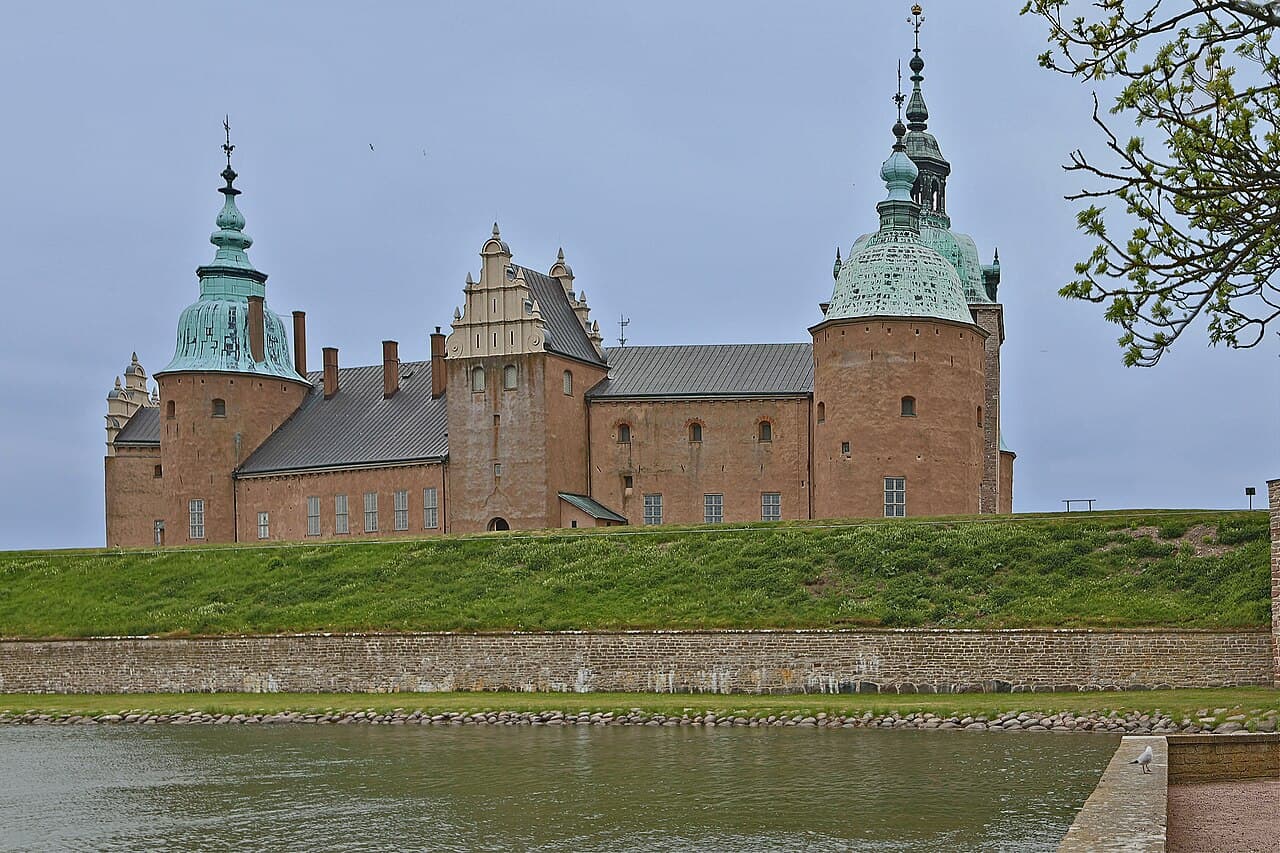
Kalmar Castle stands majestically on a small peninsula just south of the city of Kalmar in the historic province of Småland, Sweden. With origins tracing back to the 12th century, this fortress has evolved over centuries from a solitary defensive tower into one of Sweden's most important and well-preserved Renaissance castles. Situated strategically by the narrow strait of Kalmarsund, separating the mainland from the island of Öland, the castle's location was crucial for controlling maritime traffic and defending the realm.
The earliest known construction at Kalmar was a round defensive tower built in the late 1100s, marking the beginning of a fortified site that would grow in military and political significance throughout the High Medieval period. Over time, successive monarchs and architects expanded and transformed the castle, adapting it to the changing demands of warfare, politics, and royal residence. Its walls witnessed pivotal historical events, including the formation of the Kalmar Union in 1397, a landmark political union uniting Denmark, Norway, and Sweden under a single monarch.
Early medieval origins and medieval fortifications
The first fortification at Kalmar was a substantial round tower constructed in the 12th century to protect the medieval harbor and oversee the vital maritime route. This tower featured walls approximately three meters thick, designed for surveillance and defense against seaborne threats. By the late 13th century, under the reign of King Magnus III (Magnus Ladulås), the castle underwent significant expansion. A robust curtain wall was erected, encompassing the original tower and enhanced by five large round corner towers and two square gatehouses. This fortification created a formidable defensive perimeter, controlling access and providing vantage points for archers and lookouts.
The castle's medieval curtain wall included small watchtowers and a military port, reflecting the strategic importance of Kalmar as a border fortress between Sweden and Denmark. Throughout the 14th century, Kalmar Castle served not only as a military bastion but also as a royal residence. King Magnus Eriksson and Queen Blanche of Namur frequently stayed here, and in 1337, major renovations were undertaken to strengthen the ground floors of the wings and add further defensive structures.
The kalmar union and political significance
Kalmar Castle's most renowned historical moment came on June 17, 1397, when Queen Margaret I of Denmark orchestrated the assembly that led to the establishment of the Kalmar Union. This union united the crowns of Denmark, Norway, and Sweden under a single monarch, aiming to consolidate power and coordinate foreign policy across Scandinavia. The castle's role as the venue for this event underscores its importance as a political and diplomatic center during the late medieval period.
Despite the union's intent to unify the Nordic kingdoms, tensions persisted, especially from Sweden, which often resisted Danish dominance. Throughout the 15th century, Kalmar Castle was a focal point for several union meetings and battles. Control of the fortress shifted multiple times between Danish and Swedish forces, reflecting the ongoing struggle for supremacy in the region.
Renaissance transformation and royal residence
The 16th century marked a significant transformation for Kalmar Castle, shifting from a medieval fortress to a Renaissance royal residence and modern stronghold. After reconquering Kalmar in 1523, King Gustav I (Gustav Vasa) initiated extensive building projects, including ramparts and turrets designed to withstand artillery attacks. His royal builder, James (Jacob) Richter, led construction efforts from the 1550s until his death in 1571, followed by architects Johannes Baptista Pahr, Dominic Pahr, and Peter Dionysius, who continued fortification and embellishment works.
King Erik XIV, Gustav's son, contributed to the castle's interior refinement, commissioning ornate limestone portals from the Belgian stonecutter Roland Mackle and creating the elaborately decorated "King Erik's chambers." These chambers feature intricate wooden paneling and painted ceilings with hunting scenes, exemplifying Renaissance interior artistry.
Under King John III, the castle's fortifications were further strengthened, and artistic embellishments flourished. The castle church was constructed between 1589 and 1592, featuring royal seating and Latin inscriptions that highlight its religious and ceremonial role. Other notable additions include a wellhouse built from 1579 to 1581 within the inner courtyard and the grand "King's stairs," made from repurposed tombstones, connecting key parts of the castle.
Architectural features of the renaissance castle
- Four large round corner towers topped with characteristic Renaissance roofs
- Enclosed wings connecting the towers to form a compact, defensible structure
- Bastions equipped with artillery placements, reflecting advances in military technology
- The castle church with 17th-century royal pews and religious decorations
- King Erik XIV's chambers with concealed passages and elaborate woodwork
- The Striped Hall with a gilded ceiling used for receptions
- The Great Hall, a spacious banquet room covering approximately 400 square meters
- A wellhouse and a large open fireplace in the courtyard, demonstrating practical needs
Conflicts, decline, and restoration efforts
Kalmar Castle's strategic importance made it a target during the Kalmar War (1611-1613) between Sweden and Denmark. The fortress was occupied by Danish forces and suffered extensive damage, including the destruction of interior decorations, towers, and a gazebo built by John III. In 1642, a significant fire destroyed one of the palace halls, known today as the "incinerated hall," which was never restored.
Following the war and changing political borders, Kalmar Castle gradually lost its military relevance. By the mid-17th century, proposals to demolish the castle emerged, but fortunately, these were never realized. Instead, the castle's fortifications were modestly reinforced in the 1640s and 1650s. However, by the late 17th century, the castle ceased to function as a royal residence or fortress, and parts of it fell into disrepair.
In the 18th century, the castle was repurposed for various non-military uses, including a distillery and a prison. Structural alterations during this period included breaking up walls to accommodate distillery equipment. Despite these changes, the castle's core structure remained intact.
19th and 20th century restorations
Restoration efforts began in earnest in the mid-19th century under the patronage of King Oscar I. Architect Fredrik Wilhelm Scholander led the initial work, restoring key features such as "Erik XIV's chambers" between 1855 and 1862. Subsequent restorers, including Helgo Zettervall and Carl Möller, continued the restoration through the late 19th century, culminating in the castle regaining much of its Renaissance silhouette by 1891.
In the 20th century, further restoration focused on the castle's earthworks, moat, bridge, and drawbridge. Under the guidance of professor Martin Olsson, these efforts continued until 1941, restoring the castle's water defenses and historic appearance. Today, Kalmar Castle is recognized as one of Sweden's best-preserved Renaissance castles and serves as a cultural monument open to the public.
Visitor experience and cultural significance
Visitors to Kalmar Castle can explore its richly decorated interiors, including royal chambers, grand halls, and the castle church. The fortress's extensive defensive structures, such as bastions, ramparts, and moats, offer insight into medieval and Renaissance military architecture. The castle's location provides scenic views of the Kalmarsund strait and the surrounding landscape.
As a site of immense historical importance, Kalmar Castle embodies the evolution of Swedish fortifications and royal residences from the Middle Ages through the Renaissance and into modern times. Its association with key historical figures and events, such as the Kalmar Union and the reigns of Gustav I, Erik XIV, and John III, enhances its cultural and heritage value.
Today, the castle is owned by the Swedish state and managed as a public museum, hosting exhibitions, guided tours, and cultural events that celebrate its rich history and architectural grandeur.
Frequently asked questions (FAQ)
- How do I get to Kalmar Castle?
- Kalmar Castle is located in the city of Kalmar, Sweden, and is easily accessible by public transport. You can take a train or bus to Kalmar, and from there, it's a short walk to the castle. If you are driving, ample parking is available nearby.
- What is the historical significance of Kalmar Castle?
- Kalmar Castle has a rich history dating back to the 12th century and played a crucial role in Sweden's defense against Danish invasions. It was also the site of the Kalmar Union in 1397, which united the kingdoms of Denmark, Norway, and Sweden under a single monarch. Today, it stands as a symbol of Swedish heritage and medieval architecture.
- When was Kalmar Castle built?
- Kalmar Castle was originally built in the late 12th century, with significant expansions and renovations made during the 16th century. The castle's current Renaissance-style architecture reflects these later developments, showcasing its evolution over the centuries. It has been preserved to illustrate its historical importance and architectural beauty.
- Can I take a guided tour of Kalmar Castle?
- Yes, guided tours are available at Kalmar Castle, providing visitors with an in-depth understanding of its history and architecture. Tours are led by knowledgeable guides who share fascinating stories about the castle's past. It's advisable to check the schedule in advance, as tour times may vary.
- Why is Kalmar Castle popular among tourists?
- Kalmar Castle is a popular destination due to its stunning architecture, rich history, and beautiful surroundings. Visitors are drawn to its well-preserved interiors and the picturesque views of the surrounding landscape. Additionally, the castle often hosts events, exhibitions, and reenactments that enhance the visitor experience.
- Is it possible to visit Kalmar Castle year-round?
- Yes, Kalmar Castle is open year-round, but opening hours may vary by season. During the summer months, the castle typically has extended hours and more activities for visitors. It's recommended to check the official website for the most current information regarding opening times and seasonal events.
- What are the ticket prices for Kalmar Castle?
- Ticket prices for Kalmar Castle vary depending on age and the type of visit. Generally, adults pay an admission fee, while children and students may receive discounts. Family tickets are also available, making it an affordable outing for all ages.
- What is the best time to visit Kalmar Castle?
- The best time to visit Kalmar Castle is during the summer months, from June to August, when the weather is pleasant and the castle hosts various activities. Spring and early autumn can also be lovely, offering fewer crowds and beautiful scenery. Always consider local events or festivals that may enhance your visit.
- Are there any nearby attractions to Kalmar Castle?
- Yes, there are several nearby attractions, including the Kalmar County Museum and the beautiful Kalmar Cathedral. The surrounding area features charming parks and coastal views, ideal for a leisurely stroll. Visitors can also explore the nearby Öland Island, famous for its natural beauty and historical sites.
Photo gallery

Information
Website
Visit websiteSources & official resources
Verify the information above using these authoritative references.
Loading map...
Visitor reviews
No reviews yet. Been here? Write the first review and help other travelers!
Write the first reviewVisited this castle? Share your experience
Your review helps other travelers and adds first-hand knowledge to our encyclopedia.