Kaiping Diaolou
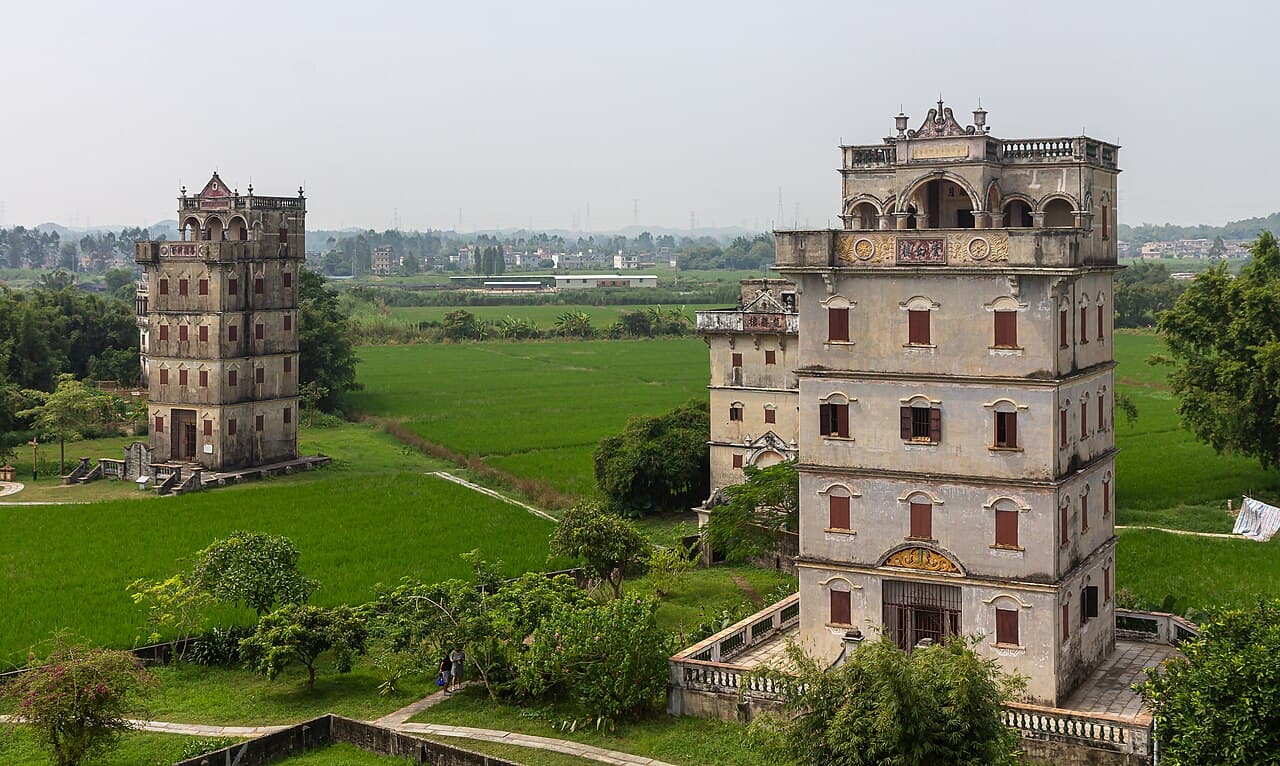
Kaiping Diaolou are a unique collection of fortified multi-storey towers located in the Kaiping region of Guangdong province, China. These towers represent a remarkable fusion of architectural styles and cultural influences, reflecting the social and historical context of early 20th-century rural China. Constructed primarily during the late 19th and early 20th centuries, the diaolou served both defensive and residential purposes, protecting local communities from bandit raids while also symbolizing wealth and status.
Historical background and cultural significance
The Kaiping Diaolou emerged in response to the turbulent social conditions in Guangdong during the late Qing dynasty and early Republic era. Frequent bandit attacks and clan conflicts made rural villages vulnerable, prompting local families, many of whom had returned from overseas, to build fortified structures that combined the functions of watchtowers, homes, and community strongholds. These towers are a testament to the migration patterns of Chinese emigrants who brought back architectural ideas and wealth from abroad, especially from North America.
The diaolou are recognized as a UNESCO World Heritage Site, highlighting their outstanding universal value as an architectural and cultural phenomenon. They illustrate the adaptation of traditional Chinese defensive architecture with Western architectural elements, reflecting the global connections of the Kaiping region's emigrant communities.
Architectural features and styles
The diaolou are typically multi-storey stone or reinforced concrete towers, ranging from three to six floors in height. Their designs incorporate a blend of Chinese traditional motifs and Western architectural styles, including elements of Art Deco, Baroque, and Neoclassical styles. This eclecticism is evident in decorative features such as arched windows, balustrades, and ornate cornices.
Structurally, the towers were built with thick walls and narrow windows to serve defensive purposes. Many towers feature battlements, loopholes for firearms, and reinforced gates. Internally, the towers contain living quarters, storage rooms, and sometimes communal spaces, designed to accommodate extended families during sieges.
Construction techniques and materials
Most Kaiping Diaolou were constructed using locally sourced stone, bricks, and later reinforced concrete, which was innovative at the time in rural China. The use of concrete allowed for taller and more durable structures. The towers’ foundations were carefully laid to ensure stability, often on uneven terrain.
Notable diaolou and their features
Among the hundreds of diaolou originally built, only about 1,800 remain today, with several notable examples attracting visitors and scholars. The Li Garden Tower is famous for its intricate carvings and blend of Chinese and Western styles. The Watchtower of Jinjiangli is notable for its height and defensive features.
Preservation and modern significance
Many Kaiping Diaolou have suffered from neglect and natural decay, but efforts have been made to preserve and restore key towers. Their designation as a World Heritage Site has increased awareness and tourism, contributing to local economies and cultural pride.
Today, the diaolou stand not only as architectural landmarks but also as symbols of the resilience and cultural hybridity of the Kaiping communities. They offer valuable insights into early 20th-century rural life, migration, and the blending of Eastern and Western influences in architecture.
Frequently asked questions (FAQ)
- What are Kaiping Diaolou?
- Kaiping Diaolou are fortified multi-storey towers in Guangdong, China, built mainly in the early 20th century for defense and residence.
- Why were the diaolou built?
- They were constructed to protect local villages from bandit attacks and clan conflicts during turbulent times in Guangdong's history.
- What architectural styles influence the diaolou?
- The towers combine traditional Chinese motifs with Western styles such as Art Deco, Baroque, and Neoclassical elements.
- Are the Kaiping Diaolou a UNESCO World Heritage Site?
- Yes, they were inscribed as a UNESCO World Heritage Site for their cultural and architectural significance.
- Can visitors tour the diaolou?
- Many diaolou are accessible to visitors, offering insights into their defensive features and historic living conditions.
Photo gallery

Information
Loading map...
Visitor reviews
No reviews yet. Been here? Write the first review and help other travelers!
Write the first reviewVisited this castle? Share your experience
Your review helps other travelers and adds first-hand knowledge to our encyclopedia.