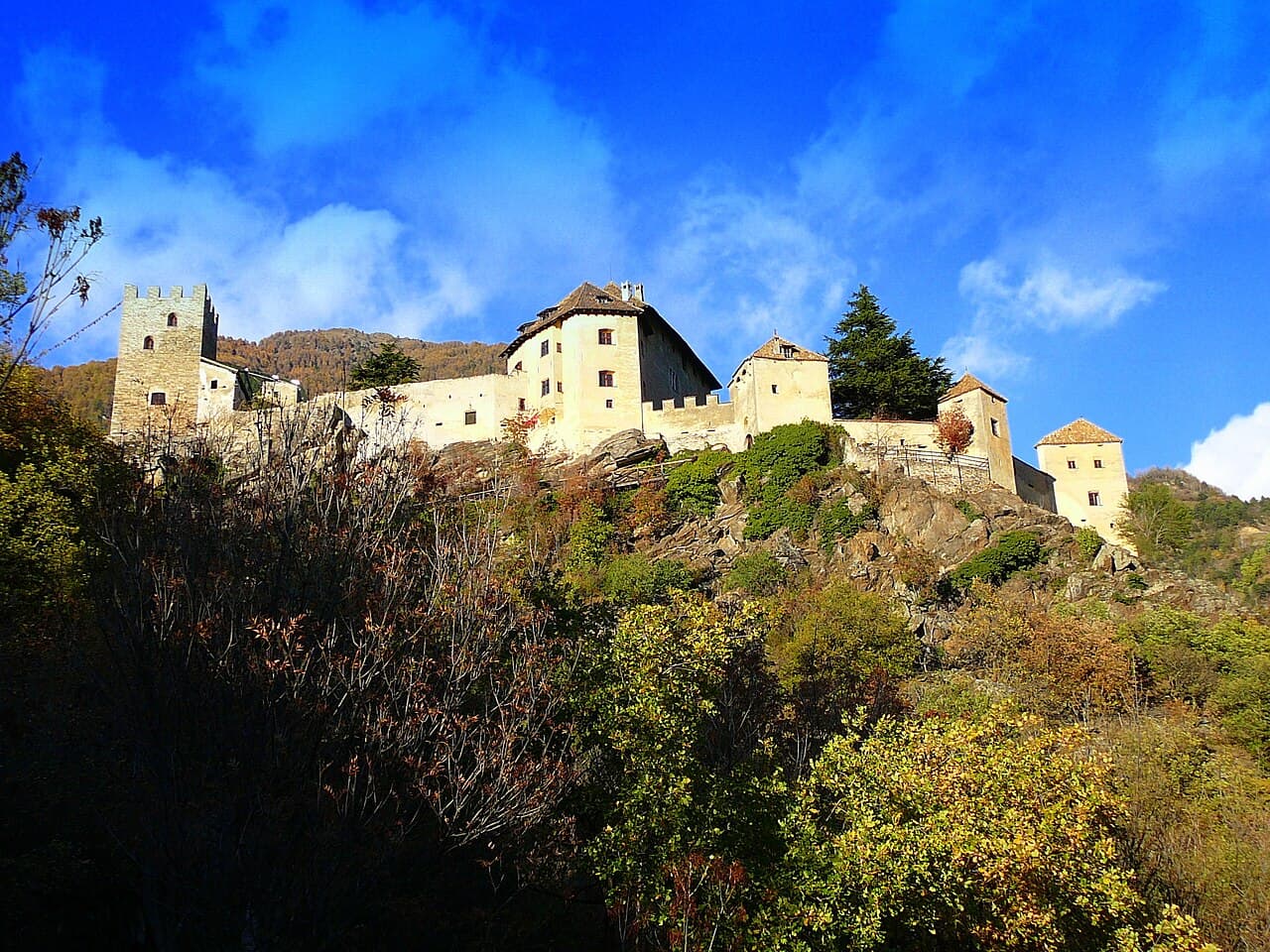
Juval Castle
Juval Castle (Italian Castel Juval) is a remarkable hill castle perched at the entrance of the Schnalstal valley in northern Italy. Its name originates from the Latin Mons Jovis, meaning "mountain of Jupiter," reflecting the site's ancient significance. The castle's earliest documented mention dates to 1278 when it was owned by Hugo of Montalban, though it was likely constructed approximately thirty years earlier, around the mid-13th century. Juval Castle's strategic location on a rocky hilltop about 1,000 meters above sea level provided commanding views of the valley entrance, making it a vital defensive stronghold during the High Medieval period.
Historical background and ownership
The site of Juval Castle has a long history of human occupation, with archaeological evidence indicating continuous settlement from the Neolithic era through the Late Bronze Age. This prolonged habitation underscores the location's strategic and cultural importance well before the castle's construction.
The castle was originally built by the Welf ministerial family of Montalban, who were prominent in Tyrol from the 11th century and exerted judicial and military control over the region. Ownership passed through several noble families over the centuries, including the lords of Starkenberg who acquired it in 1368, and later the Hendl family, who held it for nearly two centuries and were elevated to counts by the late 17th century. In 1540, the castle came into the possession of Hans Sinkmoser, a senior official in the Tyrolean Kellenamt, who initiated significant renovations.
Following its medieval heyday, the castle experienced decline in the 19th century, losing its military and residential roles and becoming a farmstead. By the early 20th century, it had fallen into disrepair until purchased in 1913 by William Robert Rowland, a Viennese planter and writer. Rowland's restoration efforts between 1923 and 1928, guided by architect Adalbert Wietek, preserved much of the castle's structure despite bureaucratic challenges.
During World War II, the castle was seized by German forces and repurposed as a factory employing forced labor under harsh conditions. After the war, ownership changed hands several times before the castle was acquired in 1983 by renowned mountaineer Reinhold Messner. Messner undertook further restorations and converted Juval Castle into his summer residence and a museum dedicated to mountain cultures.
Architectural features and restorations
Juval Castle exemplifies the architectural evolution from a medieval fortress to a Renaissance residential castle. Its core structures date to the Romanesque period of the 13th century, including defensive walls with a distinctive Carolingian-style cross carved into a stone niche, and two marble stones from the 12th century adorned with interlaced patterns. These elements signify the site's long-standing fortification history.
Hans Sinkmoser's 16th-century renovations transformed Juval from a purely defensive stronghold into a comfortable residence with large windows and representative living quarters, reflecting Renaissance architectural sensibilities. These modifications have been carefully maintained or restored, preserving the castle's residential character.
The 20th-century restoration led by Adalbert Wietek focused on stabilizing deteriorated walls and conserving original materials. More recently, architect Karl Spitaler oversaw restoration efforts that balanced preservation with adaptive reuse. A modern glass roof designed by architect Robert Danz was installed in the 1990s to protect parts of the castle while integrating contemporary design elements.
Castle layout and key structures
The castle complex includes a central courtyard that serves as an exhibition space for the Messner Mountain Museum Juval. This courtyard and adjacent halls display an extensive collection of ethnographic artifacts, including Tibetan art and masks from five continents, emphasizing the cultural diversity of mountain peoples.
Surrounding the castle is a botanical trail with informational signage highlighting the local flora, enhancing the visitor experience by linking natural and cultural heritage. The castle grounds also host a farm with a yak breeding program, a vineyard, and a tavern, reflecting Reinhold Messner's commitment to preserving mountain traditions.
Cultural significance and current use
Since 1983, Juval Castle has served as the summer residence of Reinhold Messner, who has partially converted it into the Messner Mountain Museum Juval. The museum showcases Messner's extensive collection of Tibetan art, as well as masks and artifacts from mountain cultures worldwide, highlighting the spiritual and cultural connections people have with mountainous landscapes.
The castle is open to the public outside of the summer months when Messner occupies the residence. Access is limited to footpaths requiring about an hour's walk or a special shuttle service, preserving the site's remote and authentic atmosphere. The museum's closure during Messner's residency maintains a balance between private use and public cultural access.
Visitor experience and access
Visitors to Juval Castle can explore the museum exhibits within the historic halls and courtyard, enjoy the botanical trail around the grounds, and learn about the castle's layered history through informative displays. The remote hilltop setting offers panoramic views of the Schnalstal valley and surrounding alpine landscape.
The castle's accessibility by foot or shuttle ensures that the site remains a preserved cultural landmark, free from mass tourism impacts. The combination of medieval architecture, Renaissance modifications, and modern museum installations creates a unique destination for those interested in history, architecture, and mountain culture.
Frequently asked questions (FAQ)
- How do I get to Juval Castle?
- Juval Castle is accessible only on foot via an hour-long hike or by a special shuttle bus service, preserving its remote hilltop setting.
- What is the historical significance of Juval Castle?
- Juval Castle dates back to the 13th century and has served as a medieval fortress, Renaissance residence, and now a museum showcasing mountain cultures.
- When is Juval Castle open to visitors?
- The castle is open to the public outside of July and August, when Reinhold Messner uses it as his summer residence.
- Can I visit the Messner Mountain Museum Juval year-round?
- No, the museum is closed during the summer months when Reinhold Messner occupies the castle, but it is open the rest of the year.
- What architectural styles are visible at Juval Castle?
- Juval Castle features Romanesque defensive structures from the 13th century and Renaissance residential renovations from the 16th century.
Photo gallery

Information
Sources & official resources
Verify the information above using these authoritative references.
Loading map...
Visitor reviews
No reviews yet. Been here? Write the first review and help other travelers!
Write the first reviewVisited this castle? Share your experience
Your review helps other travelers and adds first-hand knowledge to our encyclopedia.



