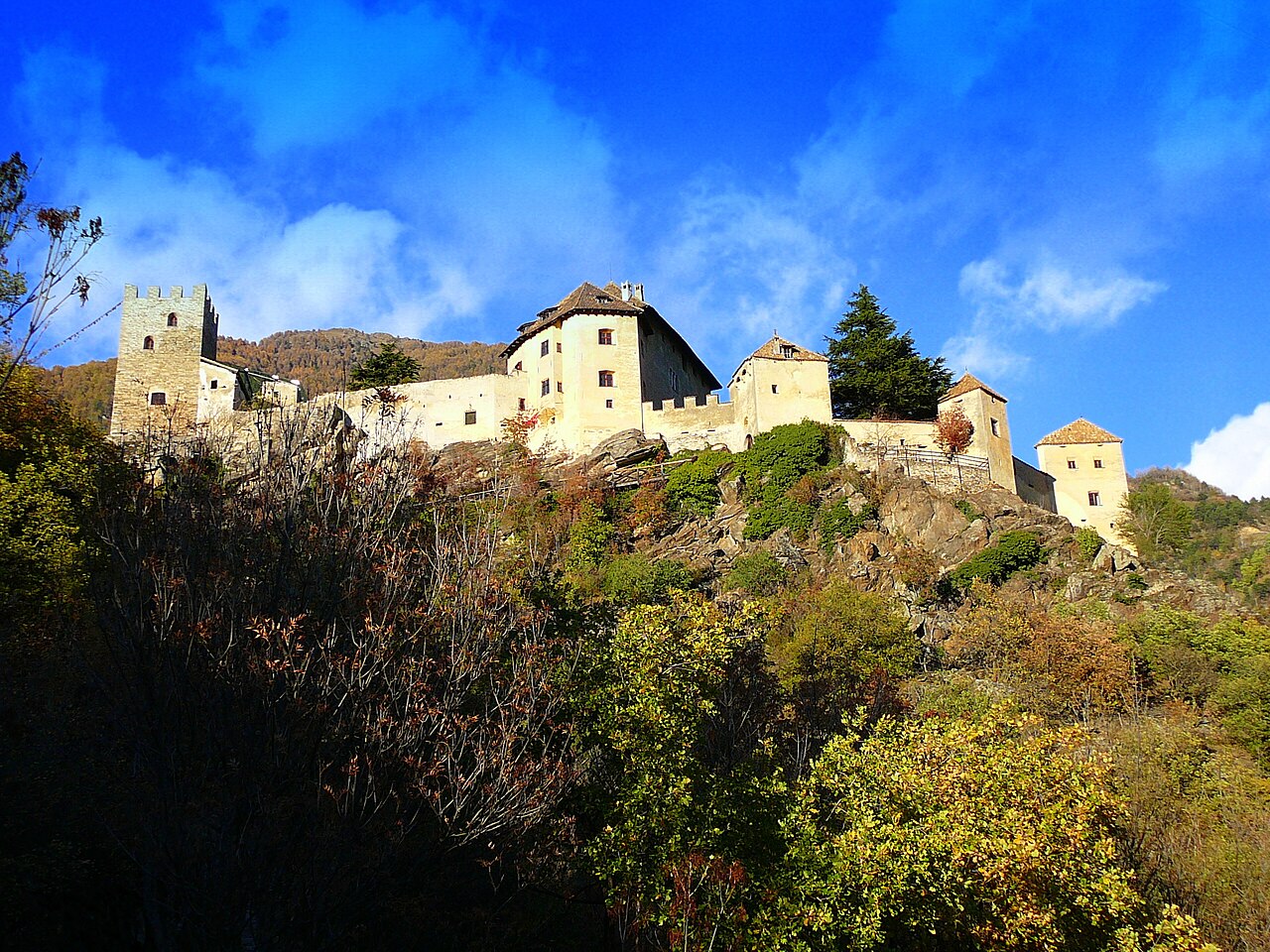
Dornsberg Castle
Dornsberg Castle, located near the municipality of Naturno in Italy, is a remarkable example of a high medieval hill castle with significant Renaissance enhancements. Founded in 1217 by the noble von Tarant family, the castle originally bore the name Tarantsberg before evolving into Dorenberch and eventually Dornsberg. The von Tarants, serving as ministeriales under the Counts of Tyrol, constructed the fortress as both a defensive stronghold and a noble residence, reflecting the political and military landscape of the early 13th century in South Tyrol.
Early history and medieval origins
The castle's earliest documented mention dates to 1232 under the name Dorenberch. It was strategically positioned on a high rock spur overlooking the valley, providing commanding views and natural defense advantages. The von Tarant family fortified the site to assert their influence and safeguard their interests under the Tyrolean overlords. During the late 13th century, the castle's ownership shifted due to changing political fortunes. In 1291, Arnold von Tarant sold the castle to Count Meinhard II of Tyrol for 226 Bernese marks, marking its transition to direct Tyrolean noble control.
The chapel of st. ursula
Between 1270 and 1280, the castle complex was enhanced with the addition of the chapel dedicated to Saint Ursula. This chapel played an important religious role within the castle, serving the spiritual needs of its inhabitants. The chapel is notable for its 16th-century altarpiece and a series of wall frescoes spanning several centuries. Some fresco fragments date back to the late 13th century, providing valuable insight into the castle's medieval ecclesiastical art and religious practices.
Ownership changes and renaissance expansions
Following its acquisition by the Counts of Tyrol, Dornsberg Castle passed through several noble families, including Heinrich von Annenberg in 1347, the counts von Mohr in 1699, and later the Giovannelli and Fuchs von Fuchsberg families. These transitions illustrate the castle's ongoing importance as a noble estate in South Tyrol.
The castle underwent significant architectural development during the Renaissance period. This era introduced notable expansions, including the construction of a loggia, a covered gallery open on one side, which added both aesthetic appeal and functional space. The Renaissance modifications reflect the period's architectural trends and the desire to combine fortification with residential comfort and style.
Architecture and layout
Dornsberg Castle is characterized by its two-courtyard layout. The outer bailey is enclosed by defensive walls and served as the first line of protection as well as a working area. Beyond this lies the inner courtyard, which is surrounded by interconnected buildings that housed the castle's residential and administrative functions.
The castle's most prominent defensive feature is the keep, or mastio, a well-preserved tower that provided refuge and command vantage. The overall fortification design follows typical medieval principles, integrating natural terrain advantages with man-made defenses.
Interior features and artworks
Inside the chapel, visitors would find an altarpiece from the 16th century alongside various ancient paintings and frescoes. The preservation of these artworks, despite damage over the centuries, highlights the castle's cultural and religious significance.
20th-century history and restoration
The castle suffered damage after World War II due to multiple families inhabiting the complex, which affected internal structures and artworks. Recognizing its heritage value, the castle was placed under monument protection in 1950. In 1964, the Gottschall family from Munich purchased Dornsberg Castle and undertook extensive restoration efforts to preserve its historical and architectural integrity.
Today, the castle remains in private ownership by the Gottschall family and is not open to the public. The restoration has maintained the castle's key features, ensuring the survival of its medieval origins and Renaissance additions for future generations.
Frequently asked questions (FAQ)
- When was Dornsberg Castle built and by whom?
- Dornsberg Castle was built in 1217 by the noble von Tarant family, who served as ministeriales under the Counts of Tyrol.
- Is Dornsberg Castle open to the public?
- No, Dornsberg Castle is privately owned by the Gottschall family and is not open for public visits.
- What architectural styles are present in Dornsberg Castle?
- The castle features a mix of high medieval fortification elements and Renaissance architectural additions, including a notable loggia.
- What is the significance of the chapel of Saint Ursula in the castle?
- The chapel, built between 1270 and 1280, contains a 16th-century altarpiece and frescoes from the late 13th century, highlighting the castle's religious heritage.
- Who owns Dornsberg Castle today?
- Since 1964, the castle has been owned by the Gottschall family from Munich, who restored and maintain it.
Information
Sources & official resources
Verify the information above using these authoritative references.
Loading map...
Visitor reviews
No reviews yet. Been here? Write the first review and help other travelers!
Write the first reviewVisited this castle? Share your experience
Your review helps other travelers and adds first-hand knowledge to our encyclopedia.