Junagarh Fort
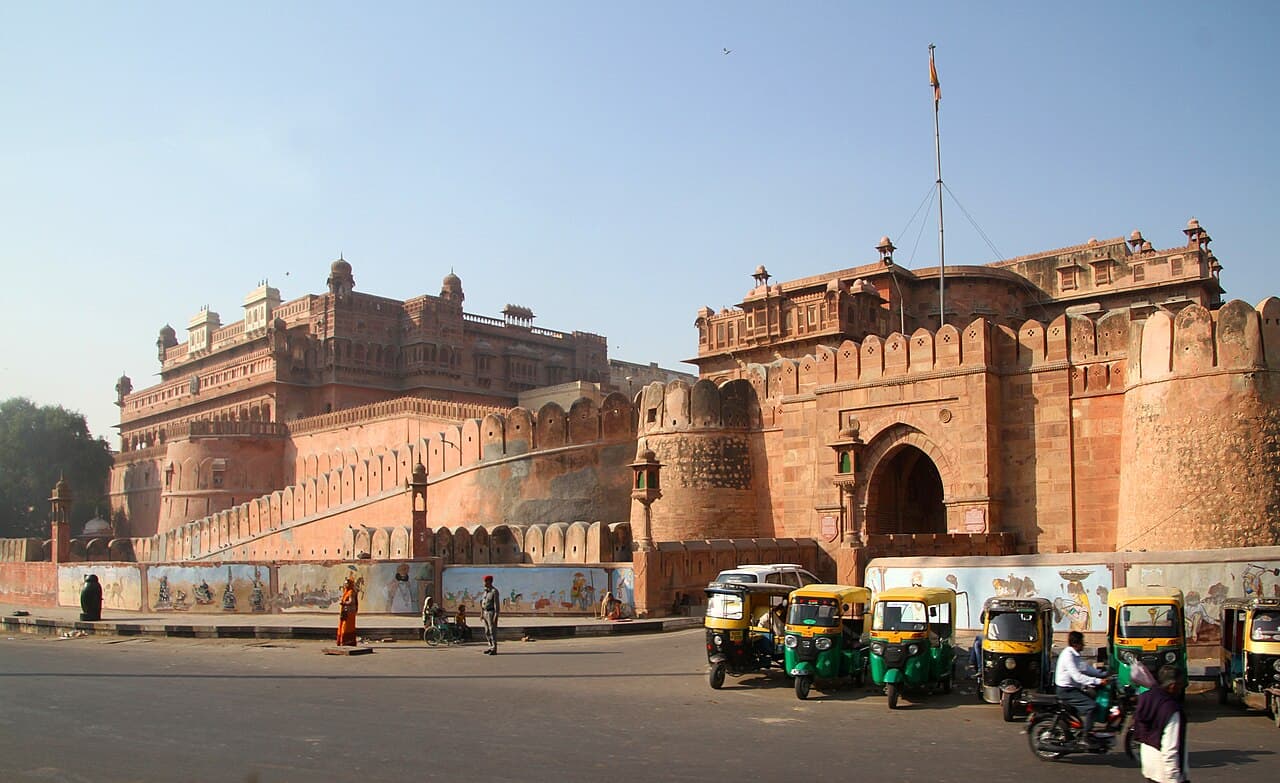
Junagarh Fort is a prominent bastioned fortress located in the city of Bikaner, in the northwestern Indian state of Rajasthan. Unlike many other forts in Rajasthan, it is one of the few major forts constructed on the plains rather than on a hilltop, which is a distinctive feature in the region's military architecture. The fort's strategic position within the city has allowed Bikaner to develop around it, making it a central historical and cultural landmark.
The fort was originally named Chintamani but was renamed Junagarh, meaning "Old Fort," in the early 20th century after the ruling family relocated to the Lalgarh Palace outside the fort's limits. Despite this move, members of the royal family's cadet branch continued to reside within the fort precincts, maintaining its status as a living heritage site.
Construction and architectural features
The construction of Junagarh Fort was overseen by Karan Chand, the Prime Minister of Raja Rai Singh, the sixth ruler of Bikaner, who reigned from 1571 to 1611 AD. The fort's walls and moat were built between 1589 and 1594, marking it as a significant military structure of the 16th century. This period aligns with the Renaissance era in a global context, though the fort's style is deeply rooted in Indian and Rajput architectural traditions rather than European Renaissance aesthetics.
Junagarh Fort is classified as a bastioned fortress, characterized by its robust defensive walls equipped with bastions designed for artillery defense. The fort's perimeter is fortified with massive walls and a deep moat, which historically served as formidable obstacles against invading forces. The moat is an important feature, enhancing the fort's defensive capabilities on the flat terrain where it stands.
Palaces and internal structures
Within the 5.28-hectare fort precinct lies a complex of palaces, temples, and pavilions that showcase a remarkable fusion of architectural styles. These buildings reflect a composite culture, combining elements of Mughal, Rajput, Gujarati, and even Persian influences. The intricate carvings, frescoes, and jharokhas (overhanging enclosed balconies) are notable features of the palatial structures.
Among the most famous palaces inside the fort are the Anup Mahal, Phool Mahal, and Karan Mahal. The Anup Mahal served as the main court and audience hall, richly decorated with murals and mirror work. The Phool Mahal is renowned for its floral decorations and delicate latticework, while the Karan Mahal was the residence of the prime minister and features a blend of Rajput and Mughal architectural details.
Temples and religious sites
The fort complex also houses several important temples, including the Laxmi Narayan Temple and the Har Mandir. The Laxmi Narayan Temple is dedicated to the Hindu deities Lakshmi and Vishnu and is known for its ornate carvings and religious significance. The Har Mandir is a temple devoted to Lord Shiva and reflects the spiritual life that was integral to the fort's inhabitants.
Historical significance and military history
Junagarh Fort has a rich history of military resilience. Despite facing numerous attacks from enemies who sought to capture it, the fort was never successfully taken by force. The only recorded exception was a brief, one-day occupation by Kamran Mirza, the second son of the Mughal Emperor Babur, who attacked Bikaner in 1534. At that time, the fort was under the rule of Rao Jait Singh. This event predates the construction of the current fort walls but is part of the broader defensive history of the site.
The fort's defenses, including its bastioned walls and moat, were designed to withstand the evolving warfare tactics of the late 16th century, including artillery assaults. The fort's ability to resist sieges and attacks is a testament to the advanced military architecture and strategic planning of its builders.
Cultural heritage and present-day status
Today, Junagarh Fort stands as a well-preserved monument and a major tourist attraction in Rajasthan. It offers visitors a glimpse into the lifestyle and governance of the Bikaner royal family during the late medieval period. The fort is managed as a heritage site, with ongoing efforts to maintain and restore its architectural and artistic treasures.
The fort's location within the modern city of Bikaner allows for easy access, and its museums and galleries display artifacts, royal costumes, and historical documents related to the region's history. The fort's blend of architectural styles and its role in regional politics make it an important subject of study for historians and architects alike.
Frequently asked questions (FAQ)
- How do I get to Junagarh Fort in Bikaner?
- Junagarh Fort is located in the city center of Bikaner, Rajasthan. It is easily accessible by road, and the nearest airport is Bikaner Airport, about 13 km away. Local taxis and auto-rickshaws are commonly used to reach the fort.
- What are the opening hours for Junagarh Fort?
- Junagarh Fort is generally open to visitors from 9:00 AM to 5:00 PM daily. It is advisable to check for any special closures or changes in timings before planning your visit.
- Is there an entry fee to visit Junagarh Fort?
- Yes, there is an entry fee for Junagarh Fort. As of now, the ticket price is approximately ₹100 for Indian adults and ₹200 for foreign tourists. Children under 15 years often have free entry.
- What architectural styles are visible in Junagarh Fort?
- Junagarh Fort exhibits a composite architectural style blending Rajput, Mughal, Gujarati, and Persian influences. This mix is evident in its palaces, temples, and decorative elements like frescoes and jharokhas.
- Can I take photographs inside Junagarh Fort?
- Photography is generally allowed in the open areas of Junagarh Fort, but restrictions may apply inside certain palaces and museums. It is best to inquire at the entrance or with guides about specific photography rules.
Photo gallery

Information
Loading map...
Visitor reviews
No reviews yet. Been here? Write the first review and help other travelers!
Write the first reviewVisited this castle? Share your experience
Your review helps other travelers and adds first-hand knowledge to our encyclopedia.