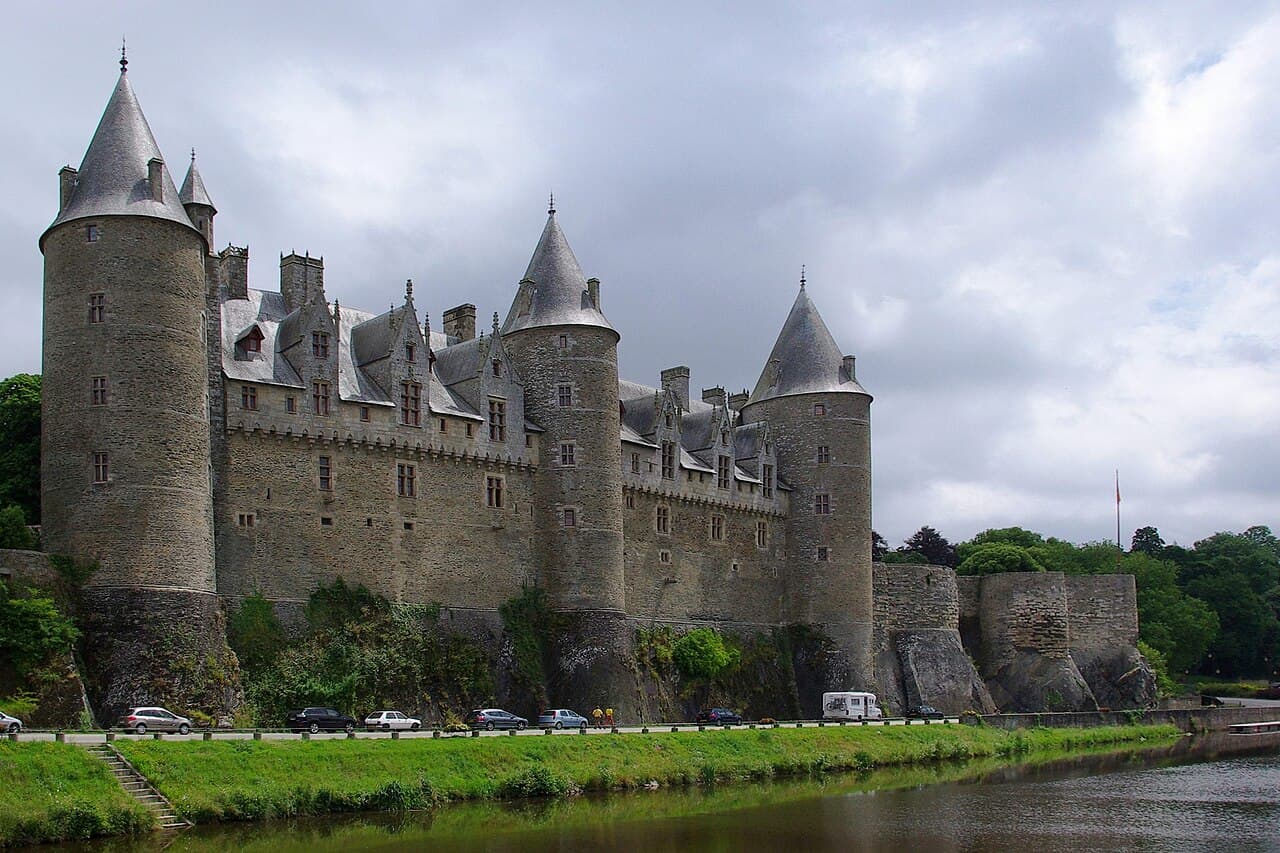
Josselin Castle
Josselin Castle is a magnificent medieval fortress located in Josselin, Brittany, France. Founded around the year 1008 by Guéthénoc, vicomte of Porhoët, Rohan, and Guéméné, it occupies a strategic rocky promontory overlooking the Oust river valley. The castle's position at the crossroads of two Roman roads and near the pilgrimage site of Notre-Dame du Roncier made it an important military and commercial stronghold throughout the Middle Ages. It has been designated a monument historique since 1928 and remains a private residence of the Dukes of Rohan.
Early medieval origins and strategic importance
The original fortress was constructed in the early 11th century by Guéthénoc, who named it Castellum Goscelini after his son Goscelinus, a name that evolved into Josselin. By 1025, the castle was fortified to protect the surrounding territory and control the vital trade routes. Its location on a rocky plateau provided natural defenses, with steep cliffs and a commanding view of the valley below.
The nearby Basilica of Our Lady of the Bramble was a pilgrimage destination since the 9th century, contributing to the local economy and the castle's wealth. The castle's early history was marked by conflict, including its destruction by Henry II of England between 1168 and 1175, who demolished the fortress and famously sowed salt on its ruins to prevent reconstruction. Rebuilding efforts began shortly after, restoring its defensive role in the region.
The 14th century fortress and the clisson era
During the Breton War of Succession (1341-1364), Josselin Castle was a key military site. The famous Battle of the Thirty in 1351, involving knights from Josselin and nearby Ploërmel, underscored the castle's martial significance. In 1370, Olivier V de Clisson, a prominent Breton soldier and later Constable of France, acquired the lordship of Josselin. He transformed the castle into one of Brittany's strongest fortresses, expanding the enclosure to approximately 4,500 square meters and adding nine cylindrical towers and a massive donjon measuring 26 meters in diameter and 32 meters high.
Clisson's fortress featured walls 3.5 meters thick, battlements, and machicolations—openings in the parapets for dropping projectiles on attackers. The castle's design combined formidable military architecture with the natural defensive advantages of the schist rock outcrop. Despite political turmoil, including Clisson's banishment and sieges by Duke Jean IV of Brittany, the fortress remained a symbol of Breton strength.
Renaissance transformation under the rohan family
The castle passed to the Rohan family through marriage when Olivier de Clisson's daughter Beatrice married Alain VIII of Rohan. In the late 15th century, Jean II de Rohan undertook significant renovations, transforming the fortress into a noble residence. Between 1490 and 1505, the castle acquired a striking granite façade in the Louis XII style, blending flamboyant Gothic and early Renaissance architectural elements.
This façade features ten large two-story dormers connected by an open gallery balustrade adorned with pinnacles, intricate tracery, and sculpted emblems including the letter "A" representing Anne of Brittany, fleurs-de-lys, and stylized ermine. The residential wing's windows and doors are framed by lowered pointed arches with elaborate foliage carvings. The central staircase, dating from around 1506, is notable for its innovative ramp-on-ramp design, the oldest known example in France.
The interior was later restored in the 19th century with neo-Gothic "Troubadour" style decoration, complementing the castle's historic character. The castle houses rare furniture, artworks, and a marble bust of the 13th Duke of Rohan sculpted by Auguste Rodin.
Conflicts, decline, and restoration
During the French Wars of Religion, the Protestant Rohans were expelled, and the castle became a Catholic League stronghold under the Duke of Mercœur. In 1603, the viscounty of Rohan was elevated to a duchy, but Henri II de Rohan moved his seat to Pontivy. In 1629, Cardinal Richelieu ordered the dismantling of the castle's donjon and four towers to punish the rebellious Rohans, sparing only the Renaissance residential wing.
In the 18th century, the castle ceased to be a seat of power and was used as a prison and warehouse during the French Revolution and First French Empire. A cotton spinning mill was established on site in 1776 to provide work for poor children. The castle returned to the Rohan family in 1799 but was in poor condition.
Restoration began in the mid-19th century under architect Jules de La Morandière, continuing into the early 20th century with neo-Gothic interior additions. The grounds were landscaped with a French formal garden by Achille Duchêne and an English-style park featuring rare plants. The former stables now house a doll museum.
Architectural features and artistic treasures
The surviving castle includes three riverside towers connected by curtain walls with characteristic Breton machicolations featuring trilobed arches. The Renaissance wing's façade is constructed of granite, unusual for Brittany, where tuffeau and brick were more common. Its flamboyant dormers and sculpted decorations are masterpieces of early Renaissance artistry in the region.
The castle's interiors display a rich collection of artworks, including portraits by Hyacinthe Rigaud and Rosalba Carriera, a monumental marble equestrian statue of Olivier de Clisson by Emmanuel Frémiet, and exquisite 18th-century furniture. The Antechamber houses a marble bust of the 13th Duke of Rohan by Auguste Rodin, highlighting the castle's cultural significance.
The surrounding gardens enhance the castle's historic ambiance, featuring clipped boxwoods, yews, a rose garden with 160 bushes of 40 varieties, and century-old trees. These elements contribute to Josselin Castle's reputation as one of Brittany's most impressive and well-preserved medieval residences.
Frequently asked questions (FAQ)
- How do I visit Josselin Castle and what are the opening hours?
- Josselin Castle is open to visitors seasonally, typically from spring through autumn. It is advisable to check the official website or local tourist information for current opening hours and guided tour availability.
- What architectural styles are represented at Josselin Castle?
- Josselin Castle showcases a blend of medieval fortress architecture and Renaissance residential design, with notable features such as granite façades, flamboyant Gothic dormers, and neo-Gothic interior restorations.
- Can I explore the gardens and park surrounding Josselin Castle?
- Yes, the castle grounds include a French formal garden designed by Achille Duchêne and an English-style park with rare plants and century-old trees, both accessible to visitors.
- What is the historical significance of Josselin Castle in Brittany?
- Josselin Castle has played a pivotal role in Brittany's history since the 11th century, serving as a military fortress, noble residence, and cultural landmark associated with the powerful Rohan family.
- Is Josselin Castle still a private residence?
- Yes, the castle remains the residence of the Dukes of Rohan, maintaining a unique blend of private home and historic monument.
Photo gallery

Information
Website
Visit websiteSources & official resources
Verify the information above using these authoritative references.
Loading map...
Visitor reviews
No reviews yet. Been here? Write the first review and help other travelers!
Write the first reviewVisited this castle? Share your experience
Your review helps other travelers and adds first-hand knowledge to our encyclopedia.



