
Jesús Nazareno Castle
Jesús Nazareno Castle, also known locally as Castillo de Jesús Nazareno, Castillo del Nazareno, or Castillo de las Escobetas, is a significant 18th-century military fortification located in the town of Garrucha, in the province of Almería, Spain. This post-Renaissance hill castle was constructed in response to the persistent threat of Berber pirate raids along the southern Spanish Mediterranean coast during the mid-18th century. Its strategic position near the beach underscores its primary role in coastal defense.
Historical context and construction
During the 18th century, the southern coast of Spain was frequently targeted by Berber pirates, who disrupted maritime trade and coastal settlements. To counter these threats, King Charles III of Spain ordered the construction of a series of fortifications in 1764 along the coast of the Kingdom of Granada. Among these was Jesús Nazareno Castle, completed in 1769 under the direction of the architect and military engineer Francisco Ruiz Garrido.
The castle's construction was a major investment, costing approximately 181,000 reales. It was designed as a rectangular artillery fortification with a semicircular counterguard facing the sea, optimized for coastal defense. Its design closely resembles other contemporary forts such as San Ramón, San Felipe, Guardias Viejas, Carchuna, and La Herradura, reflecting a standardized military architectural approach of the period.
Architectural features and layout
Jesús Nazareno Castle is primarily built of masonry and comprises three main sections arranged to maximize defensive capabilities. The central section forms a rectangular core with rounded short sides, featuring the main entrance on one of these curved ends. This entrance originally included a drawbridge, enhancing the fort's security against attackers.
Attached to the right side of the central body is a truncated pyramid-shaped segment with sloping walls, known in fortification terms as a talud. This sloped design made the walls more difficult to scale and better able to deflect cannon fire. The upper part of this section is crowned with a parapet pierced by loopholes or arrow slits, allowing defenders to fire upon enemies while remaining protected.
The left side of the castle consists of a simpler, lower extension without openings, likely serving as a solid bastion or support wall. Access to the castle is provided by an external staircase leading to the right segment, controlling entry and exit.
Equipped with four cannons, the fort was manned by a small garrison consisting of an officer, three corporals, and twenty soldiers, reflecting its role as a coastal artillery defense point rather than a large-scale fortress.
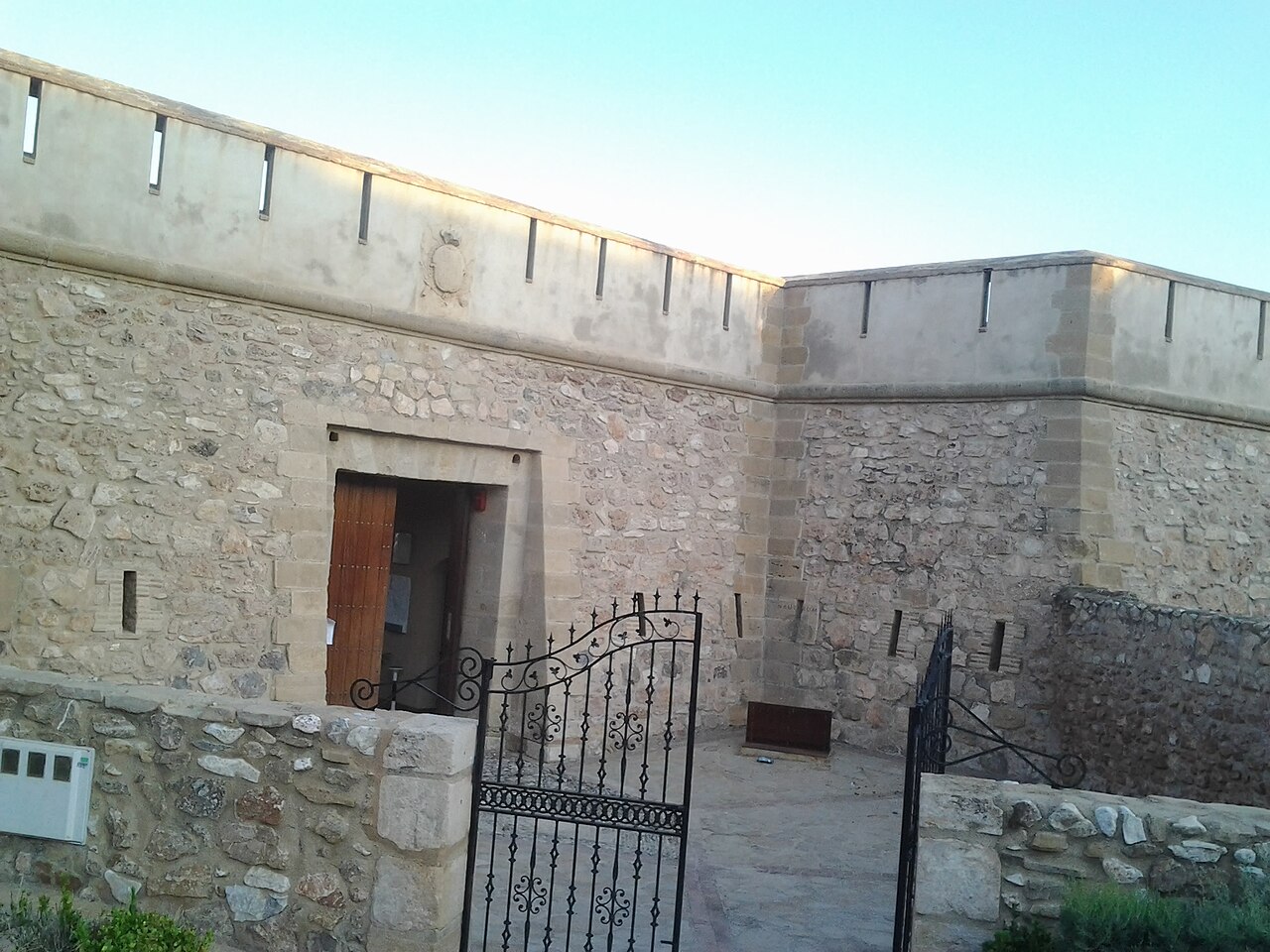
Photo by Menesteo • CC BY-SA 3.0
Military and civic history
Initially built to repel pirate attacks, the castle played a crucial role in securing Garrucha and its surrounding coastline. By 1845, the fort's military function evolved as it was transferred to the Carabineros Corps, a Spanish law enforcement agency responsible for customs and border protection. Later, it was used by the Guardia Civil, further emphasizing its continued strategic importance.
The establishment of the castle also contributed to the growth and development of Garrucha, transforming it from a vulnerable fishing village into a more secure and prosperous town. The presence of such a fortification encouraged settlement and economic activity by providing protection from maritime threats.
Current use and preservation
Today, Jesús Nazareno Castle is well preserved and serves as a marine life museum, offering visitors insight into both its historical military role and the local maritime environment. The castle’s location just three meters above sea level on relatively flat terrain near the Mediterranean shore makes it an accessible site for tourists interested in military architecture and coastal history.
Visitors can explore the castle’s distinctive architectural features, including its artillery placements, parapets, and defensive walls. Although the original drawbridge no longer exists, the structure’s overall form remains intact, showcasing 18th-century Spanish coastal fortification design.
The castle is open for visits for a fee, though seasonal closures may apply. Its cultural significance has been recognized through its designation as a Bien de Interés Cultural, highlighting its importance as a heritage monument in Spain.
Architectural significance and comparable forts
The design of Jesús Nazareno Castle reflects the military architectural trends of the post-Renaissance period, particularly the standardized approach to coastal defense employed by Spain in the 18th century. Its rectangular artillery fort layout with semicircular counterguards was a common feature in forts built to withstand cannon warfare and provide overlapping fields of fire.
The fort shares architectural similarities with other Spanish coastal defenses constructed during the same era, such as the forts of San Ramón, San Felipe, Guardias Viejas, Carchuna, and La Herradura. These forts collectively represent Spain’s strategic response to piracy and foreign naval threats along the Mediterranean coast.
Design elements enhancing defense
- Truncated pyramid shape with sloping walls (talud) to deflect projectiles and prevent scaling.
- Parapets pierced with loopholes for protected firing positions.
- Rectangular core with rounded short sides to reduce blind spots and improve structural resilience.
- Drawbridge entrance for controlled access and enhanced security.
Location and geographical context
Situated in Garrucha, a coastal town in the province of Almería, Jesús Nazareno Castle occupies a strategic position less than a kilometer south of the town center. Its proximity to the Mediterranean Sea allowed it to serve as an early warning and defensive post against seaborne threats.
The terrain around the castle is relatively flat, rising gradually to hills toward the southwest, which provided natural observation points and additional defensive advantages. The castle’s placement at approximately three meters above sea level ensured visibility over the coastline and facilitated communication with other nearby forts.
Visitor information and cultural importance
Jesús Nazareno Castle is accessible to the public, offering a unique opportunity to explore an 18th-century coastal fortification. Visitors can learn about the historical context of pirate threats, the architectural design of the fort, and its role in the development of Garrucha.
The castle’s current function as a marine life museum enriches the visitor experience by connecting the region’s military history with its natural maritime environment. This dual focus makes it an important cultural and educational site.
Its status as a Bien de Interés Cultural monument ensures ongoing preservation efforts and recognition of its significance in Spanish heritage.
Frequently asked questions (FAQ)
- When was Jesús Nazareno Castle built and why?
- Jesús Nazareno Castle was built in 1769 under the order of King Charles III to defend the southern Spanish coast from Berber pirate attacks.
- What are the main architectural features of Jesús Nazareno Castle?
- The castle features a rectangular artillery fort design with a semicircular counterguard, a truncated pyramid-shaped section with sloping walls, parapets with loopholes, and originally had a drawbridge entrance.
- Is Jesús Nazareno Castle open to visitors?
- Yes, the castle is open to visitors for a fee, typically during the tourist season. It also houses a marine life museum.
- What role did Jesús Nazareno Castle play in local history?
- The castle protected Garrucha from pirate raids, contributed to the town's growth, and later served as a base for the Carabineros Corps and Guardia Civil.
- Where is Jesús Nazareno Castle located?
- Jesús Nazareno Castle is located in Garrucha, Almería, Andalusia, Spain, near the Mediterranean coast on Calle Salcillo.
Photo gallery

Information
Opening hours
Seasonal, check local listings
Ticket prices
€3 adult, €1.5 child
Architect
Francisco Ruiz Garrido
Current owner
Municipality
Website
Visit websiteAddress
Calle Salcillo, Garrucha, Almería, Spain
Sources & official resources
Verify the information above using these authoritative references.
Loading map...
Visitor reviews
No reviews yet. Been here? Write the first review and help other travelers!
Write the first reviewVisited this castle? Share your experience
Your review helps other travelers and adds first-hand knowledge to our encyclopedia.